
Victims of careless accidents involving fire, scalds, or severe burns in Valparaiso can suffer serious, life-changing injuries. If you’ve been harmed in a burn accident, our Valparaiso burn injury attorneys can help you pursue justice. As a Valparaiso injury firm, Langer & Langer has extensive experience handling complex burn injury claims, including workplace burns, fire-related injuries, and catastrophic burn accidents, providing dedicated legal support and fighting for the compensation you deserve.
4 Indiana Ave Valparaiso, IN 46383
in**@*******aw.com
(219) 464-3246

Langer & Langer represents individuals in Valparaiso and throughout Porter County who have suffered serious burn injuries caused by negligence. Our lawyers handle complex personal injury claims involving landlords, employers, drivers, contractors, and product manufacturers, pursuing full compensation under Indiana law.
These cases include fire and flame burns, chemical exposure, electrical injuries, scalding incidents, and inhalation damage. Severe burns often result in permanent scarring, nerve damage, disfigurement, and extensive medical treatment, including skin grafting and reconstructive surgery. Our Valparaiso burn injury attorneys pursue recovery for medical expenses, lost income, future care costs, and pain and suffering.
If you or a loved one has suffered a burn injury, we are prepared to investigate the cause, preserve critical evidence, and build a strong case on your behalf. Our office is located at 4 Indiana Ave, Valparaiso, IN 46383.
Call 219-464-3246 to schedule a free consultation.
We handle burn injury claims arising from unsafe property conditions, defective products, workplace hazards, and other negligent conduct in Valparaiso. These cases often involve significant medical treatment and disputed liability.
The cause and severity of the burn determine the legal strategy and potential sources of recovery.
Thermal burns
Caused by direct exposure to fire, open flames, or contact with hot surfaces.
Scald burns
Result from hot liquids or steam, commonly occurring in homes or food service settings.
Grease burns
Often happen in kitchens when overheated oil splashes or ignites.
Chemical burns
Caused by industrial chemicals, cleaning agents, or corrosive materials.
Electrical burns
Arise from contact with live wires, arc flashes, or faulty electrical systems.
Inhalation injuries
Occur when smoke or toxic fumes are breathed in, potentially damaging the lungs or airway.
Radiation burns
Rare, but may result from sun exposure, radiation treatments, or industrial sources.
These injuries often occur in residential fires, construction sites, industrial facilities, commercial kitchens, and vehicle accidents. Chemical, electrical, and inhalation burns may involve internal damage beyond visible skin injury.
These symptoms may signal serious internal or delayed injuries; seek medical care immediately.
Burn injuries are classified by depth:
Severity depends on burn depth, total body surface area (TBSA), and location. Burns affecting the face, hands, joints, or airway increase the risk of permanent impairment. Long-term consequences may include scarring, nerve damage, chronic pain, reduced mobility, and psychological trauma.
Northwest Indiana’s steel mills, refineries, and manufacturing facilities create a higher risk of serious industrial burn injuries. Workers in Valparaiso and surrounding communities face exposure to extreme heat, hazardous chemicals, and high-voltage systems.
We handle cases involving:
Not every workplace burn is limited to Workers’ Compensation. While Workers’ Compensation may cover medical expenses and partial wage replacement, it does not provide damages for pain and suffering or full future earning capacity.
If a third party contributed to the burn injury, a separate personal injury lawsuit may be available. These claims arise when someone other than the direct employer caused or contributed to the incident.
Examples include:
In these cases, an injured worker may pursue full personal injury damages through a third-party claim.
Liability depends on the cause of the accident and who controlled the hazardous condition. In many cases, more than one party shares responsibility. Common defendants in burn injury cases include:
Property owners and landlords may be liable when a burn results from unsafe conditions or building code violations, including:
Workplace burns may involve third-party negligence, particularly in construction or multi-contractor environments. Examples include:
Manufacturers may be liable for burn injuries caused by:
Preserving the product, packaging, and serial numbers is critical in these cases.
Burn injuries may result from vehicle fires, explosions, or hazardous cargo following a crash. Liability may arise from negligent driving, improper vehicle maintenance, or unsafe transport of flammable materials.
Schedule a consultation to identify all responsible parties.
Our burn injury attorneys build documented, evidence-based claims to pursue full compensation. We take the following steps:
Insurance carriers often attempt to resolve burn injury claims quickly and for less than their full value. Early settlement offers may not account for future surgeries, rehabilitation, or permanent impairment.
Speak with a burn injury lawyer before accepting any settlement offer.
Severe burn injuries are not just physically painful; they can also change how a person lives, works, and interacts with others. Burn injuries often result in substantial medical expenses, lost income, and permanent physical impairment.
Damages generally fall into two categories:
1. Economic Damages
Economic damages compensate for measurable financial losses, including:
Indiana does not cap economic damages in standard personal injury cases.
2. Non-economic damages
Non-economic damages compensate for the personal impact of a burn injury, including:
Indiana does not impose a general cap on non-economic damages in ordinary negligence cases (medical malpractice cases are different and governed by separate statutes).
If a burn injury results in death, the personal representative of the estate may bring a wrongful death claim under Indiana law.
Recoverable damages may include:
Wrongful death claims in Indiana are governed by specific statutes, and available damages may vary depending on whether the decedent was an adult, a child, or a dependent.
Burn injuries require immediate medical attention and prompt action to protect your legal rights.
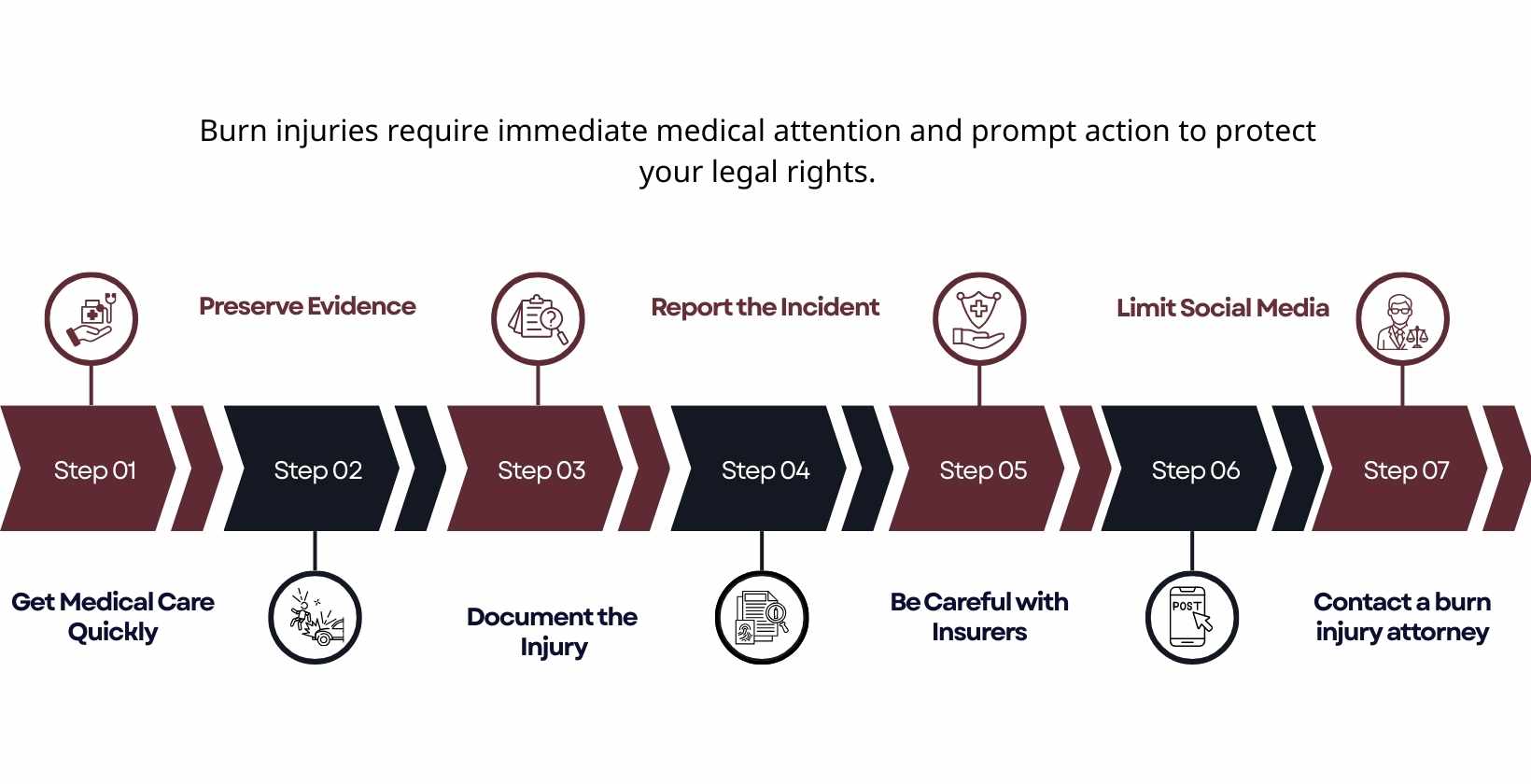
1. Get medical care immediately: Serious burns and inhalation injuries may require treatment at a specialized burn center.
2. Preserve evidence: Do not discard the product, packaging, or clothing involved. Keep everything in a sealed bag and take photos before anything is cleaned or repaired (when safe to do so).
3. Document the injury and scene: Photograph the burn, the location, and any hazards, and continue documenting changes during treatment and recovery.
4. Report the incident:
5. Be cautious with insurers: Avoid recorded statements and broad medical authorizations without legal advice.
6. Limit social media: Do not post about the incident or recovery while a claim is pending.
7. Contact a burn injury attorney early: An attorney can send preservation (spoliation) letters and request reports and video footage before it is lost.
Call 219-464-3246 to protect your rights and begin your claim.
Our firm represents burn injury victims in Valparaiso and throughout Porter County with substantial litigation experience and a structured case strategy.
Litigation-focused approach
We build claims with documented evidence and prepare each case with trial readiness in mind.
Courtroom experience
Our attorneys practice in the Porter County Superior Courts and the Indiana federal courts.
Thorough investigation
We obtain fire and incident reports, preserve physical evidence, review surveillance footage, and consult qualified experts when necessary.
Insurance strategy
We analyze liability, coverage, and policy limits before entering negotiations.
Established experience
Our lawyers bring more than 100 years of combined legal experience.
We represent burn injury clients throughout Valparaiso and the surrounding areas in Porter County.
We serve clients in:
Downtown Valparaiso
Valparaiso University area
North Calumet Avenue
Chesterton
Union Township
Westhill
To file a burn injury lawsuit in Indiana, you generally have two years from the date of the injury. This deadline is set by Indiana’s personal injury statute of limitations. Waiting too long can result in losing your right to compensation.
If you’re partly at fault for the burn accident, Indiana’s comparative fault rule still allows you to recover damages, as long as you’re less than 51% at fault. Your compensation may be reduced based on your percentage of fault.
Responsibility depends on who caused the injury. In most cases, the at-fault party’s insurance company is liable for medical expenses and related damages.
Burn injury cases are typically handled on a contingency fee basis. There are no upfront fees, and attorney fees are paid only if compensation is recovered.
If you have suffered a serious burn injury, contact Langer & Langer to discuss your legal options. Our injury lawyer offers free consultations, and there is no fee unless we recover compensation for you.
During your consultation, we will review the circumstances of the injury, assess potential liability, and explain the next steps in pursuing a claim.
Call 219-464-3246 or submit our contact form today to start your case review.



© 1980-2026 Langer & Langer • All Rights Reserved
Copyright © 1980-2026 All Rights Reserved.
Past results do not guarantee any future outcome, and every case is different.
We improve our products and advertising by using Microsoft Clarity to see how you use our website. By using our site, you agree that we and Microsoft can collect and use this data.
Have legal questions or need expert advice? Our experienced team is here to help.
Langer & Langer
Accessibility Statement
Compliance status
We firmly believe that the internet should be available and accessible to anyone, and are committed to providing a website that is accessible to the widest possible audience, regardless of circumstance and ability.
To fulfill this, we aim to adhere as strictly as possible to the World Wide Web Consortium’s (W3C) Web Content Accessibility Guidelines 2.1 (WCAG 2.1) at the AA level. These guidelines explain how to make web content accessible to people with a wide array of disabilities. Complying with those guidelines helps us ensure that the website is accessible to all people: blind people, people with motor impairments, visual impairment, cognitive disabilities, and more.
This website utilizes various technologies that are meant to make it as accessible as possible at all times. We utilize an accessibility interface that allows persons with specific disabilities to adjust the website’s UI (user interface) and design it to their personal needs.
Additionally, the website utilizes an AI-based application that runs in the background and optimizes its accessibility level constantly. This application remediates the website’s HTML, adapts Its functionality and behavior for screen-readers used by the blind users, and for keyboard functions used by individuals with motor impairments.
If you’ve found a malfunction or have ideas for improvement, we’ll be happy to hear from you. You can reach out to the website’s operators by using the following email
Screen-reader and keyboard navigation
Our website implements the ARIA attributes (Accessible Rich Internet Applications) technique, alongside various different behavioral changes, to ensure blind users visiting with screen-readers are able to read, comprehend, and enjoy the website’s functions. As soon as a user with a screen-reader enters your site, they immediately receive a prompt to enter the Screen-Reader Profile so they can browse and operate your site effectively. Here’s how our website covers some of the most important screen-reader requirements, alongside console screenshots of code examples:
Screen-reader optimization: we run a background process that learns the website’s components from top to bottom, to ensure ongoing compliance even when updating the website. In this process, we provide screen-readers with meaningful data using the ARIA set of attributes. For example, we provide accurate form labels; descriptions for actionable icons (social media icons, search icons, cart icons, etc.); validation guidance for form inputs; element roles such as buttons, menus, modal dialogues (popups), and others. Additionally, the background process scans all the website’s images and provides an accurate and meaningful image-object-recognition-based description as an ALT (alternate text) tag for images that are not described. It will also extract texts that are embedded within the image, using an OCR (optical character recognition) technology. To turn on screen-reader adjustments at any time, users need only to press the Alt+1 keyboard combination. Screen-reader users also get automatic announcements to turn the Screen-reader mode on as soon as they enter the website.
These adjustments are compatible with all popular screen readers, including JAWS and NVDA.
Keyboard navigation optimization: The background process also adjusts the website’s HTML, and adds various behaviors using JavaScript code to make the website operable by the keyboard. This includes the ability to navigate the website using the Tab and Shift+Tab keys, operate dropdowns with the arrow keys, close them with Esc, trigger buttons and links using the Enter key, navigate between radio and checkbox elements using the arrow keys, and fill them in with the Spacebar or Enter key.Additionally, keyboard users will find quick-navigation and content-skip menus, available at any time by clicking Alt+1, or as the first elements of the site while navigating with the keyboard. The background process also handles triggered popups by moving the keyboard focus towards them as soon as they appear, and not allow the focus drift outside it.
Users can also use shortcuts such as “M” (menus), “H” (headings), “F” (forms), “B” (buttons), and “G” (graphics) to jump to specific elements.
Disability profiles supported in our website
Additional UI, design, and readability adjustments
Browser and assistive technology compatibility
We aim to support the widest array of browsers and assistive technologies as possible, so our users can choose the best fitting tools for them, with as few limitations as possible. Therefore, we have worked very hard to be able to support all major systems that comprise over 95% of the user market share including Google Chrome, Mozilla Firefox, Apple Safari, Opera and Microsoft Edge, JAWS and NVDA (screen readers).
Notes, comments, and feedback
Despite our very best efforts to allow anybody to adjust the website to their needs. There may still be pages or sections that are not fully accessible, are in the process of becoming accessible, or are lacking an adequate technological solution to make them accessible. Still, we are continually improving our accessibility, adding, updating and improving its options and features, and developing and adopting new technologies. All this is meant to reach the optimal level of accessibility, following technological advancements. For any assistance, please reach out to