
4 Indiana Ave Valparaiso, IN 46383
in**@*******aw.com
(219) 464-3246
Accidents happen on our roads and highways near you. When they do, you need an Indiana car accident lawyer who understands how to thoroughly investigate, build a strong strategy, and effectively fight for your case. If you or someone close to you has been seriously hurt in a car wreck caused by someone else in Indianapolis, Bloomington, Muncie, Fort Wayne, Anderson, or anywhere near Indiana, you deserve to be compensated for your losses. Don’t let the insurance company intimidate you into accepting a settlement that is less than what your case is worth.
If another driver or vehicle parts manufacturer contributed to your crash, the experienced car accident lawyers at Langer & Langer can help you recover the compensation you deserve. Fill out our online form or call us today at 219-600-8847 for dedicated help with insurance companies, legal proceedings, and negotiations.
Why Injury Victims in Indiana Trust Langer & Langer
There are a number of reasons car accident victims in Indiana choose the injury lawyers at Langer & Langer to handle their personal injury claims. When you hire our law office.
Insurance companies have earned a reputation for trying to take advantage of injured victims who are not represented by an accident lawyer. They frequently attempt to get victims to make recorded statements that can be used against them in court. They undervalue claims. Sometimes, they even try to place blame on innocent people. When you hire a car accident attorney with Langer & Langer, our law office will handle communications with the insurance company on your behalf. This includes presenting a demand for settlement to compensate you for your medical bills, lost wages, pain and suffering, and more. Once the insurance company responds with an initial offer, our team will begin negotiations.
Our Indiana personal injury law office takes pride in providing the highest level of personalized service to our clients. Taking care of our clients is our first priority. As such, when you hire our law firm, you will have direct contact with the legal team that is handling your personal injury claim. We will keep you informed as your case progresses through the legal system, notifying you of any important changes along the way. We also encourage you to reach out to your car accident lawyer if you have any questions or concerns that arise while your claim is underway.
Our car accident lawyers will gather evidence to help prove how the crash occurred, and we will work to identify all parties who may have contributed to the incident. We may request photos and videos, dashcam footage, and any available footage from nearby security cameras or traffic cams. We will interview witnesses, examine the accident scene, and inspect the vehicles that were involved in the crash. Our injury attorneys will also collect information from your doctors about your medical treatment and your prognosis. If the crash involves a rideshare vehicle, a skilled rideshare accident lawyer in Indiana can help determine whether the Uber/Lyft driver, the company, or another negligent party should be held responsible.
It is common for insurance companies to play hardball when evaluating car accident claims. In an attempt to minimize payout, the insurance company is likely to dispute your claim about how the accident happened or how severely you were injured. If the cause of the accident or the severity of your injuries are in question, our injury attorneys may hire top medical experts, accident reconstruction specialists, and/or investigators to help prove negligence. Expert testimony significantly increases your chances of recovering full compensation for your losses.
If negotiations fail, and the insurance company refuses to provide you with an appropriate settlement offer, our accident lawyers are not afraid to litigate your case in court. Our law firm is composed of experienced trial lawyers, and we have gone up against countless large corporations and big-name insurance companies since we began representing injured victims in 1980. Even in cases involving uninsured or underinsured drivers’ claims, our attorneys are prepared to fight in court to secure maximum compensation.
The insurance company starts building its defense before you leave the scene.
Call (219) 600-8847 nowFrom Valparaiso to Indianapolis and across the state, Langer & Langer stands ready to fight for car accident victims – putting powerful legal representation in your corner, wherever you are.


Langer & Langer handles every collision type in Indiana, and the liability analysis differs significantly by crash type. Our accident injury attorneys investigate each case independently rather than applying a formula.

Blind Spot Accidents

Head-On Crashes

Multi-Vehicle Accidents

Rear-End Collisions

Rollover Accidents

Sideswipe Crashes

Although some fender benders cause only temporary, minor injuries to accident victims, other crashes result in catastrophic injuries that change people’s lives forever. When car accidents cause traumatic brain injuries, spinal cord injuries, amputations, severe burns, or disfigurement, the resulting financial burdens can be enormous. Victims and their families are often left facing:
When Indiana car accident injuries are severe, victims may be forced to endure extreme pain, emotional distress, and continuous medical treatments or surgeries for months or years after the crash. Accident victims may find themselves unable to participate in activities they once enjoyed, or care for themselves independently. In many cases, victims’ lives are changed forever.
If you are involved in a car accident, pull over immediately and check for injuries. If you are able, you should move your vehicle out of harm’s way and turn on your hazard lights to warn other motorists and reduce the risk of additional accidents and injuries.
Call 9-1-1 and get police and emergency medical responders on the way. If your injuries are severe, ask someone at the accident scene to place the call for you. In Indiana, you are required to report your car accident if it involves injury, entrapment, or death to another person.
Gather the contact information of anyone involved in the car accident and bystanders who may have witnessed the crash. Witness statements can be used to help support your claim if the other driver fabricates his or her story later to avoid liability for injuries.
Take photos or videos of the crash scene if you are able. Be sure to capture anything you think might have contributed to the accident, property damage, vehicle positions, and other evidence like skid marks. Also make note of any security cameras in the area that may have captured the accident.
Even if you do not think your injuries are severe, be sure to be evaluated by a medical professional as soon as possible after the accident. Sometime, internal injuries may not be evident immediately after an accident. Symptoms may worsen over time.
Before making a statement to the insurance company or accepting a settlement offer, get legal advice from a personal injury lawyer to learn about your legal rights and how much your claim may be worth. The car accident attorneys at Langer & Langer offer FREE case review to personal injury victims.
Indiana law allows you to file a personal injury claim against negligent parties if you suffer injuries in a car accident.
When you retain the services of our law firm, your car accident lawyer will investigate your case to identify who may be legally liable for your losses and any insurance coverage that may apply. In multi-vehicle collisions, multiple parties can be held liable for damages.
Once we have determined who may be responsible for paying for your losses, we will add up your medical bills, the projected cost of future medical treatment, your lost wages, and any other expenses the accident caused. Then we will discuss the real harm, consistory of pain and suffering, and the impact on a person’s life.
Our car accident attorneys will collect various types of evidence to demonstrate that the other party caused you to be injured. This may include, but is not limited to, photos and video footage of the crash scene, photos of your injuries, medical reports from your doctors, police reports, and more. We may employ the services of accident reconstruction specialists and medical experts as well.
We will send a demand letter to the insurance company that includes a statement of our case and a request for the amount of money you are owed. The insurance company will try to undervalue your claim at this stage, attempting to deny liability or minimize your losses. It is common for insurance companies to reply with a counter-offer that is significantly less than a claim is worth.
If our car accident attorneys cannot reach an agreement with the insurance company that provides you with a fair settlement amount, we will file a personal injury lawsuit in civil court. Although it is possible that your case will proceed to trial, it is not likely. Most personal injury lawsuits that involve car accident injuries are settled out of court.
Negotiations with the insurance company will likely continue as your case moves through the legal system. Your car accident lawyer will present to you each settlement offer we receive, and offer our advice about whether the offer is fair. Ultimately, however, accepting an offer or continuing to negotiate is your decision.
If negotiations with the insurance company fail, we will present your case to the jury in court. After both side have presented their cases, and they have cross-examined the other side’s witnesses, the jury will deliberate and reach a verdict. Once a decision is made, all parties will reconvene and the verdict will be announced.
Your case value depends on the severity of injuries, total medical costs, lost income, liability evidence, and available insurance coverage. Soft-tissue cases typically resolve in the tens of thousands. Cases involving spinal cord injury, TBI, or permanent disability can reach the hundreds of thousands or more. A realistic assessment requires reviewing your medical records, the crash report, and all available insurance policy limits.
In nearly every case, the first offer is well below the claim's full value. Adjusters make early offers to close files before you know the total cost of treatment. A soft-tissue injury that appears minor at 30 days may require a year of physical therapy. Signing a release ends all future claims permanently. Have a lawyer review any offer before you sign anything.
Your own UM coverage becomes the recovery source. If you lack UM coverage or your limits are insufficient, our attorneys can investigate other liable parties: a vehicle manufacturer if a defect contributed, a government entity if a road hazard played a role, or an employer if the at-fault driver was operating a company vehicle.
Straightforward soft-tissue cases with clear liability typically resolve in six to nine months. Cases involving ongoing treatment, disputed liability, or severe injuries take 12 to 36 months. Cases that go to trial in Marion County Superior Court take longer but often produce higher outcomes. Our team gives a realistic timeline after reviewing the evidence.
Many people skip representation after low-speed crashes, then discover weeks later that the impact caused a herniated disc requiring surgery. Because our firm works on contingency, consulting one costs only your time. Call (219) 600-8847 for a free case review.
Yes, you can recover as long as your share of fault does not reach 51% under IC § 34-51-2-6. At 30% fault on a $100,000 award, you recover $70,000. At 51% or more, you recover nothing. Do not discuss fault with any adjuster before speaking with a lawyer.
Every day after a crash, the other side is gathering evidence, locking in witness statements, and building its defense. Our car accident attorneys have represented Indiana crash victims since 1980, and every case is taken on contingency: you pay nothing unless we recover for you.
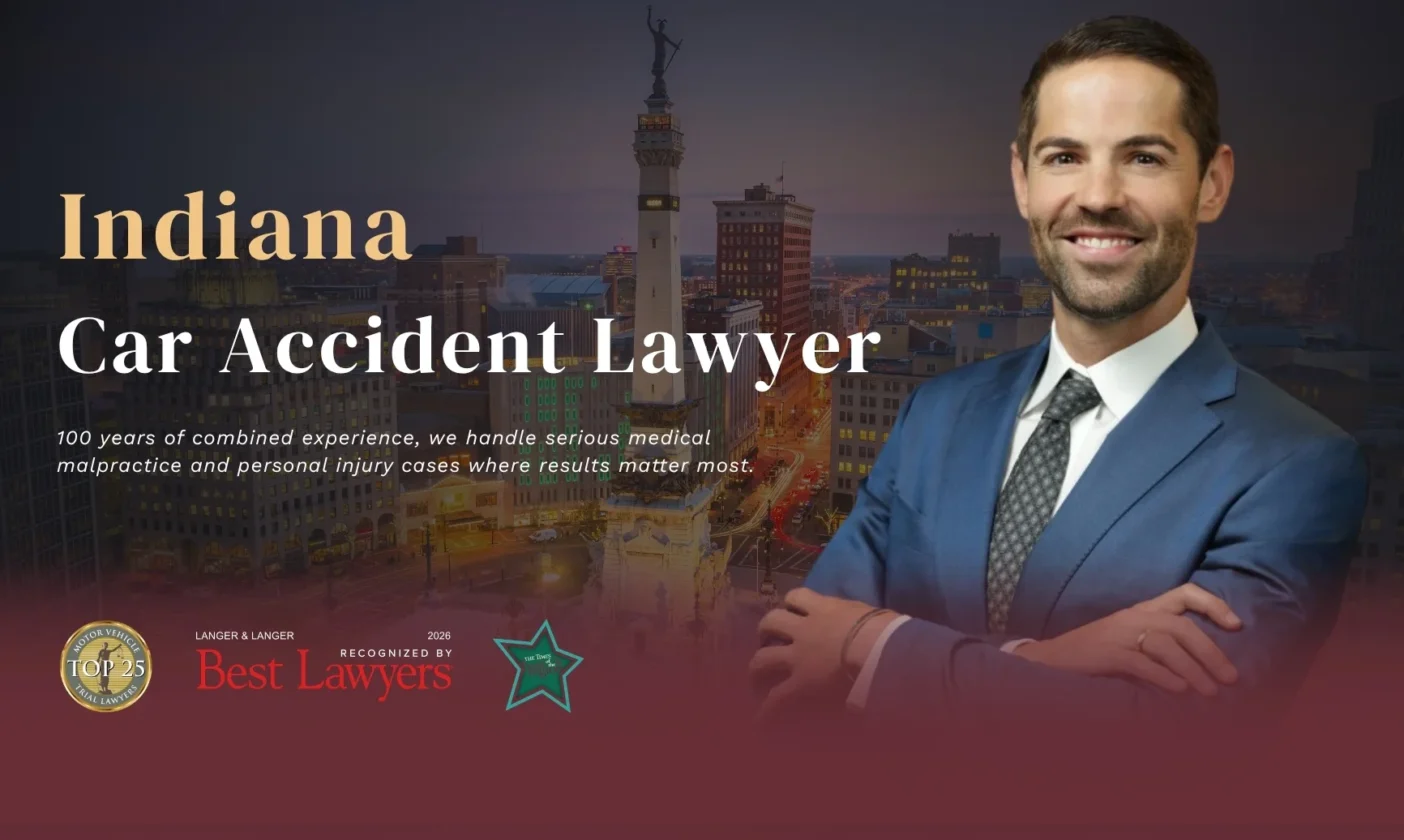
Serving Indianapolis, Marion County, and crash victims across Indiana, including South Bend, Bloomington, Hammond, and communities statewide.



© 1980-2026 Langer & Langer • All Rights Reserved
Copyright © 1980-2026 All Rights Reserved.
Past results do not guarantee any future outcome, and every case is different.
We improve our products and advertising by using Microsoft Clarity to see how you use our website. By using our site, you agree that we and Microsoft can collect and use this data.
Have legal questions or need expert advice? Our experienced team is here to help.
Langer & Langer
Accessibility Statement
Compliance status
We firmly believe that the internet should be available and accessible to anyone, and are committed to providing a website that is accessible to the widest possible audience, regardless of circumstance and ability.
To fulfill this, we aim to adhere as strictly as possible to the World Wide Web Consortium’s (W3C) Web Content Accessibility Guidelines 2.1 (WCAG 2.1) at the AA level. These guidelines explain how to make web content accessible to people with a wide array of disabilities. Complying with those guidelines helps us ensure that the website is accessible to all people: blind people, people with motor impairments, visual impairment, cognitive disabilities, and more.
This website utilizes various technologies that are meant to make it as accessible as possible at all times. We utilize an accessibility interface that allows persons with specific disabilities to adjust the website’s UI (user interface) and design it to their personal needs.
Additionally, the website utilizes an AI-based application that runs in the background and optimizes its accessibility level constantly. This application remediates the website’s HTML, adapts Its functionality and behavior for screen-readers used by the blind users, and for keyboard functions used by individuals with motor impairments.
If you’ve found a malfunction or have ideas for improvement, we’ll be happy to hear from you. You can reach out to the website’s operators by using the following email
Screen-reader and keyboard navigation
Our website implements the ARIA attributes (Accessible Rich Internet Applications) technique, alongside various different behavioral changes, to ensure blind users visiting with screen-readers are able to read, comprehend, and enjoy the website’s functions. As soon as a user with a screen-reader enters your site, they immediately receive a prompt to enter the Screen-Reader Profile so they can browse and operate your site effectively. Here’s how our website covers some of the most important screen-reader requirements, alongside console screenshots of code examples:
Screen-reader optimization: we run a background process that learns the website’s components from top to bottom, to ensure ongoing compliance even when updating the website. In this process, we provide screen-readers with meaningful data using the ARIA set of attributes. For example, we provide accurate form labels; descriptions for actionable icons (social media icons, search icons, cart icons, etc.); validation guidance for form inputs; element roles such as buttons, menus, modal dialogues (popups), and others. Additionally, the background process scans all the website’s images and provides an accurate and meaningful image-object-recognition-based description as an ALT (alternate text) tag for images that are not described. It will also extract texts that are embedded within the image, using an OCR (optical character recognition) technology. To turn on screen-reader adjustments at any time, users need only to press the Alt+1 keyboard combination. Screen-reader users also get automatic announcements to turn the Screen-reader mode on as soon as they enter the website.
These adjustments are compatible with all popular screen readers, including JAWS and NVDA.
Keyboard navigation optimization: The background process also adjusts the website’s HTML, and adds various behaviors using JavaScript code to make the website operable by the keyboard. This includes the ability to navigate the website using the Tab and Shift+Tab keys, operate dropdowns with the arrow keys, close them with Esc, trigger buttons and links using the Enter key, navigate between radio and checkbox elements using the arrow keys, and fill them in with the Spacebar or Enter key.Additionally, keyboard users will find quick-navigation and content-skip menus, available at any time by clicking Alt+1, or as the first elements of the site while navigating with the keyboard. The background process also handles triggered popups by moving the keyboard focus towards them as soon as they appear, and not allow the focus drift outside it.
Users can also use shortcuts such as “M” (menus), “H” (headings), “F” (forms), “B” (buttons), and “G” (graphics) to jump to specific elements.
Disability profiles supported in our website
Additional UI, design, and readability adjustments
Browser and assistive technology compatibility
We aim to support the widest array of browsers and assistive technologies as possible, so our users can choose the best fitting tools for them, with as few limitations as possible. Therefore, we have worked very hard to be able to support all major systems that comprise over 95% of the user market share including Google Chrome, Mozilla Firefox, Apple Safari, Opera and Microsoft Edge, JAWS and NVDA (screen readers).
Notes, comments, and feedback
Despite our very best efforts to allow anybody to adjust the website to their needs. There may still be pages or sections that are not fully accessible, are in the process of becoming accessible, or are lacking an adequate technological solution to make them accessible. Still, we are continually improving our accessibility, adding, updating and improving its options and features, and developing and adopting new technologies. All this is meant to reach the optimal level of accessibility, following technological advancements. For any assistance, please reach out to