
Losing someone to another person's negligence leaves no time to figure out the law. An Indianapolis wrongful death lawyer at Langer & Langer reviews your case at no cost and tells you exactly what your family can recover under Indiana law.
4 Indiana Ave Valparaiso, IN 46383
in**@*******aw.com
(219) 464-3246
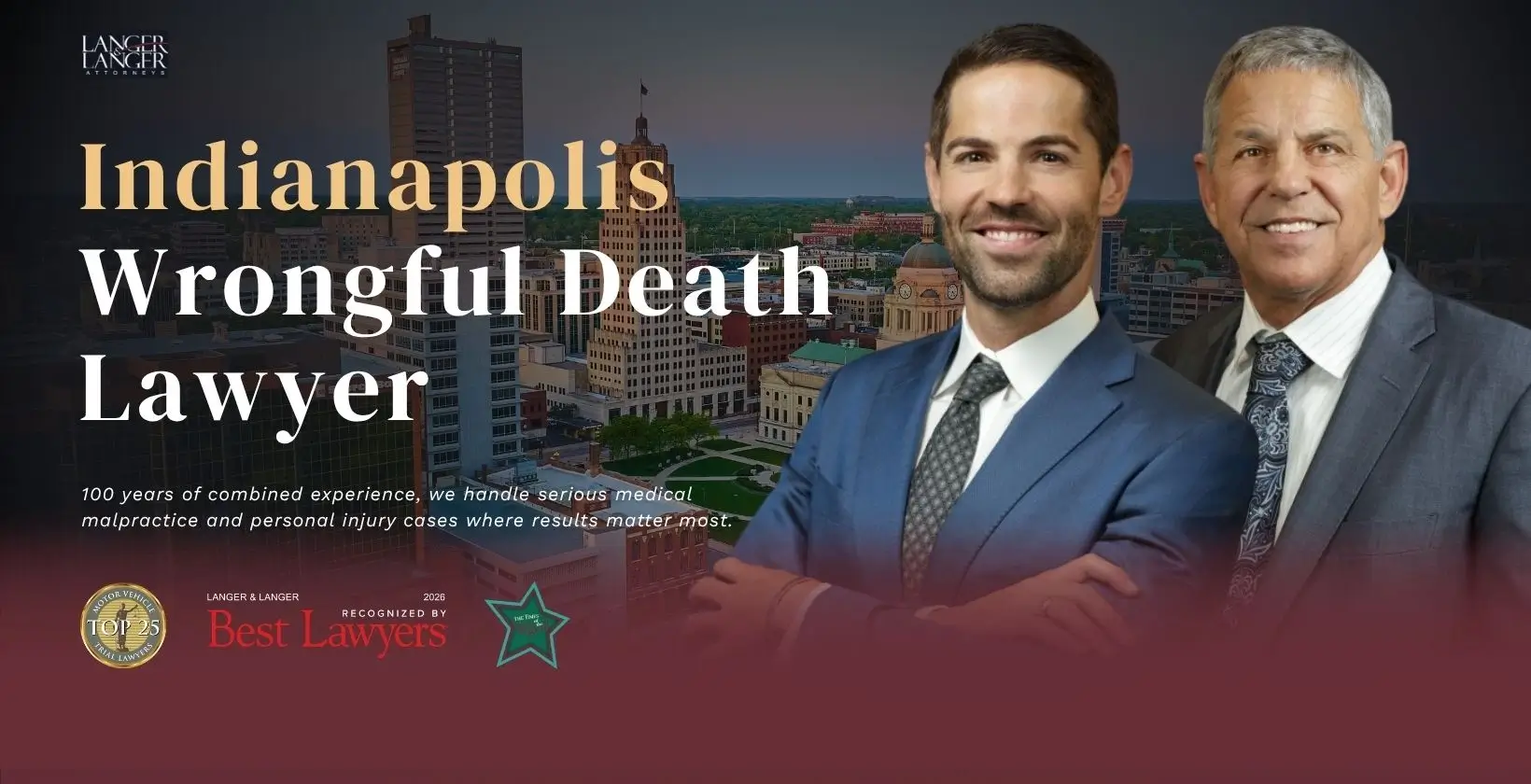
When an unexpected death leaves a family behind, insurance companies do not wait for grief to pass. Their adjusters start investigating the same day. At Langer & Langer, founding partner Steven L. Langer has represented Indiana families in wrongful death cases since 1980.
Call (219) 464-3246 or use our free consultation form to speak with our team today. Langer & Langer handles wrongful death cases on a contingency fee basis. You pay nothing unless we secure a settlement or verdict for your family.
Why Indianapolis Families Trust Us
CASE RESULTS
Our case results record includes settlements and verdicts across fatal accident, medical malpractice, and truck crash cases throughout Indiana.
After losing my father in a tragic car accident and caring for my injured mother, I had no idea how to handle the legal and insurance mess that followed. Attorney Robert Langer and his team at Langer & Associates in Valparaiso, Indiana stepped in and guided our family through every stage of the probate and wrongful-death process with remarkable compassion, clarity, and persistence.
Over the next several years, Rob and Tara Haack managed countless communications with hospitals, rehab facilities, multiple insurance carriers, and other parties. They kept me informed, explained complex legal issues in plain English, and made sure I always understood the next step. Rob even pursued what seemed like a long-shot appeal that resulted in an unexpected refund — something I would never have known was possible without his persistence.
If you’re looking for a compassionate, experienced probate attorney in Valparaiso, IN, who treats clients like family and sticks with them until everything is resolved, I cannot recommend Robert Langer and his team highly enough.
Mike Dixon
Google Review · November 2025
LANGER & LANGER · MAXIMIZING INJURY AWARDS SINCE 1980
A wrongful death occurs when someone dies because of another party’s negligent, reckless, or intentional act. Indiana Code § 34-23-1-1 gives the deceased person’s estate the right to pursue compensation; the same claim the deceased could have brought personally had they survived.
Wrongful death is not a separate theory of liability. It is personal injury law applied to a fatal outcome. To succeed, the family’s legal team must prove four things: the defendant owed a duty of care to the deceased, the defendant breached that duty, the breach caused the death, and the death produced measurable damages.
Duty takes different forms depending on the situation. A driver owes a duty of reasonable care to others on the road. A physician owes a duty to meet the accepted medical standard of care. A property owner owes a duty to maintain reasonably safe conditions for visitors. When any of these duties are violated, and a person dies as a result, Indiana law permits the family to hold the responsible party accountable.
Indiana wrongful death cases arise from fatal car and truck accidents, medical errors, nursing home negligence, defective products, workplace incidents, and premises liability events. The facts of each case determine liability; the statute that governs the case determines what damages the family can recover.

Marion County recorded 36,489 traffic collisions in 2022, the highest count of any Indiana county, and Indiana reported 989 motor vehicle deaths in 2023. Fatal accidents on Indianapolis roads, medical errors in the city’s hospitals, and incidents in workplaces and nursing homes account for the majority of wrongful death claims filed each year.
Fatal car crashes are the most common source of wrongful death claims in Indianapolis. Drunk drivers, distracted drivers, and commercial truck operators cause fatal collisions on I-65, I-70, I-465, and city streets throughout Marion County. When a commercial carrier is involved, the investigation expands to include the trucking company’s hiring records, driver logs, hours-of-service violations, and maintenance files. Indiana’s liability rules place potential responsibility on more than just the driver. Families pursuing Indiana truck accident wrongful death claims may hold the carrier, dispatcher, and third-party contractors accountable alongside the driver.
Surgical errors, misdiagnoses, emergency room failures, and medication mistakes kill patients who came to a hospital seeking help. A wrongful death claim arising from medical negligence carries an additional procedural step: Indiana Code § 34-18-8-4 requires filing with the Indiana Department of Insurance and completing a Medical Review Panel process before a lawsuit can be filed in Marion Superior Court. This process adds time, which makes early legal action critical. Birth injuries that prove fatal follow the same procedural track. Our Indianapolis birth injury attorneys handle wrongful death claims arising from delivery room negligence under the same Medical Review Panel framework.
Fatal falls, medication mismanagement, dehydration, and infections caused by neglect in long-term care facilities give families the right to pursue a wrongful death claim against the facility and its ownership. Indiana nursing home deaths frequently involve chronic understaffing and inadequate care protocols that management was aware of and failed to correct.
Workers killed on construction sites, in manufacturing plants, or during industrial operations generate wrongful death claims separate from workers’ compensation. When a third party, a subcontractor, equipment manufacturer, or property owner, contributed to the workplace death, that party can be sued for wrongful death damages entirely outside the workers’ compensation system.
A fatal defect in a vehicle’s braking system, a malfunctioning medical device, or a dangerous consumer product can give rise to a product liability wrongful death claim against the manufacturer, distributor, or retailer responsible for putting that item into commerce.
Property owners who fail to maintain safe conditions (unmarked hazards, inadequate security, or structural failures) face wrongful death liability when those conditions cause a fatal injury on their property. Indiana premises liability claims follow the same four-element framework.
Under Indiana Code § 34-23-1-1, only the personal representative of the deceased person’s estate has legal standing to file a wrongful death lawsuit. Individual family members acting on their own, regardless of their relationship to the deceased, do not have that standing under the general statute.
The personal representative is typically named in the deceased’s will. When no will exists, the Marion Superior Court, located at 200 East Washington Street, Indianapolis, IN 46204, appoints a personal representative. Courts generally appoint the surviving spouse, an adult child, or another close family member to serve in that role.
Once the case resolves, the compensation does not stay with the estate indefinitely. Medical, hospital, funeral, and burial expense reimbursements go to the estate for payment of those debts. The remainder is distributed to the surviving spouse and dependent children, or to dependent next of kin if no spouse or children survive.
Child wrongful death cases operate differently. When a minor or a young adult under 23 enrolled in a postsecondary institution dies, Indiana Code § 34-23-2-1 applies, and one or both parents, not the estate, hold the right to file the lawsuit. In cases where the parents are divorced, the parent with primary legal custody at the time of death controls that right.
If you are unsure whether you have standing or how to identify a personal representative, call (219) 245-7229. Langer & Langer answers these questions at no cost in an initial consultation.
Questions about your family’s rights? (219) 245-7229 or schedule a free consultation
The damages your family can recover depend on which of Indiana’s three wrongful death statutes governs the case. Families where the deceased had dependents may recover the broadest range of damages, including lost earnings. Families where the deceased was an unmarried adult with no dependents face narrower recovery options under a different statute.
The General Wrongful Death Statute (Indiana Code § 34-23-1-1) applies. Your family can recover reasonable medical, hospital, funeral, and burial expenses; the deceased’s projected lost earnings; and loss of love and companionship. Compensation flows first to the estate for payment of final expenses, then to the surviving spouse and dependent children or next of kin. For a full breakdown of what families can recover in Indiana wrongful death lawsuits, see our detailed blog post.
The Adult Wrongful Death Statute (Indiana Code § 34-23-1-2) applies. Recovery is limited to medical, hospital, funeral, and burial expenses, and loss of love and companionship. Lost earnings are not recoverable under this statute. An amendment effective July 1, 2022, extended this statute to cover certain married individuals whose death was caused by their spouse.
The Child Wrongful Death Statute (Indiana Code § 34-23-2-1) applies. There is no cap on damages. Recoverable losses include services, loss of love and companionship, and psychiatric or psychological counseling costs for surviving parents and minor siblings, a category of damages unique to this statute.
Pain and suffering your loved one experienced between the time of injury and the time of death may also be recoverable through a separate survival action filed alongside the wrongful death claim. Indiana uses a multiplier method to value these losses; our blog covers how pain and suffering damages are calculated in Indiana for both survival and wrongful death cases.
For families in the Valparaiso area, our Valparaiso wrongful death attorneys handle fatal accident and malpractice cases with the same depth of preparation as our Indianapolis team.
| Not sure which statute governs your family’s case? (219) 245-7229 or schedule a free consultation |
Indiana’s General Wrongful Death Statute sets a two-year deadline from the date of death to file a lawsuit. Missing it ends the case permanently. But the two-year window is not the only deadline that matters; for some Indianapolis families, a separate, less-known notice requirement arrives much sooner.
When the death involved a city bus, school bus, county employee, or other political subdivision, Indiana Code § 34-13-3-8 requires written notice within 180 days of the death. When the death involved INDOT, a state agency vehicle, or a state-operated facility, Indiana Code § 34-13-3-6 sets the notice window at 270 days. Both deadlines expire well before the two-year lawsuit deadline. A family that misses either window loses the right to pursue that claim.
Physical evidence degrades quickly: dashcam and surveillance footage are overwritten, skid marks disappear, witnesses move on or forget details.
The type of wrongful death case also shapes the procedural path, and families benefit from understanding this early. A claim arising from medical negligence requires a Medical Review Panel process under Indiana Code § 34-18-8-4 before any lawsuit can be filed, a procedural step that adds months to the timeline and makes early legal engagement decisive. A child wrongful death claim follows different filing rules than an adult claim under the general statute. Identifying the right statute, the right filing party, and the correct deadlines at the outset protects the entire case.
Call (219) 245-7229 today. Waiting costs families options they cannot get back.
Indiana Code § 34-51-2-6 applies a modified comparative fault system to wrongful death cases. If the deceased is found 51% or more at fault for the incident that caused their death, the family recovers nothing. Below that threshold, fault assigned to the deceased reduces the family’s recovery proportionally but does not eliminate it.
Defense attorneys and insurance carriers use comparative fault strategically. In a fatal car accident, the insurer may argue the deceased was speeding, failed to yield, or was not wearing a seatbelt. In a medical malpractice wrongful death, the defense may argue that the patient missed follow-up appointments or failed to disclose a relevant medical history, which contributed to the fatal outcome.
Langer & Langer counters these arguments with evidence built before the defense has a chance to set the narrative. Accident reconstruction experts, independent medical specialists, and key witnesses are identified and retained early. The stronger the investigation at the outset, the more difficult it becomes for a defendant to shift fault onto the deceased.
Comparative fault findings are determined by the jury. The difference between 49% and 51% fault assigned to the deceased is the difference between a substantial recovery for your family and no recovery at all. That gap is decided by the quality of the evidence built before filing.
Cases lost to evidentiary gaps can rarely be repaired at trial. We preserve physical evidence before scenes are cleared, secure medical records before they are altered, and retain expert witnesses before opposing counsel builds its counter-narrative.
The investigation begins the moment we take a case. For fatal crash cases, that means contacting the Indianapolis Metropolitan Police Department for crash reports, requesting preservation of available surveillance and dashcam footage, and deploying accident reconstruction specialists to document the scene before evidence disappears. For medical malpractice wrongful death cases, the process includes a complete medical records request, independent expert medical review, and the Medical Review Panel submission required under § 34-18-8-4.
Trucking companies, hospital systems, and nursing home chains retain legal teams that begin work the day they learn of a death. Discovery into their hiring records, training protocols, maintenance logs, and internal communications often produces the most critical evidence in the case. Langer & Langer does not wait for the defense to finish building its file before starting ours.
Steve Langer and his team provided exceptional attention and care to my mother’s case. Steve is a no-nonsense but compassionate attorney and he is extremely meticulous and detail oriented. He leaves no stone unturned and while working with him you have no doubt that he is going to fully dedicate himself to your case. I am eternally grateful for his perseverance and support throughout the legal process, and I can’t thank him enough for helping me get justice for my mother. I highly recommend Steve Langer and his team. You will be in the best hands and they will be with you every step along the way. |
Langer & Langer has fought for Indiana wrongful death families since 1980, with founding partner Steven L. Langer holding an AV Preeminent rating, Two-Time ITLA Trial Lawyer of the Year (2004 and 2009), and a $9.05 million medical malpractice settlement among the firm’s confirmed results.
Steven L. Langer entered practice in 1980, the year our firm was founded. He has argued wrongful death cases across Indiana at the trial and appellate levels, published on medical malpractice and evidence, and earned recognition in Super Lawyers every year since 2008. Heather Gilbert focuses specifically on medical malpractice and wrongful death claims, bringing dedicated attention to the cases that demand the most thorough preparation. A full overview of every attorney who handles wrongful death cases at this firm is on our Indiana wrongful death attorney team page.
Langer & Langer takes wrongful death cases on a contingency fee basis. No legal fees are owed unless we recover compensation for your family. Indianapolis families across Marion County have recovered compensation for lost income, final expenses, and the absence of a loved one, through Langer & Langer’s preparation and trial-readiness. What sets Langer & Langer apart from other Indiana firms handling fatal injury cases is detailed on our why hire us page.
Ready to speak with our team? (219) 245-7229 or schedule a free consultation
Yes, as long as the deceased is not found to bear 51% or more of the fault under Indiana Code § 34-51-2-6. Fault assigned to the deceased reduces the family’s recovery proportionally but does not eliminate it below that threshold. Early, thorough evidence-gathering minimizes the fault that defense teams can attribute to the deceased.
Most wrongful death cases in Indiana resolve through settlement before trial. Langer & Langer prepare every case as if it will go to trial. That preparation creates the leverage necessary to negotiate meaningful settlements. When a fair resolution cannot be reached, our lawyers do not hesitate to litigate in Marion Superior Court or at the appellate level.
If a city bus, Indianapolis Metropolitan Police Department vehicle, or other political subdivision vehicle contributed to the death, Indiana Code § 34-13-3-8 requires written notice within 180 days. If INDOT or another state agency was involved, Indiana Code § 34-13-3-6 applies and sets that window at 270 days. Missing either deadline is case-ending. Call (219) 245-7229 immediately if a government entity may be involved.
A wrongful death claim compensates the deceased’s survivors for their own losses: financial dependence, loss of love and companionship, and final expense costs. A survival action compensates the estate for damages the deceased personally suffered between the time of injury and the time of death, such as conscious pain and suffering or lost wages during that period. In Indiana, both claims can be filed simultaneously when the facts support them.
Langer & Langer handles wrongful death cases on a contingency fee basis. There are no upfront costs and no attorney fees unless we recover compensation for your family. The initial consultation is free, by phone or in person.
Your family has a limited window to act. Insurance companies and defense attorneys are already at work. Langer & Langer puts 46+ years of wrongful death litigation experience on your side.
Call (219) 245-7229 now or schedule your free consultation online. Langer & Langer serves families throughout Indianapolis, Marion County, Hamilton County, Hendricks County, and surrounding Central Indiana communities.
Maximizing Injury Awards since 1980.
Medical errors are complex. We cut through the confusion – just share your records and our team will give you an honest case evaluation, free of charge.

© 1980-2026 Langer & Langer • All Rights Reserved
Copyright © 1980-2026 All Rights Reserved.
Past results do not guarantee any future outcome, and every case is different.
We improve our products and advertising by using Microsoft Clarity to see how you use our website. By using our site, you agree that we and Microsoft can collect and use this data.
Have legal questions or need expert advice? Our experienced team is here to help.
Langer & Langer
Accessibility Statement
Compliance status
We firmly believe that the internet should be available and accessible to anyone, and are committed to providing a website that is accessible to the widest possible audience, regardless of circumstance and ability.
To fulfill this, we aim to adhere as strictly as possible to the World Wide Web Consortium’s (W3C) Web Content Accessibility Guidelines 2.1 (WCAG 2.1) at the AA level. These guidelines explain how to make web content accessible to people with a wide array of disabilities. Complying with those guidelines helps us ensure that the website is accessible to all people: blind people, people with motor impairments, visual impairment, cognitive disabilities, and more.
This website utilizes various technologies that are meant to make it as accessible as possible at all times. We utilize an accessibility interface that allows persons with specific disabilities to adjust the website’s UI (user interface) and design it to their personal needs.
Additionally, the website utilizes an AI-based application that runs in the background and optimizes its accessibility level constantly. This application remediates the website’s HTML, adapts Its functionality and behavior for screen-readers used by the blind users, and for keyboard functions used by individuals with motor impairments.
If you’ve found a malfunction or have ideas for improvement, we’ll be happy to hear from you. You can reach out to the website’s operators by using the following email
Screen-reader and keyboard navigation
Our website implements the ARIA attributes (Accessible Rich Internet Applications) technique, alongside various different behavioral changes, to ensure blind users visiting with screen-readers are able to read, comprehend, and enjoy the website’s functions. As soon as a user with a screen-reader enters your site, they immediately receive a prompt to enter the Screen-Reader Profile so they can browse and operate your site effectively. Here’s how our website covers some of the most important screen-reader requirements, alongside console screenshots of code examples:
Screen-reader optimization: we run a background process that learns the website’s components from top to bottom, to ensure ongoing compliance even when updating the website. In this process, we provide screen-readers with meaningful data using the ARIA set of attributes. For example, we provide accurate form labels; descriptions for actionable icons (social media icons, search icons, cart icons, etc.); validation guidance for form inputs; element roles such as buttons, menus, modal dialogues (popups), and others. Additionally, the background process scans all the website’s images and provides an accurate and meaningful image-object-recognition-based description as an ALT (alternate text) tag for images that are not described. It will also extract texts that are embedded within the image, using an OCR (optical character recognition) technology. To turn on screen-reader adjustments at any time, users need only to press the Alt+1 keyboard combination. Screen-reader users also get automatic announcements to turn the Screen-reader mode on as soon as they enter the website.
These adjustments are compatible with all popular screen readers, including JAWS and NVDA.
Keyboard navigation optimization: The background process also adjusts the website’s HTML, and adds various behaviors using JavaScript code to make the website operable by the keyboard. This includes the ability to navigate the website using the Tab and Shift+Tab keys, operate dropdowns with the arrow keys, close them with Esc, trigger buttons and links using the Enter key, navigate between radio and checkbox elements using the arrow keys, and fill them in with the Spacebar or Enter key.Additionally, keyboard users will find quick-navigation and content-skip menus, available at any time by clicking Alt+1, or as the first elements of the site while navigating with the keyboard. The background process also handles triggered popups by moving the keyboard focus towards them as soon as they appear, and not allow the focus drift outside it.
Users can also use shortcuts such as “M” (menus), “H” (headings), “F” (forms), “B” (buttons), and “G” (graphics) to jump to specific elements.
Disability profiles supported in our website
Additional UI, design, and readability adjustments
Browser and assistive technology compatibility
We aim to support the widest array of browsers and assistive technologies as possible, so our users can choose the best fitting tools for them, with as few limitations as possible. Therefore, we have worked very hard to be able to support all major systems that comprise over 95% of the user market share including Google Chrome, Mozilla Firefox, Apple Safari, Opera and Microsoft Edge, JAWS and NVDA (screen readers).
Notes, comments, and feedback
Despite our very best efforts to allow anybody to adjust the website to their needs. There may still be pages or sections that are not fully accessible, are in the process of becoming accessible, or are lacking an adequate technological solution to make them accessible. Still, we are continually improving our accessibility, adding, updating and improving its options and features, and developing and adopting new technologies. All this is meant to reach the optimal level of accessibility, following technological advancements. For any assistance, please reach out to