

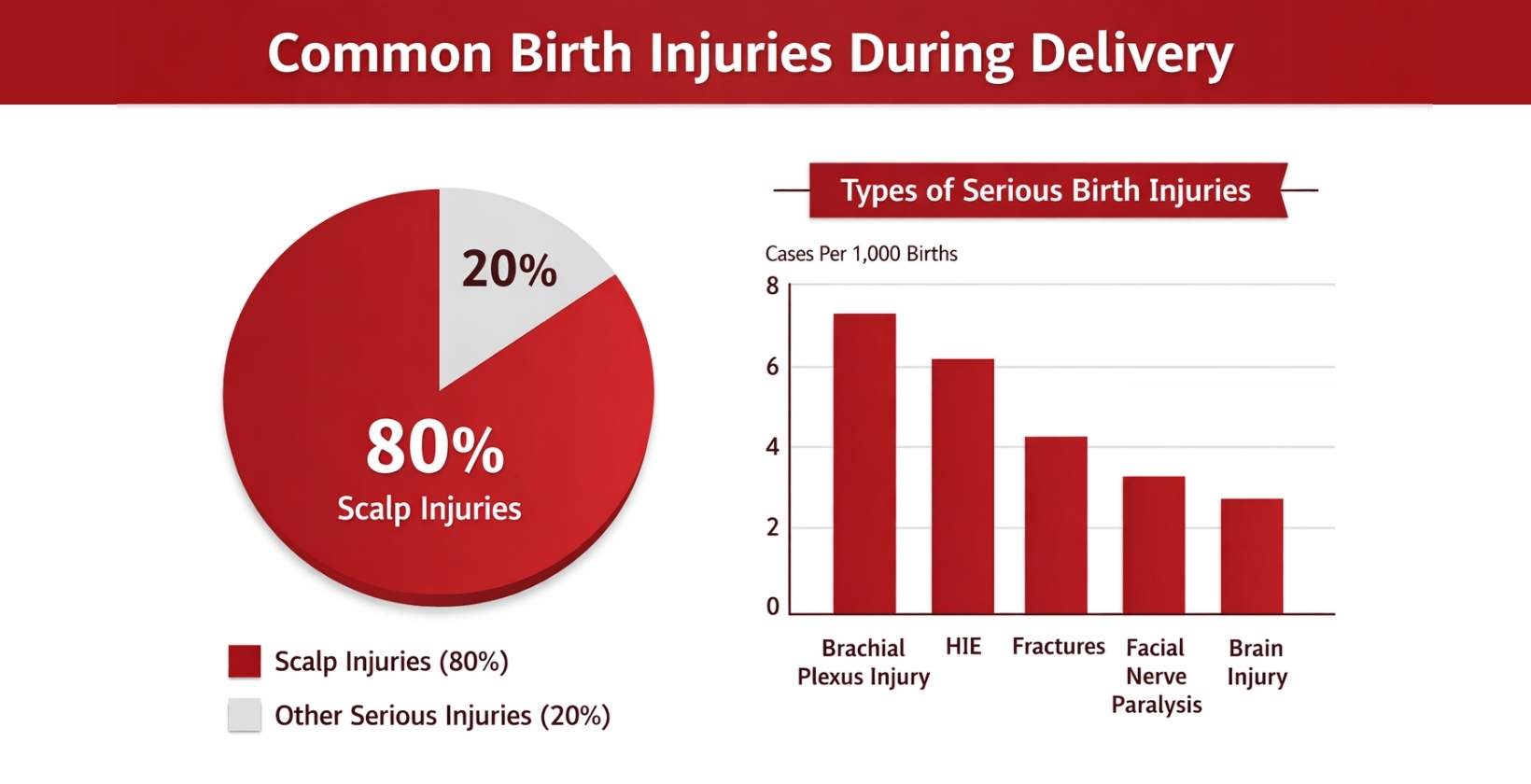
Brachial plexus injuries and hypoxic-ischemic encephalopathy (HIE) are the birth injuries most often linked to preventable medical errors. Brachial plexus injuries, including Erb’s palsy, commonly result from failure to manage shoulder dystocia correctly or improper use of forceps and vacuum extractors during delivery. HIE is a brain injury caused by oxygen deprivation, most often connected to failure to recognize fetal distress or a delayed emergency C-section.Scalp injuries happen far more often overall, but they are almost always minor and rarely involve any failure of care.
If something felt wrong during your delivery or a diagnosis arrived later that no one fully explained, the question you are really asking is probably this: could this have been prevented? That is the question the birth injury attorneys at Langer & Langer help Indiana families answer.
Key Takeaways
- Not every birth injury is the result of a medical mistake, but brachial plexus injuries, HIE, and some cases of cerebral palsy are among the most serious ones that often are.
- Scalp injuries are the most common birth injuries overall, but they are usually minor and rarely involve medical negligence.
- The injuries most often connected to preventable errors follow recognizable patterns – excessive traction during delivery, failure to recognize fetal distress, a delayed C-section, and missed infection screening.
- In Indiana, if your child was injured before age 6, the family generally has until the child’s eighth birthday to file a medical malpractice claim, giving families time to understand a delayed diagnosis before the deadline passes.
- Before a lawsuit can proceed in Indiana, the claim must go through a Medical Review Panel. An attorney handles that process on your behalf.
Birth Injuries During Delivery: Which Are Most Common?
According to data from the National Institutes of Health, approximately 25 to 31 birth traumas per 1,000 hospital births occur in the United States. About 80 percent of those are scalp injuries – temporary swelling, bruising, or fluid buildup that usually resolves without lasting harm.
Frequency is not the same as severity. The injuries that appear most often in data are usually minor, while injuries such as nerve damage, oxygen deprivation, and brain injury occur less often but are far more likely to leave permanent consequences. That is why the most common birth injury is not always the one most closely connected to negligent care.
Caput Succedaneum
Caput succedaneum is swelling in the soft tissues of a newborn’s scalp, often caused by pressure during labor or instrument-assisted delivery. It is common after prolonged labor or vacuum-assisted birth and usually goes away within a few days without long-term problems.
Cephalohematoma
Cephalohematoma is bleeding between the skull bone and its fibrous covering. It often appears hours after birth as a raised lump on the head and usually resolves over weeks or months. Larger cases can contribute to jaundice as the blood breaks down, and in some instances, increase the risk of anemia, calcification, or infection.
Subgaleal Hemorrhage
Subgaleal hemorrhage is bleeding in the space between the skull and the fibrous layer covering it. Unlike cephalohematoma, it is not confined to one area – blood can spread across the scalp, accumulate rapidly, and become life-threatening if the condition is not recognized quickly. It is most commonly associated with vacuum extractor use and requires immediate clinical attention.
Clavicle Fractures
A clavicle fracture – broken collarbone – is the most common bone injury during delivery. It can happen when there is difficulty delivering the shoulder, such as during a shoulder dystocia or during a breech birth. Most cases heal quickly, though the baby may move the affected arm less for a short time.
Facial Nerve Paralysis
Facial nerve paralysis happens when pressure during labor or the use of forceps injures the facial nerve. It is often noticed when the baby cries and one side of the face does not move normally. Many cases improve within a few weeks if the nerve was bruised rather than torn.
Which Birth Injuries Are Most Often Linked to Medical Negligence?
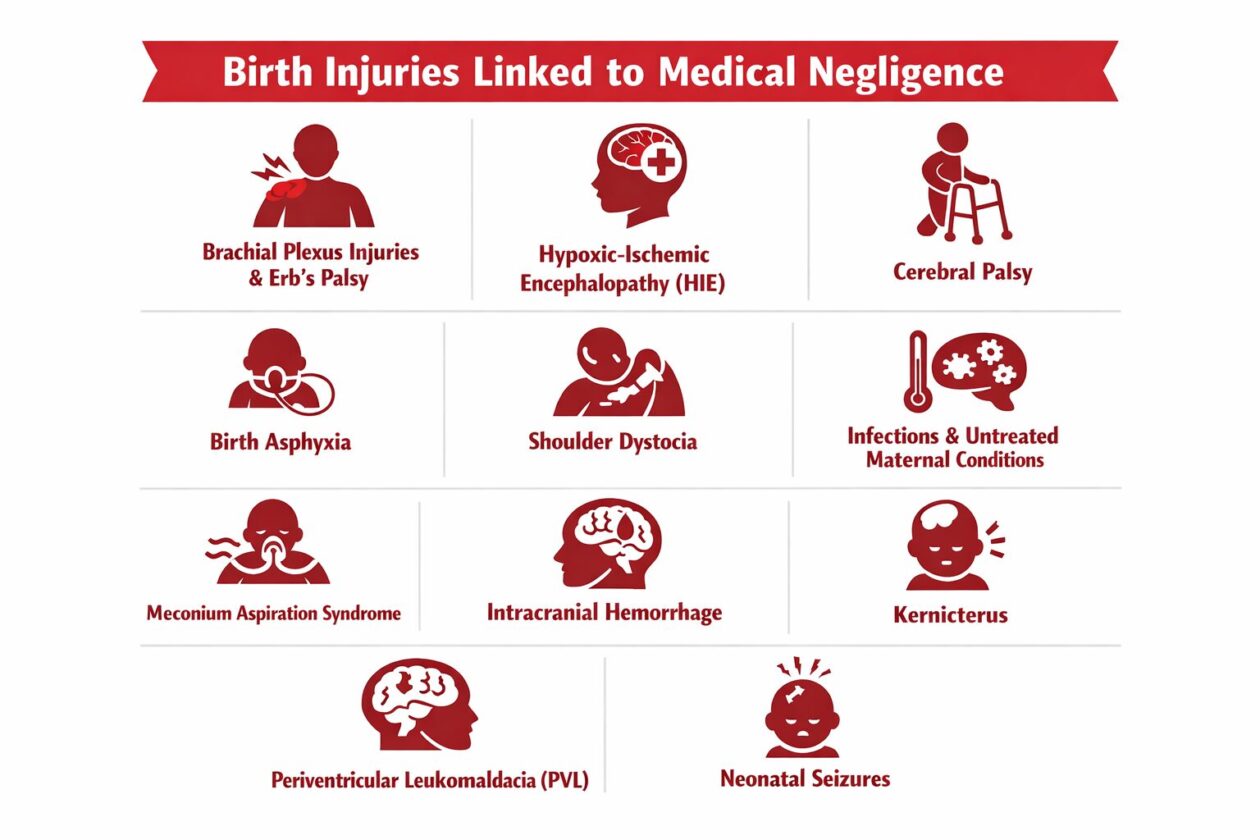
Not every birth complication is a medical error. A shoulder dystocia or a cord prolapse can happen in any delivery. What turns a complication into a potential negligence case is the response – whether the team recognized the warning signs, followed established protocols, and acted within the window that mattered. The injuries below are the ones where that distinction comes up most often.
Brachial Plexus Injuries and Erb’s Palsy
A brachial plexus injury occurs when the nerves controlling the arm and shoulder are stretched or torn during delivery. Erb’s palsy affects the upper arm. Klumpke’s palsy, a less common variation, affects the lower arm and hand.
These injuries most often follow shoulder dystocia. Established protocols, such as the McRoberts maneuver, suprapubic pressure, and other sequential steps, exist specifically to manage that complication without force. Cases where those steps were skipped, and excessive traction was applied to the baby’s head or neck instead, are the ones that most often raise negligence questions.
Hypoxic-Ischemic Encephalopathy (HIE)
HIE is a brain injury caused by reduced oxygen and blood flow to a newborn’s brain around the time of birth. Damage begins within minutes and can become permanent. Cooling therapy, therapeutic hypothermia, can limit that damage, but it must begin within approximately six hours of birth to be effective.
HIE is connected to delayed recognition of fetal distress, delayed emergency C-section, cord prolapse, nuchal cord, uterine rupture, and mismanagement of labor-inducing medications. Pitocin and misoprostol can cause uterine hyperstimulation when not carefully monitored, directly reducing oxygen flow to the baby.
Cerebral Palsy
Cerebral palsy affects movement, muscle tone, and posture, and is the most common motor disability in childhood, affecting approximately 1 in 345 children in the U.S. The cases most connected to negligence involve preventable oxygen deprivation during labor, a delayed C-section, or failure to respond to fetal distress. Because cerebral palsy is often not diagnosed until a child is 18 months to 3 years old, Indiana’s extended filing deadline for children injured before age 6 is particularly relevant for these families.
Birth Asphyxia
Birth asphyxia is oxygen deprivation during the birth process, the underlying event that leads to HIE. It can follow placental abruption, cord prolapse, prolonged obstructed labor, or failure to act on abnormal fetal heart rate patterns. Electronic fetal monitoring exists to detect these warning signs in real time. When abnormal readings are ignored, misread, or not communicated to the right provider, the intervention window closes.
Shoulder Dystocia
Shoulder dystocia can cause brachial plexus injuries, as covered above, but it can also contribute directly to oxygen deprivation if the delivery is prolonged. Properly managed using established protocols, it resolves without lasting harm. When excessive force is applied instead of following proper technique, the consequences extend beyond nerve damage. Fetal macrosomia, a larger-than-average baby, is a known risk factor that providers are expected to identify and plan for before delivery begins.
Infections and Untreated Maternal Conditions
Group B Streptococcus, chorioamnionitis, preeclampsia, and HELLP syndrome each carry established screening and treatment protocols. Group B Strep is routinely screened for late in pregnancy. A missed result or failure to administer antibiotics during labor can lead to neonatal sepsis or meningitis.
When a provider fails to screen, fails to communicate results, or fails to follow protocol, and a newborn suffers a preventable infection or brain injury as a result, that is not an unavoidable outcome. It is a failure to follow a standard that exists precisely to prevent it.
Meconium Aspiration Syndrome
Meconium aspiration syndrome occurs when a newborn inhales amniotic fluid containing meconium – the baby’s first stool – during or around delivery. Meconium-stained fluid is itself a warning sign of fetal distress.
MAS can cause serious breathing problems, lung damage, and in severe cases, brain injury. It is associated with failure to respond to fetal distress, delayed delivery, and inadequate airway management immediately after birth.
Intracranial Hemorrhage
Intracranial hemorrhage is bleeding inside the skull, most often caused by improper use of forceps or vacuum extractors. Severity ranges from minor to life-threatening. Prompt diagnosis is critical because blood accumulation can cause rapid and permanent brain damage.
Kernicterus
Kernicterus is brain damage caused by untreated severe jaundice in a newborn. Jaundice affects up to 80 percent of newborns, but kernicterus is entirely preventable with standard bilirubin monitoring and phototherapy. A failure to screen or treat is a clear breach of an established standard protocol.
Periventricular Leukomalacia (PVL)
Periventricular leukomalacia is an injury to the white matter near the brain’s ventricles, most common in premature infants. It is associated with failures to manage preterm labor, placental insufficiency, and oxygen deprivation. Approximately 30,000 premature infants are affected by PVL each year in the United States, and around 7,000 of those will develop cerebral palsy.
Neonatal Seizures
Neonatal seizures in a newborn are a serious warning sign often connected to HIE, infection, or metabolic disruption. They require immediate evaluation and are sometimes the first indicator that oxygen deprivation occurred during delivery.
When these patterns appear, an experienced Valparaiso birth injury attorney can evaluate whether the care met the standard expected under Indiana law, often working alongside to build the case.
Birth Injury or Birth Defect: Which One Supports a Malpractice Claim?
Not every birth injury is a malpractice claim. The first question is whether the harm was a birth injury at all because a birth defect, which develops during pregnancy through genetic or environmental causes, generally does not support a malpractice claim. A birth injury, which occurs during labor, delivery, or shortly after birth, may result from negligent care.
| Concepts | Birth Injury | Birth Defect |
|---|---|---|
| When it occurs | During labor, delivery, or shortly after birth | During pregnancy, before delivery |
| Cause | Physical trauma, oxygen deprivation, or medical decisions made during childbirth | Genetic, environmental, or developmental factors |
| Examples | HIE, brachial plexus injury, cephalohematoma, facial nerve paralysis | Down syndrome, spina bifida, and congenital heart defects |
| Legal relevance | May support a malpractice claim if caused by negligent care | Generally does not support a malpractice claim |
Once it is established that a birth injury occurred, four elements must be present for a claim to be viable under Indiana law.
- Duty: A treatment relationship existed between the provider and the mother or baby, creating a legal obligation to meet the accepted standard of care.
- Breach: The provider failed to meet that standard through an act, omission, or decision that a reasonably careful provider would not have made in the same situation.
- Causation: The provider’s failure directly caused or contributed to the child’s injury. Showing that an error occurred is not enough. The error must be connected to the harm.
- Damages: The child suffered measurable harm, a permanent injury, a neurological condition, or other documented loss.
All four elements must be supported by evidence. What matters is whether the care provided met Indiana’s accepted standard and whether the failure caused the harm the child suffered.
Signs of a Birth Injury: What to Watch For at Birth and in the Months After
Some birth injuries are visible in the delivery room. Others do not show up until a child misses a milestone at six months, a year, or even later. If your child has recently received a diagnosis – cerebral palsy, Erb’s palsy, or a developmental delay, and you are trying to understand whether it connects to how labor was managed, these are the signs medical and legal professionals look at.
- Unusual limpness or stiffness in the baby’s body or limbs.
- One arm that does not move normally or is held close to the body.
- Difficulty breathing or the need for resuscitation at delivery.
- Seizures in the newborn period.
- Abnormal muscle tone, either too rigid or too floppy.
- Feeding problems that continue beyond the first day or two.
- Visible swelling, bruising, or asymmetry of the head or face.
Signs that may emerge later include:
- Missing motor milestones such as rolling, sitting, or walking at expected ages.
- Muscle stiffness, weakness, or involuntary movements.
- Delays in speech or cognitive development.
- Ongoing problems with coordination or balance as the child grows.
- A later diagnosis, such as cerebral palsy or Erb’s palsy.
- Persistent feeding difficulties or poor weight gain in infancy
These signs do not prove that a medical error occurred – they are a starting point for understanding whether a difficult delivery connects to what came after
If any of these signs match what you observed, the next step is connecting them to what happened during delivery. A birth injury attorney can review the delivery record and give you a direct answer about whether the timeline raises legitimate questions.
Indiana Birth Injury Laws And Deadlines Every Family Should Know
Indiana birth injury claims follow rules that differ from ordinary injury cases. Most malpractice complaints must be filed within two years, but Indiana gives children injured before age 6 until the eighth birthday to file. Before any lawsuit can proceed, claims against qualified healthcare providers must also go through a Medical Review Panel. Because of these procedural requirements, families often rely on an Indiana birth injury lawyer to navigate the process.
Filing Deadlines for Birth Injury Claims
The standard Indiana malpractice deadline is two years from the alleged act, omission, or neglect. For a child injured before age 6, the family generally has until the child’s eighth birthday to file. That extended window matters because developmental delays and other signs of birth injury harm may not become apparent until months or years after delivery.
A mother’s own injury claim follows the standard two-year rule. If you were injured during delivery through an anesthesia error, a surgical complication during a C-section, or another provider failure, that is a separate claim with its own deadline. It does not pause or extend because your child’s claim has a longer window.
Medical Review Panel
Before a birth injury lawsuit can proceed in an Indiana court, the case must go through a Medical Review Panel, a panel of medical professionals who evaluate the care provided and issue an opinion on whether the standard of care was met.
Here is how the process generally works:
- A proposed complaint is filed with the Indiana Department of Insurance. This filing pauses the statute of limitations clock while the review is pending.
- A panel is formed, typically consisting of three healthcare providers from the relevant medical specialty and one attorney who serves as a non-voting chair.
- The panel reviews the medical records, expert reports, and other submitted evidence.
- The panel issues a written opinion stating whether the evidence supports a finding that the standard of care was breached.
- The opinion is not binding; a judge or jury is not required to follow it, but it carries significant weight in litigation and settlement discussions.
The panel process does not eliminate your right to pursue a lawsuit. It is a required preliminary step that helps establish the legal and medical foundation for what follows.
What Compensation Can Indiana Families Recover in a Birth Injury Case?
When a birth injury results from preventable medical negligence, Indiana families may be entitled to compensation that covers both the immediate and long-term consequences for their child. What that includes depends on the specific injury and its lasting effects.
Compensation in a birth injury case may include:
- Past and future medical expenses, including NICU care, surgeries, and ongoing treatment.
- Physical, occupational, and speech therapy are often needed for years in cases involving cerebral palsy, Erb’s palsy, or HIE.
- Specialized medical equipment such as wheelchairs, braces, or communication devices.
- Home modifications to accommodate a child’s physical needs.
- Special education services and adaptive learning programs.
- Lost earning capacity if the child’s injury affects the ability to work as an adult.
- Pain and suffering, including the emotional burden carried by the child and the family.
Indiana caps total recovery at $1.8 million for malpractice occurring after June 30, 2019, with the provider responsible for up to $500,000 and the Patient’s Compensation Fund covering the remainder. Understanding how those caps apply to your child’s specific situation is one of the first things an attorney reviews with you.
Talk to a Birth Injury Attorney at Langer & Langer
If you have concerns about a birth injury and are unsure whether the delivery was handled correctly, we can help. At Langer & Langer, we review birth injury cases across Indiana, examine medical records, and give honest guidance based on the facts and Indiana law. Our team is an experienced Indiana medical malpractice attorney group, proudly serving clients throughout Indiana since 1980.
Call us at 219-464-3246 or submit a free case review online.