
If you were injured in a car crash due to someone else's negligence in Indianapolis, Langer & Langer can help. Our experienced Indianapolis car accident lawyers handle insurer communications, preserve critical evidence, and pursue full compensation for your medical bills, lost income, and other damages.
4 Indiana Ave Valparaiso, IN 46383
in**@*******aw.com
(219) 464-3246

Timing matters. Critical evidence can disappear quickly, and insurance companies begin building their defense right away. Acting early helps preserve your position and avoid common claim pitfalls.
With more than 100 years of combined experience in Indiana motor vehicle litigation and a $4.1 million recovery in a single Indianapolis crash, our firm has the proven record and trial readiness to take on any insurer in Marion County. Our lead trial lawyer, Steven L. Langer, has received the ITLA Trial Lawyer of the Year award twice – a distinction that changes how insurers respond to every claim our car accident attorneys handle.
No fee unless we recover compensation for you. Call 219-464-3246 to request your free consultation today.
A valid Indiana car accident claim requires three things: another party’s negligence, a direct causal link to the crash, and documented harm. When a driver violates an Indiana traffic statute, breach of duty is established without additional argument under the negligence per se doctrine.
Insurers challenge causation when no same-day medical record exists. They dispute damages when injuries are documented only through self-reporting. The two actions that protect a claim more than any other are seeking medical evaluation the same day as the crash and calling an attorney.
Taking the correct steps immediately after a collision protects your health and preserves your legal right to full compensation under Indiana law.
1. Call 911
Indiana law requires reporting crashes with injury or significant property damage. Insurers use the absence of a police report as a basis to deny fault entirely.
2. Seek medical evaluation the same day
Even one phrase documented in an ER record, patient reports pain beginning at the time of the crash, closes that causation gap permanently.
3. Photograph the scene before vehicles move
Capture positions, skid marks, traffic signals, and road conditions. These cannot be recreated.
4. Collect witness contact information
Independent witnesses carry significant weight when fault is disputed.
5. Refuse a recorded statement to the opposing insurer
One minimizing phrase, I feel okay, it wasn’t that bad, can shift comparative fault against you. You have no legal obligation to give a statement to the other driver’s insurer.
6. Contact a car accident lawyer before signing anything
A signed release permanently extinguishes all future claims, regardless of how injuries develop.
Distracted driving and failure to yield are the leading causes of car accidents in Marion County. When either involves a traffic law violation, Indiana courts treat that violation as automatic proof of negligence.
| Cause | Indiana Statute | Legal Effect |
|---|---|---|
| Distracted driving | IC 9-21-8-59 | Negligence per se |
| Failure to yield at intersection | IC 9-21-8-29 / IC 9-21-8-30 | Negligence per se |
| Drunk driving | IC 9-30-5 | Negligence per se + punitive damages |
| Speeding on I-465 and I-70 | IC 9-21-5-1 | Negligence per se |
| Rear-end tailgating | IC 9-21-8-14 | Rebuttable presumption against following driver |
| Reckless driving | IC 9-21-8-52 | Negligence per se |
| Construction zone violations | IC 9-21-8-6 | Negligence per se |
We handle every category of car accident claim in Marion County and across Indiana, from routine rear-end disputes to complex commercial carrier litigation.
Serious car accidents produce injuries ranging from soft tissue damage that may not appear until days after the crash to catastrophic conditions that permanently alter the victim’s life and earning capacity.
Indiana follows modified comparative fault under IC 34-51-2. At 50% fault or below, your recovery is reduced proportionally. A 20% fault finding on a $150,000 verdict produces a $120,000 recovery. At 51% fault, recovery is eliminated entirely.
This is why adjusters request recorded statements within 24 hours of a crash. They are not documenting the incident. They are building fault evidence, and one careless statement can push the percentage past the threshold.
As of July 1, 2024, under HB 1090, a jury can reduce your damages by an unlimited amount if the defendant proves you were not wearing a seatbelt and that wearing one would have reduced your injuries. It does not establish fault for the crash. The defendant carries the burden of proof on both elements.
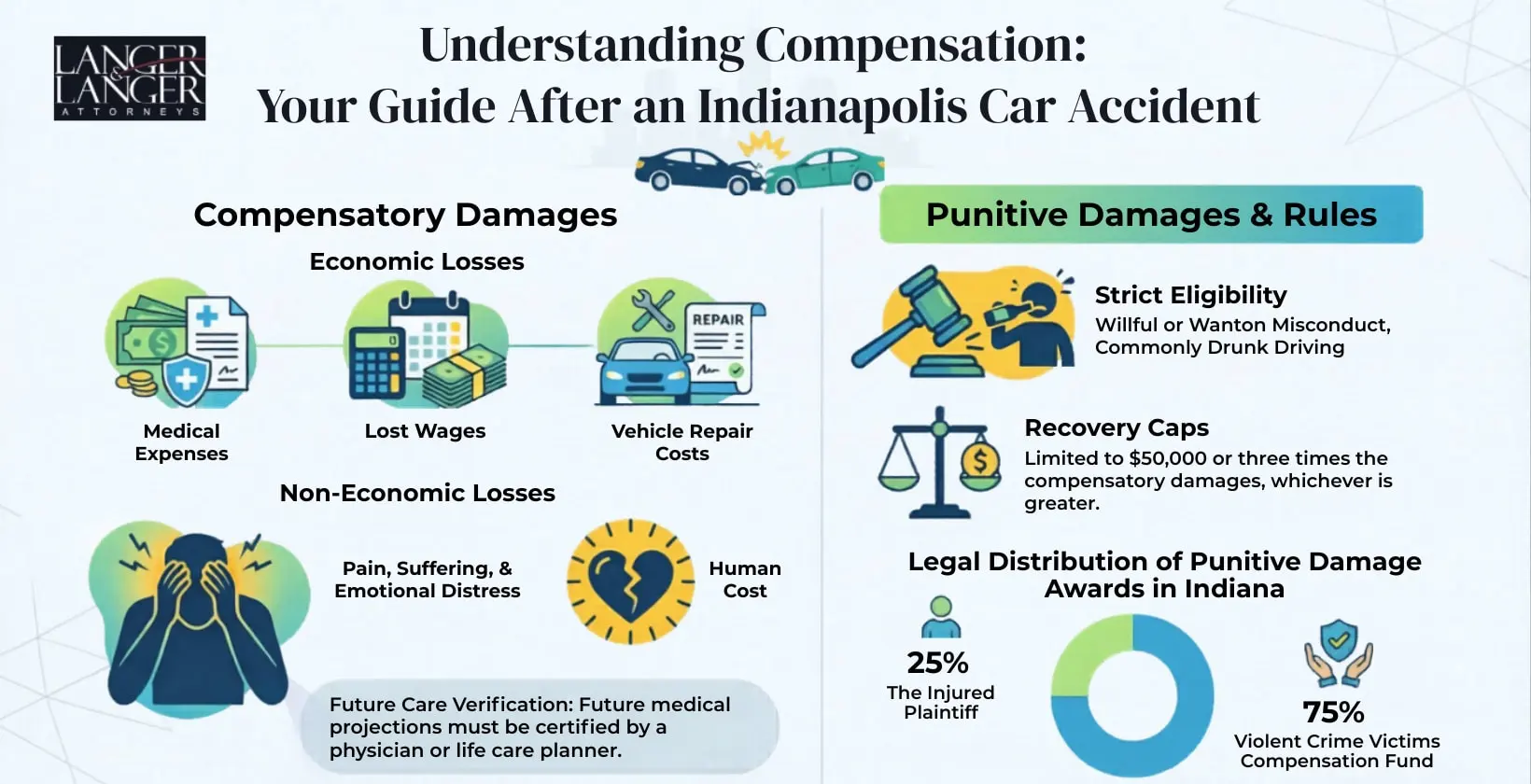
After an Indianapolis car accident, you can recover two primary categories of damages: economic losses with a calculable dollar value, and non-economic losses for the human cost of the injury. In cases involving willful or wanton misconduct, punitive damages may also apply.
Economic Damages: Medical expenses, future medical care, lost wages, lost earning capacity, and vehicle costs. Future care projections require a treating physician or certified life care planner. Insurers reject attorney estimates.
Non-Economic Damages: Pain and suffering, emotional distress, loss of enjoyment of life, and loss of consortium. The spouse’s consortium claim is separate from the injured plaintiff’s claim and is routinely omitted from initial settlement offers.
Punitive Damages: Available when the defendant’s conduct was willful, wanton, or intentionally harmful, not merely negligent. Drunk driving is the most common basis in car accident cases, but other conduct can qualify. Capped at three times compensatory damages or $50,000, whichever is greater. The plaintiff retains 25%, and the remaining 75% goes to Indiana’s Violent Crime Victims Compensation Fund. Punitive damages require clear and convincing evidence of misconduct, a higher burden than standard negligence.
Indiana Code 34-11-2-4 gives victims two years from the crash date to file. Missing the deadline permanently bars the claim regardless of how clear the fault may be.
Minor Victims: IC 34-11-6-1 gives a minor two years after turning 18. The clock starts on the 18th birthday, not the crash date. A child injured at 15 has until age 20 to file.
Government Defendant Crashes: Claims against IndyGo, IMPD, or Marion County require a written Tort Claim Notice within 180 days under IC 34-13-3-8. Claims against INDOT require notice within 270 days under IC 34-13-3-6. Missing either deadline permanently bars the claim.
Delayed Injury Discovery: Indiana recognizes a narrow tolling exception when an injury was genuinely undiscoverable on the crash date, not merely undiagnosed. It does not apply when any symptom was documented at the ER that day. Treat the clock as running from the crash date unless an attorney advises otherwise.
Wrongful Death Claims: IC 34-23-1-1 governs adult wrongful death claims. The two-year limitation applies, with the estate’s personal representative as the filing party. The adult wrongful death act (IC 34-23-1-2) covers adults without dependents and carries different damage categories.
When you hire Langer & Langer, here is what happens on your behalf from day one. Every step below has a deadline measured in hours or days, not weeks, and each one directly affects the value of your claim.
Evidence Preservation: Issue a spoliation letter within 48 hours to preserve EDR data, dashcam footage, and traffic camera recordings before they are overwritten.
Liability Documentation: Obtain the police report, IMPD incident records, and crash reconstruction data to establish an indisputable record of fault.
Expert Retention: Hire medical experts to close the causation gap that insurers exploit when no same-day clinical record exists.
Communication Management: Take over all insurer correspondence so no statement can be used to build a comparative fault argument against the claim.
IME ( Independent Medical Examination) Defense: If the insurer schedules an IME, you are not required to sign any release at the examination and are entitled to bring a witness. Their physician is paid to minimize your injuries; your treating doctor’s consistent records carry more weight.
Demand Package Assembly: Compile medical records, billing, wage loss documentation, vocational reports, and certified life care plans.
Litigation Filing: File suit in Marion County Superior Court when the insurer’s offer fails to reflect actual damages and the case requires a trial-ready stance.
Pre-litigation settlement runs 6 to 18 months from the crash date. The timeline shortens when liability is clear, and injuries are well-documented. It lengthens when fault is disputed, multiple defendants require fault allocation, or a catastrophic injury requires a certified life care plan before a demand can be sent.
Litigation in Marion County Superior Court runs 18 months to four years from the filing date. Every case is prepared for trial regardless of how it ultimately resolves. The vast majority of Indiana personal injury cases resolve at mediation before trial. Mediation is a structured negotiation before a neutral third-party mediator, where the insurer attends with a final authority number. Cases without a complete demand package consistently settle below their value, which is why we prepare every file for mediation with the same standard as a trial.
The clock starts on the crash date. Early attorney involvement preserves evidence that disappears within days and compresses the pre-litigation phase.
No upfront costs. We advance all case expenses, including filing fees, expert witness fees, and crash reconstruction costs. The contingency fee is 33% if the case resolves before litigation and up to 40% if it goes to trial. If no compensation is recovered, the client owes nothing for attorney time or advanced expenses.
Langer & Langer has built its reputation over four decades of Indiana personal injury litigation. Here is what sets our firm apart.
100+ years of combined experience handling Indiana motor vehicle cases, we know how Marion County insurers negotiate and how local courts move.
Trial-ready from day one. Insurers know which firms settle cheap and which ones go to trial. That distinction shapes every offer you receive.
We handle everything from day one, insurer communications, evidence preservation, and expert coordination, so you can focus on recovery.
Available 24 hours a day, seven days a week. Evidence disappears fast. When you need us, we are there.
No fee unless compensation is recovered. We advance all case costs, filing fees, expert witnesses, and crash reconstruction. You owe nothing if we do not recover for you.
Deep local knowledge. From I-465 to 38th and Keystone, we know the corridors, the courts, and the carriers operating in Marion County.
Our firm’s case results reflect that experience directly.
You can recover damages through your own Uninsured Motorist (UM) coverage under IC 27-7-5-2. Indiana law requires insurers to offer UM coverage at liability policy limits unless you have rejected it in writing. Your own insurer becomes the recovery source when the at-fault driver carries no insurance.
Yes, provided your assigned fault is 50% or less. Under IC 34-51-2-5, your recovery is reduced by your fault percentage. A 25% fault finding on a $100,000 award produces a $75,000 recovery. At 51% fault, IC 34-51-2-6 eliminates all recovery.
No. The first offer is calculated before the full scope of your injuries is established and before future medical costs are documented. Accepting extinguishes all future claims against that party permanently. No settlement offer should be evaluated without a legal review of total damages.
Seek medical evaluation immediately to document the delayed onset. Soft tissue injuries, whiplash, and TBI symptoms commonly manifest 24 to 72 hours after impact. Clinical documentation within that window establishes the causal link to the crash that insurers require before accepting causation.
Yes. The police report is the primary liability record for any Indianapolis car accident claim. Under IC 9-26-1-1.1, crashes with injury or significant property damage require a report by law. Insurers routinely deny liability when no report was filed.
If you were injured in a crash while performing job duties, driving a company vehicle, making a delivery, or traveling between worksites, you likely have two separate legal options. The first is a workers' compensation claim, which is handled separately and covers medical costs and a portion of lost wages regardless of fault. The second is a third-party personal injury claim against the at-fault driver, which is the claim Langer & Langer handles. A third-party claim can recover the full value of your lost wages, pain and suffering, and other damages that workers' compensation does not cover. Contact us to discuss the personal injury side of your case.
Evidence disappears within days, and insurer deadlines don’t wait. Call us at 219-464-3246 or complete our contact form. If you prefer to meet in person, we are at 4 Indiana Ave, Valparaiso, IN 46383.
The insurer has already assigned someone to your claim. A free case review puts an experienced Indiana car accident lawyer on your side at no cost, no commitment, and no risk.
Have legal questions or need expert advice? Our experienced personal injury legal team is here to help.

© 1980-2026 Langer & Langer • All Rights Reserved
Copyright © 1980-2026 All Rights Reserved.
Past results do not guarantee any future outcome, and every case is different.
We improve our products and advertising by using Microsoft Clarity to see how you use our website. By using our site, you agree that we and Microsoft can collect and use this data.
Have legal questions or need expert advice? Our experienced team is here to help.
Langer & Langer
Accessibility Statement
Compliance status
We firmly believe that the internet should be available and accessible to anyone, and are committed to providing a website that is accessible to the widest possible audience, regardless of circumstance and ability.
To fulfill this, we aim to adhere as strictly as possible to the World Wide Web Consortium’s (W3C) Web Content Accessibility Guidelines 2.1 (WCAG 2.1) at the AA level. These guidelines explain how to make web content accessible to people with a wide array of disabilities. Complying with those guidelines helps us ensure that the website is accessible to all people: blind people, people with motor impairments, visual impairment, cognitive disabilities, and more.
This website utilizes various technologies that are meant to make it as accessible as possible at all times. We utilize an accessibility interface that allows persons with specific disabilities to adjust the website’s UI (user interface) and design it to their personal needs.
Additionally, the website utilizes an AI-based application that runs in the background and optimizes its accessibility level constantly. This application remediates the website’s HTML, adapts Its functionality and behavior for screen-readers used by the blind users, and for keyboard functions used by individuals with motor impairments.
If you’ve found a malfunction or have ideas for improvement, we’ll be happy to hear from you. You can reach out to the website’s operators by using the following email
Screen-reader and keyboard navigation
Our website implements the ARIA attributes (Accessible Rich Internet Applications) technique, alongside various different behavioral changes, to ensure blind users visiting with screen-readers are able to read, comprehend, and enjoy the website’s functions. As soon as a user with a screen-reader enters your site, they immediately receive a prompt to enter the Screen-Reader Profile so they can browse and operate your site effectively. Here’s how our website covers some of the most important screen-reader requirements, alongside console screenshots of code examples:
Screen-reader optimization: we run a background process that learns the website’s components from top to bottom, to ensure ongoing compliance even when updating the website. In this process, we provide screen-readers with meaningful data using the ARIA set of attributes. For example, we provide accurate form labels; descriptions for actionable icons (social media icons, search icons, cart icons, etc.); validation guidance for form inputs; element roles such as buttons, menus, modal dialogues (popups), and others. Additionally, the background process scans all the website’s images and provides an accurate and meaningful image-object-recognition-based description as an ALT (alternate text) tag for images that are not described. It will also extract texts that are embedded within the image, using an OCR (optical character recognition) technology. To turn on screen-reader adjustments at any time, users need only to press the Alt+1 keyboard combination. Screen-reader users also get automatic announcements to turn the Screen-reader mode on as soon as they enter the website.
These adjustments are compatible with all popular screen readers, including JAWS and NVDA.
Keyboard navigation optimization: The background process also adjusts the website’s HTML, and adds various behaviors using JavaScript code to make the website operable by the keyboard. This includes the ability to navigate the website using the Tab and Shift+Tab keys, operate dropdowns with the arrow keys, close them with Esc, trigger buttons and links using the Enter key, navigate between radio and checkbox elements using the arrow keys, and fill them in with the Spacebar or Enter key.Additionally, keyboard users will find quick-navigation and content-skip menus, available at any time by clicking Alt+1, or as the first elements of the site while navigating with the keyboard. The background process also handles triggered popups by moving the keyboard focus towards them as soon as they appear, and not allow the focus drift outside it.
Users can also use shortcuts such as “M” (menus), “H” (headings), “F” (forms), “B” (buttons), and “G” (graphics) to jump to specific elements.
Disability profiles supported in our website
Additional UI, design, and readability adjustments
Browser and assistive technology compatibility
We aim to support the widest array of browsers and assistive technologies as possible, so our users can choose the best fitting tools for them, with as few limitations as possible. Therefore, we have worked very hard to be able to support all major systems that comprise over 95% of the user market share including Google Chrome, Mozilla Firefox, Apple Safari, Opera and Microsoft Edge, JAWS and NVDA (screen readers).
Notes, comments, and feedback
Despite our very best efforts to allow anybody to adjust the website to their needs. There may still be pages or sections that are not fully accessible, are in the process of becoming accessible, or are lacking an adequate technological solution to make them accessible. Still, we are continually improving our accessibility, adding, updating and improving its options and features, and developing and adopting new technologies. All this is meant to reach the optimal level of accessibility, following technological advancements. For any assistance, please reach out to