

If your baby was diagnosed with hypoxic-ischemic encephalopathy, you are probably trying to understand two things at once: what this injury means for your child’s future, and whether someone failed your family. Those are not the same question, and they don’t have the same answer on the same timeline.
This page focuses on the second question, and it focuses on Indiana specifically. The state’s Medical Review Panel, filing deadlines tied to the child’s age, and a statutory recovery cap all shape how these cases are evaluated and resolved. What applies in a national overview may not apply here.
Some HIE cases result from preventable medical errors. Many do not. A cord prolapse, placental abruption, or other obstetric emergency can occur even when the clinical team responds correctly. The only reliable way to distinguish a tragedy from a preventable failure is to review the labor record, fetal monitor strips, cord blood gases, NICU notes, and brain imaging together, not to assume an outcome either way.
Key Takeaways
- HIE is often reported in a range of about 1 to 8 per 1,000 live births, depending on the study and population.
- Therapeutic hypothermia should begin within 6 hours because the secondary phase of brain injury develops after the initial oxygen-and-blood-flow interruption.
- Indiana generally gives malpractice claimants 2 years from the act or omission, and a child under 6 generally has until the eighth birthday to file.
- Most Indiana malpractice claims against qualified providers must go through a Medical Review Panel, and that process often adds many months before the case reaches ordinary court litigation.
- Indiana currently caps total recovery in qualified malpractice claims at $1.8 million, with the provider generally responsible for the first $500,000 and the Patient’s Compensation Fund covering the balance up to the cap.
What Hypoxic-Ischemic Encephalopathy Actually Is
Hypoxic-ischemic encephalopathy is brain dysfunction caused by too little oxygen and too little blood flow around the time of birth. “Hypoxic” refers to the oxygen problem. “Ischemic” refers to reduced blood flow carrying oxygen. “Encephalopathy” refers to the resulting brain injury.
The injury usually develops in two phases. First comes the initial energy failure during the oxygen-and-blood-flow interruption itself. Then comes a later wave of injury, as inflammation, excitotoxicity, and cell death continue damaging brain tissue. That second phase explains why cooling therapy has a time window and why timing is such an important legal issue.
Outcomes vary. Two babies can appear to have similar early distress and still have very different long-term outcomes. One may have mild learning problems later. Another may develop cerebral palsy, seizure disorder, feeding difficulty, or profound disability. Outcome alone does not answer the negligence question.
How Doctors Grade HIE Severity and Why It Affects Your Case
HIE severity is graded using Sarnat staging, and the grade affects both prognosis and case value.
| Grade | Clinical signs | Outcome range |
|---|---|---|
| Grade I | Irritability, hyperalertness, mild tone changes, no major prolonged seizures | Often better early outlook, but some children later show cognitive or executive-function problems |
| Grade II | Lethargy, weak suck, hypotonia, abnormal reflexes, seizures | Moderate to high risk of lasting neurological impairment |
| Grade III | Stupor or coma, flaccidity, absent reflexes, severe seizures, major breathing problems | Highest risk of death or profound lifelong disability |
A mild label does not automatically end the analysis. Some children first described as having mild neonatal encephalopathy later develop school-related problems, speech delay, executive-function issues, or need an IEP. Families should not assume that “mild” means there is no meaningful injury.
Grade II and Grade III cases usually drive the largest damage analysis because the costs can continue for decades. That can include therapies, mobility equipment, communication devices, home modifications, attendant care, and lost earning capacity over a lifetime.
What the MRI Reveals About When the Injury Occurred
MRI can help show both severity and timing. A basal ganglia and thalamic pattern, often shortened to BGT, is more consistent with an acute, profound event. A watershed or parasagittal pattern is more often associated with a longer partial-prolonged insult. The two patterns often support different timing arguments.
The defense often uses a watershed pattern to argue the injury began before labor or could not have been prevented by intrapartum intervention. Plaintiff experts usually respond by lining the MRI up with fetal monitoring, cord pH, base deficit, Apgar scores, and the labor timeline to show the injury developed during labor and worsened because the response was too slow.
In many HIE cases, the MRI report is one of the first records that matters because it can shape the entire causation argument.
What Happens to the Brain and Body: HIE Consequences
Outcomes depend on Sarnat grade, cooling timing, and individual neurobiological factors.
Neurological consequences
- Cerebral palsy.
- Epilepsy or persistent seizure disorder.
- Cortical vision impairment.
- Sensorineural hearing loss.
- Cognitive, language, and motor delays.
Systemic and organ consequences
- Kidney injury, including acute tubular necrosis in more serious cases.
- Cardiac dysfunction.
- Persistent pulmonary hypertension of the newborn.
- Bowel injury in severe cases.
If NICU records mention kidney problems, a heart issue, pulmonary hypertension, or bowel concerns alongside HIE, those findings may be part of the same injury event. Studies report that 15 to 25 percent of moderate-to-severe HIE neonates do not survive the neonatal period, and a significant portion of survivors develop lasting neurological disability (Shankaran et al., NEJM, 2005; Jacobs et al., Cochrane, 2013). That range is a reason to review the records carefully, not to guess based on outcome alone.
Therapeutic Hypothermia: The Only Proven Treatment and Why Its Timing Is a Legal Issue
Therapeutic hypothermia is controlled cooling, usually to about 33 to 34°C for 72 hours. It is the best-established treatment for moderate-to-severe neonatal HIE because it can reduce death and disability when it starts quickly enough after birth.
Cooling eligibility usually depends on a combination of factors, including term or near-term gestation, evidence of significant oxygen deprivation at birth, such as severe acidosis or prolonged resuscitation, and signs of encephalopathy on neurological exam. Those details often become key evidence in expert review.
The legal issue is timing. If a baby met accepted cooling criteria and the hospital failed to start cooling or arrange transfer within the treatment window, that delay can become a separate negligence theory. It does not automatically create liability, but it can be a major part of the case.
The Medical Errors That Cause Preventable HIE
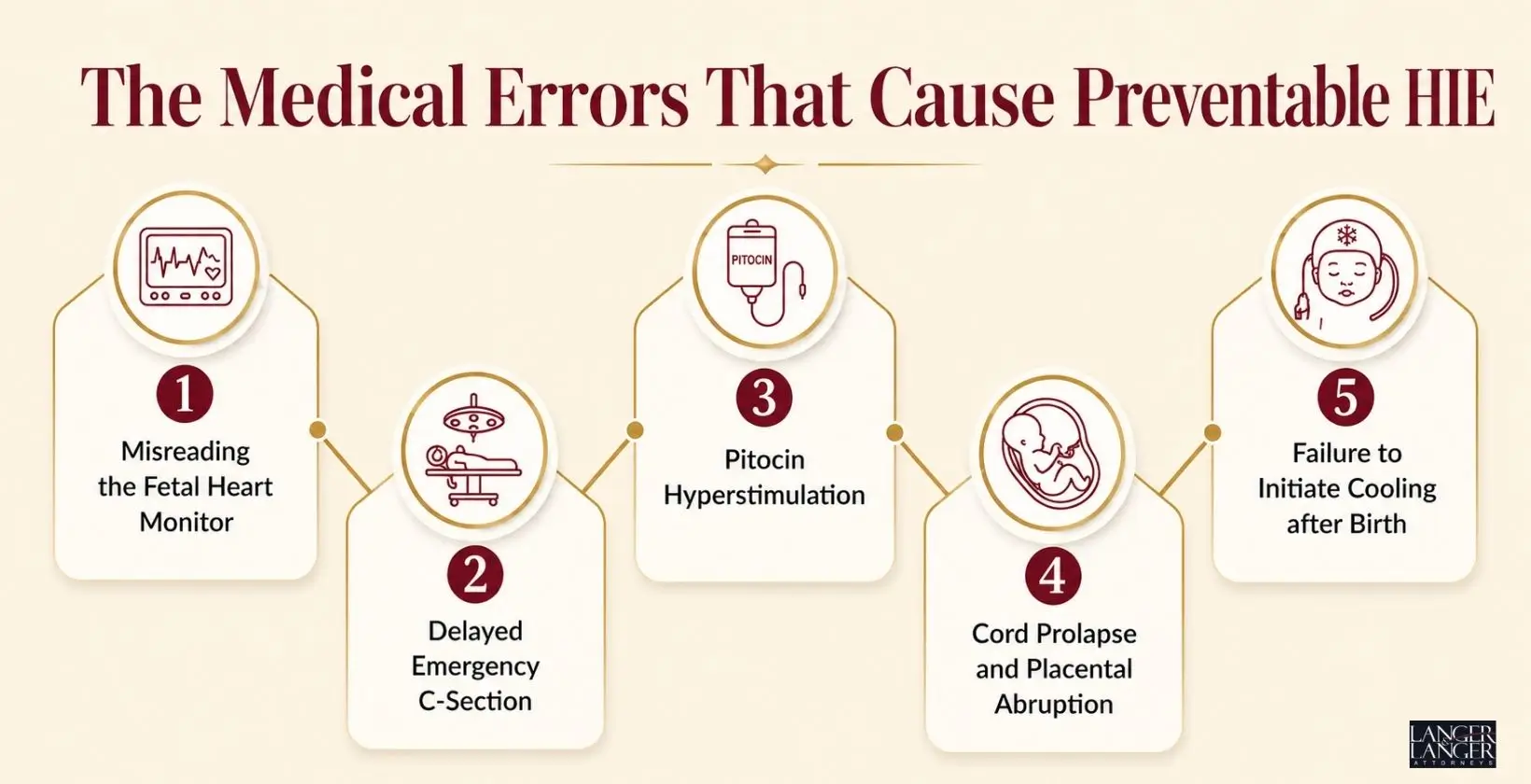
HIE can result from unavoidable obstetric complications despite appropriate care. It can also result from preventable negligence, most often in the form of misread fetal monitoring, delayed emergency C-section, Pitocin hyperstimulation, missed cord or placental emergencies, or failure to start cooling after birth.
Misreading the Fetal Heart Monitor
A common allegation is that the team failed to recognize worsening electronic fetal monitoring patterns as requiring escalation. The strip may show a worsening picture, but no one moved fast enough toward physician notification, bedside intervention, or delivery.
These cases usually turn on the response, not just the strip. If the record shows prolonged concerning tracings, little or no meaningful intervention, and continued deterioration, that gap can become core breach evidence.
Delayed Emergency C-Section
Some HIE cases come down to minutes. Cord prolapse, placental abruption with fetal compromise, uterine rupture, or an unresolved severe tracing can require immediate operative delivery. In those cases, the labor record, operating-room record, and birth record can become the most important evidence in the file.
The defense often argues the injury had already happened before the decision point, so a faster delivery would not have changed the outcome. Plaintiff experts usually answer that with the MRI pattern, cord gas data, and fetal-monitoring timeline to show the baby was still in a preventable injury window during labor.
Pitocin Hyperstimulation
Pitocin can help labor progress, but it can also create excessive contractions. When contractions come too close together, placental oxygen exchange can drop, and fetal stress can worsen.
These cases often focus on the medication administration record. That record may show whether the infusion was raised, reduced, paused, or left running while contractions and fetal status worsened. If the chart shows excessive contractions and no meaningful Pitocin adjustment, that may support a negligence theory.
Cord Prolapse and Placental Abruption
Cord prolapse is a true emergency because the cord drops ahead of the baby and can be compressed with each contraction. The expected response is immediate recognition, pressure relief when possible, and fast operative delivery. In many lawsuits, the key question is how much time passed between recognition and birth.
Placental abruption interrupts uteroplacental blood flow and may present with bleeding, abdominal pain, uterine rigidity, fetal heart-rate changes, or some combination of those signs. Some strong cases involve records showing the warning signs were documented but not escalated in time.
Failure to Initiate Cooling after Birth
This is a postpartum negligence theory that stands apart from what happened during labor. A hospital may argue the birth event itself was unavoidable, but a later failure to start cooling or arrange timely transfer can still support a separate claim if the baby met accepted eligibility criteria.
That distinction matters most at community hospitals without in-house neonatology or a Level III or IV NICU. AAP guidance requires passive cooling to begin immediately while a transport team is called, and active servo-regulated cooling during transfer where a cooling-capable team is available. The goal is that cooling starts within six hours of birth.
The legal question in a transfer-delay case is narrow: did the hospital recognize the baby met cooling criteria, initiate passive cooling while arranging transfer, and move quickly enough that the delay was reasonable? The records that answer that question are the resuscitation record, nursing notes from the first hours of life, the encephalopathy assessment, the transport call time, and the transport record. Gaps between those timestamps drive the case.
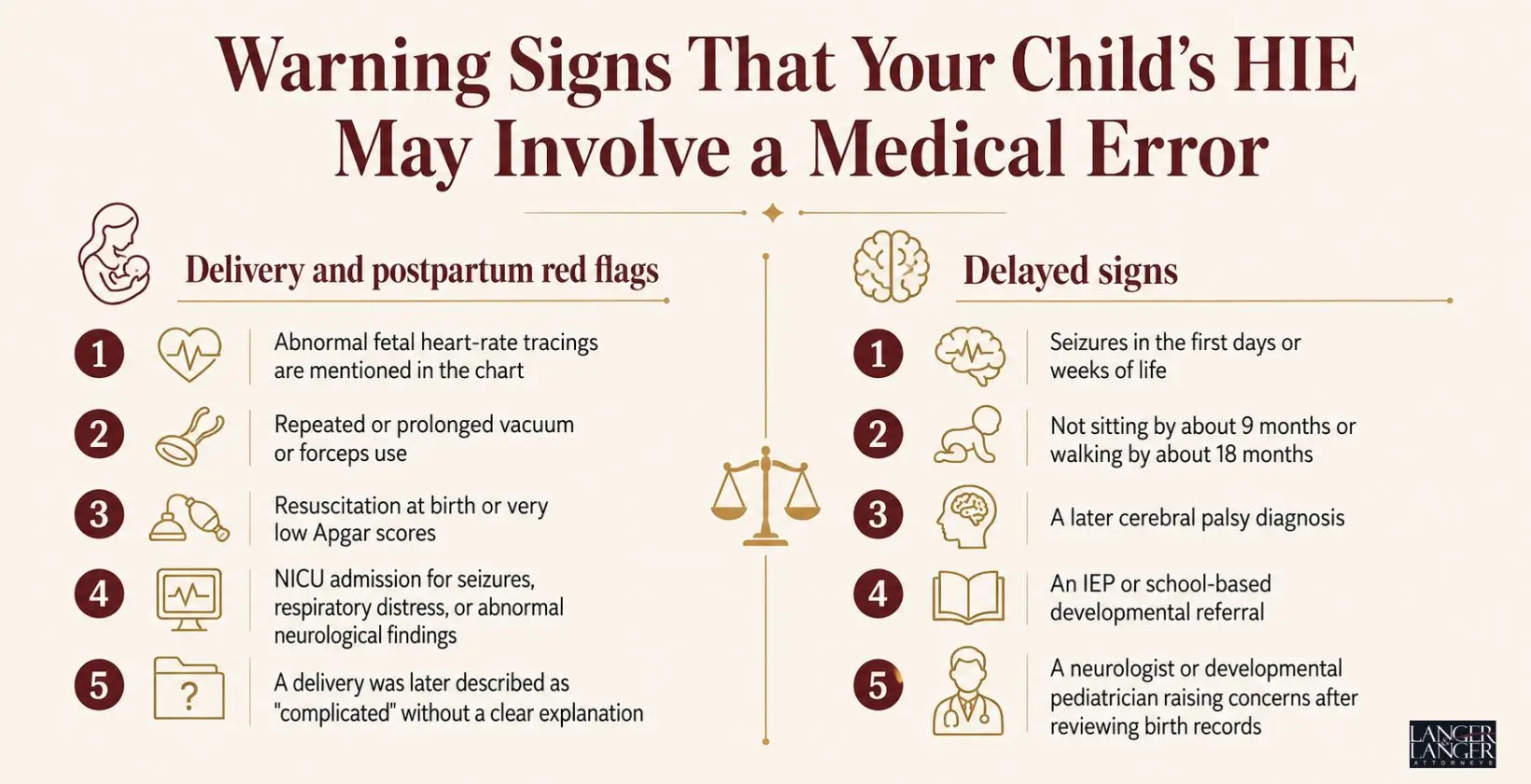
Warning Signs That Your Child’s HIE May Involve a Medical Error
These are not diagnostic criteria. They are recurring patterns seen in proven or settled birth injury cases.
Delivery and postpartum red flags
- Abnormal fetal heart-rate tracings are mentioned in the chart.
- Repeated or prolonged vacuum or forceps use.
- Resuscitation at birth or very low Apgar scores.
- NICU admission for seizures, respiratory distress, or abnormal neurological findings.
- A delivery was later described as “complicated” without a clear explanation.
Delayed signs
- Seizures in the first days or weeks of life.
- Not sitting by about 9 months or walking by about 18 months.
- A later cerebral palsy diagnosis.
- An IEP or school-based developmental referral.
- A neurologist or developmental pediatrician raising concerns after reviewing birth records.
Families dealing with a delayed diagnosis often ask whether Indiana law still allows a claim years later. That depends on the child’s age at the time of the event, the statutory deadline, and sometimes the discovery rule.
The Four Legal Elements an Indiana HIE Claim Must Establish
Every Indiana HIE claim has to prove the same four legal elements, but each one plays out through labor records, newborn records, and expert review.
- Duty: The provider owed a legal duty because the hospital, doctor, nurse, or other clinician was responsible for the mother’s or baby’s care. This is usually shown through the records and is rarely disputed.
- Breach: The family must prove that a specific act or omission fell below the applicable standard of care. Indiana malpractice cases almost always require qualified expert support on that issue.
- Causation: Causation is almost always the hardest element. The case must show the specific failure that caused or worsened the HIE injury. MRI pattern, cord blood gases, Apgar scores, and fetal-monitoring timelines drive this dispute, with defense and plaintiff experts routinely drawing opposite conclusions from the same records. Indiana law requires a qualified expert in the same or related field as the defendant, typically a board-certified OB for labor theories or a neonatologist for cooling-delay theories.
- Damages: The claim must prove the real harm caused by the injury, including future care, equipment, therapy, and other long-term losses. In severe cases, a life care plan becomes central.
A simple way to see complication versus negligence is to compare the same emergency handled two different ways. If cord prolapse is identified immediately, the team responds fast, and the C-section happens in 22 minutes, HIE may still be a tragic complication. If the prolapse or severe fetal distress is documented, no physician is called for 35 minutes, and the decision-to-incision interval reaches 58 minutes, that delay may support negligence.
Indiana’s Medical Malpractice Act: The Process No Other State Requires
Before a malpractice case against a qualified Indiana provider fully proceeds in court, the family usually files a proposed complaint with the Indiana Department of Insurance. That filing tolls the limitations period while the Medical Review Panel process runs and for 90 days after receipt of the panel opinion.
The Medical Review Panel generally includes three health care providers and one attorney chair. The panel reviews the records and written evidence, then issues a nonbinding opinion about whether the evidence supports a deviation from the standard of care and whether that deviation caused the alleged injury. Filing a proposed complaint does not automatically form a panel, and the Department does not select panel members.
That panel phase often takes 12 to 18 months before a case reaches ordinary court litigation. A negative panel opinion does not automatically end the case, but it does affect strategy.
Indiana’s Statute of Limitations for HIE Claims
Indiana generally gives malpractice claimants 2 years from the date of the alleged act, omission, or neglect. That is the basic rule, and it usually runs from the event itself rather than from the date a family first understands the full extent of the injury.
There are also special rules for children. In birth-injury matters, the rule that usually matters most is that a child under six generally has until the eighth birthday to file. Families should not wait, because record collection, expert review, and panel preparation take time.
When the Clock Starts Late: The Discovery Rule for Delayed HIE Diagnoses
Indiana case law recognizes a discovery-rule concept in some malpractice settings, including Martin v. Richey. That means some claims may not fully accrue until the plaintiff knew or reasonably should have known of the injury and its possible cause.
That does not make delayed-diagnosis cases easy. They are fact-specific and urgent. If a child’s cerebral palsy, learning disability, or developmental delay is being tied back to birth years later, the timing issue should be reviewed quickly and carefully.
Indiana’s $1.8 Million Cap and the Patient’s Compensation Fund
Indiana’s $1.8 million cap is the ceiling on total recovery in any qualified malpractice claim, regardless of the child’s actual lifetime costs. The provider or insurer pays the first $500,000. The Patient’s Compensation Fund covers the balance up to the cap.
Severe HIE cases routinely involve lifetime costs that exceed what Indiana law allows a family to recover. The cap limits the claim. It does not limit the child’s needs.
What a Successful HIE Claim Can Recover and How to Make It Last
Economic damages often include NICU bills, surgeries, therapy, medications, future medical care, equipment, home modifications, attendant care, and lost earning capacity. In severe cases, those figures are often supported by a formal life care plan.
Non-economic damages may include pain and suffering, disability-related loss of enjoyment of life, and other human losses recognized in the claim. The family’s daily burden may also shape how damages are presented.
A life care plan can be one of the most important documents in a severe HIE case because it projects the cost of wheelchairs, therapies, communication devices, home-accessibility changes, nursing support, educational support, and transportation needs over time.
A first-party d4A trust under 42 U.S.C. § 1396p(d)(4)(A) can help preserve Medicaid and SSI eligibility when a recovery is structured properly. In a severe birth injury case, that can be an important part of long-term planning because the child may need both private recovery funds and ongoing public benefits. That is why settlement planning often involves both trust counsel and financial coordination.
HIE Lawsuits: Verdicts and Settlements That Show the Range
Indiana qualified malpractice cases have a ceiling of $1.8 million total. A severe HIE case with projected lifetime care costs of $6 million or $10 million cannot recover beyond that figure through this legal framework.
How the cap is structured matters. The provider or their insurer pays the first $500,000. If the claim value exceeds that, the family must file a separate claim with the Indiana Patient’s Compensation Fund to recover the balance up to $1.8 million. That second claim does not happen automatically. Timing and documentation requirements apply to both layers, and families need to understand the two-step structure from the beginning.
Nationally reported HIE outcomes, including a $4.2 million settlement and a $33 million verdict, reflect what these cases have resolved for in uncapped states. Those figures are not available under Indiana law, but they reflect the severity of harm Indiana families are dealing with, often at costs the legal system cannot fully recover.
The more useful question is whether the records show a preventable failure, whether causation can be established, and what the child will actually need over a lifetime. The gap between recoverable damages and real lifetime cost requires planning alongside litigation, not instead of it.
How the HIE Lawsuit Process Works in Indiana, Step by Step
Most Indiana HIE cases move through the same basic stages, even though the timing and complexity can vary from one case to another.
- Record collection and screening: Prenatal, labor, delivery, NICU, imaging, and later developmental records are gathered and reviewed.
- Proposed complaint filing: The complaint is filed with the Indiana Department of Insurance, which tolls the limitations period.
- Medical Review Panel formation: The attorney chair and panel members are selected under the statutory process.
- Panel opinion: The panel issues a nonbinding opinion that affects litigation posture.
- Court litigation: If the case proceeds, the parties move into depositions, expert discovery, and motions.
- Damages development: Life care plans and expert reports help prove the full extent of harm.
- Resolution and PCF process: If the value exceeds the provider layer, a separate Patient’s Compensation Fund phase may follow.
The process takes time. The review-panel requirement alone often adds months, and a full HIE case can take years from intake to resolution.
Langer & Langer: Indiana Medical Malpractice Representation since 1980
Langer & Langer has handled Indiana medical malpractice cases since 1980, taking cases through the Medical Review Panel process across decades. That experience shapes how we screen cases, prepare proposed complaints, and respond when panel opinions go against the family.
When we review an HIE case, the records that matter most are often the hardest to read: fetal monitor strips from the hours before delivery, cord blood gas values, the resuscitation record, and nursing notes from the first NICU hours. Knowing what those records show, and what they should have shown, is where medical knowledge and courtroom experience meet.
Steven L. Langer is a former President of the Indiana Trial Lawyers Association and a Fellow of the American College of Trial Lawyers, recognized by Super Lawyers and Best Lawyers. Langer & Langer is located at 4 Indiana Ave, Valparaiso, IN 46383. Call 219-464-3246.