
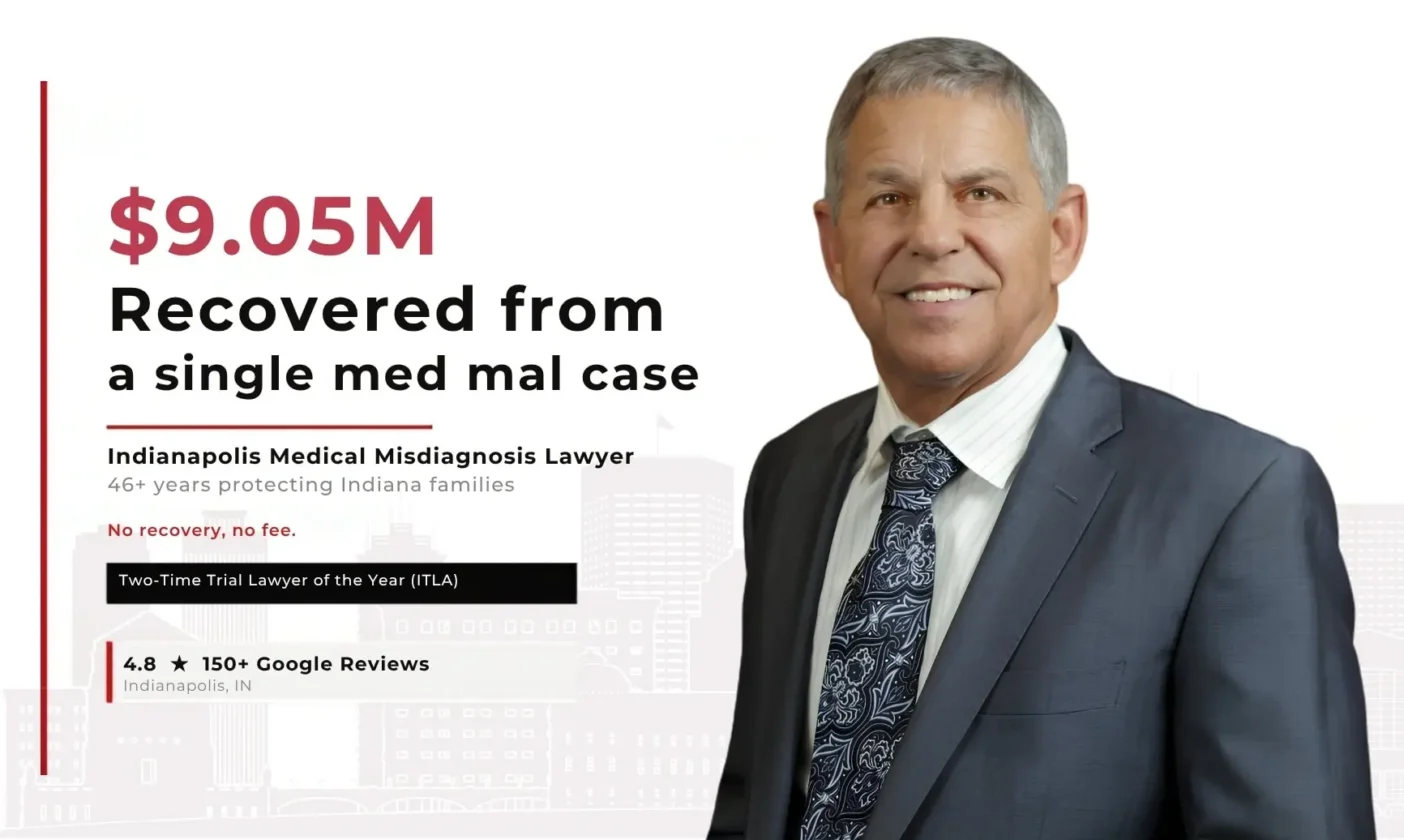
A wrong diagnosis can cost you everything. Indiana's two-year deadline means you can't afford to wait. Langer & Langer's Indianapolis medical misdiagnosis attorneys have 46+ years of experience, a $9.05 million recovery on record, and zero fees unless you win.
4 Indiana Ave Valparaiso, IN 46383
in**@*******aw.com
(219) 464-3246
A missed, delayed, or wrong diagnosis can change everything, and the harm it causes is often permanent. If a provider in Indianapolis failed to identify your condition, reached the wrong conclusion, or took too long to find the right answer, Langer & Langer can help.
Indiana’s Medical Malpractice Act gives you the right to hold them accountable, but Indiana’s two-year occurrence-based deadline starts on the date of the error, not the date you discovered it. The longer a claim sits without counsel, the harder causation becomes to establish. Our Indianapolis medical misdiagnosis lawyers build every case for trial from the first file review. Our results include a $9.05 million single medical malpractice recovery.
Call 219-464-3246 or request your free case review today.
Medical misdiagnosis under Indiana law is a diagnostic error by a licensed healthcare provider that falls below the accepted standard of care and causes documented harm. Not every incorrect diagnosis creates a viable claim. The distinction turns on what a reasonably careful provider in the same specialty would have done.
Three forms of diagnostic failure qualify:
Newman-Toker et al., BMJ Quality & Safety (January 2024), estimated 795,000 Americans sustain permanent disability or death each year from misdiagnosis-related harm. The governing question in every Indiana misdiagnosis case is whether a reasonably careful provider in the same specialty would have been right, and whether being right sooner would have changed the outcome.
Indiana courts require four elements in every misdiagnosis claim: a provider-patient relationship, a breach of the accepted standard of care, a direct causal link between the breach and measurable harm, and documented proof of that harm. The absence of any one element ends the claim.
| Element | What It Requires | Evidence That Supports It |
|---|---|---|
| Duty | A provider–patient relationship existed at the time of the error | Admission records, ER intake paperwork, clinic and registration documents |
| Breach | Diagnosis fell below what a reasonably careful provider in the same specialty would have done | Qualified medical expert testimony |
| Causation | Error directly caused measurable harm or reduced the probability of a better outcome | Medical timeline, staging records, expert opinion on disease progression |
| Documented Harm | Concrete, provable physical or financial injury | Medical bills, wage records, treatment history |
Insurers challenge causation when correct-condition treatment began weeks after the original appointment. A clinical note documenting when the patient first reported relevant symptoms significantly strengthens that causal link; without it, the insurer argues the injury predates the error. They dispute the breach when the record shows only the wrong conclusion without independent expert testimony on what a competent provider would have done differently.
Causation is where most Indiana misdiagnosis claims are won or lost, which is why the evidentiary record built during the investigation determines the outcome long before trial.
A lung cancer patient whose survival probability dropped from 70% to 30% because of a diagnostic delay has suffered a calculable loss. Recovery is proportional to the reduction in probability, applied to the provable value of the lost chance, not the full statutory cap. The Indiana Supreme Court established this proportional damages calculation method in Cahoon v. Cummings, 734 N.E.2d 535 (Ind. 2000).
The dollar amount requires expert testimony on disease progression and counterfactual outcomes, and Indiana’s $1,800,000 statutory cap applies to the total damages ultimately established. The proportional calculation is a framework, not a formula.
The conditions most often misdiagnosed in serious harm cases include stroke, sepsis, pneumonia, venous thromboembolism, and lung cancer. Together, they account for nearly 40% of serious misdiagnosis-related harm nationally, per Newman-Toker et al., BMJ Quality & Safety (January 2024).
If a condition like this was missed or delayed in your care, contact us for a free case review to understand whether you have a viable claim.
Understanding why diagnostic errors occur matters because the cause often determines who bears liability and what evidence establishes the breach.
The most common contributing factors in Indianapolis-area misdiagnosis cases include:

Liability for a wrong diagnosis in Indiana can attach to the treating physician, the hospital, radiologists, pathologists, clinical labs, and medical device manufacturers, depending on where in the diagnostic chain the error occurred. Most cases involve distributed liability across multiple parties, and some extend to hospital malpractice independent of any individual provider’s conduct.
Treating physicians and specialists carry individual liability when their conduct falls below the standard of care in their specialty. Oncologists, cardiologists, neurologists, and emergency physicians are each held to the standard of a reasonably careful provider in their own field.
Liability attaches to the hospital entity when the negligent provider is a hospital employee. Most emergency physicians, radiologists, and hospitalists work directly for the hospital.
Indiana courts have held in many cases that patients have no reasonable way to distinguish employed from contracted providers, and the hospital cannot avoid liability simply by pointing to contractor status.
Inadequate credentialing, deficient protocols for communication errors, or staffing decisions that contributed to the failure each create liability separate from any individual physician’s conduct.
A radiologist who misreads imaging or fails to communicate critical findings carries liability regardless of direct patient contact. Pathologists who misread biopsy samples and labs that produce wrong results through faulty equipment or improper handling carry liability for the incorrect diagnoses that follow.
Defective diagnostic equipment that produces an incorrect output creates product liability independent of the provider’s conduct.
A strong misdiagnosis case requires building the evidentiary record before opposing counsel does. Langer & Langer prepares every file for trial from the initial review, a posture that is visible to opposing counsel and shapes settlement positioning before a trial date is set.
The investigation covers four areas:
Indiana’s Medical Review Panel is a mandatory pre-litigation step under IC 34-18 for claims against qualified healthcare providers, which covers the vast majority of misdiagnosis cases filed in Indiana. The panel issues a written opinion on whether the provider’s conduct fell below the accepted standard of care. That opinion is admissible at trial but not binding on the court.
The panel’s composition is governed by IC 34-18-10-8: three healthcare providers, two of whom must be members of the same profession as the defendant, with one non-voting attorney chair under IC 34-18-10-3.
The process typically runs eight months to over a year. Filing the proposed complaint with the Indiana Department of Insurance, not a court, initiates it. Under IC 34-18-7-3, the statute of limitations tolls from that filing through 90 days after the claimant receives the panel’s written opinion.
A favorable panel opinion shifts the insurer’s negotiating posture considerably. Most cases move into settlement discussions at this stage, and many resolve without a trial date. Where the insurer declines to offer fair value, the panel opinion and the underlying expert submissions form the foundation of the trial presentation. Mediation, a structured negotiation with a neutral third party, is also available as an alternative to trial and is sometimes used when both sides want to avoid the cost and uncertainty of a jury verdict. An unfavorable panel opinion is not final; it affects leverage but does not end a viable claim.
An Indiana misdiagnosis claim must be filed within two years of the date the diagnostic error occurred under IC 34-18-7-1, not the date the patient discovered it. Indiana follows the occurrence rule, not the discovery rule.
The two-year clock starts on the date of the error. A patient misdiagnosed in January 2024 who does not discover the error until January 2026 may already be time-barred. The discovery rule applies only where no reasonable person could have discovered the malpractice within two years, and Indiana courts interpret that exception strictly.
One exception applies to minors; a child under six at the time of malpractice has until that minor’s eighth birthday to file. Minors six and older are subject to the standard two-year deadline.
Because the Medical Review Panel process must precede any court filing, the effective window to retain counsel is shorter than two years from the date of the error.
If you are unsure when the error occurred or whether your window is still open, speaking with an attorney now is the safest step. Call 219-464-3246.
If you suspect a misdiagnosis in Indianapolis, request your complete medical records immediately, get a documented second opinion, and contact a misdiagnosis attorney before Indiana’s two-year deadline under IC 34-18-7-1 closes. Each step below depends on the one before it.
Recoverable compensation in an Indiana misdiagnosis case includes additional medical costs, future treatment, lost income, pain and suffering, and loss of quality of life, subject to a total statutory cap of $1,800,000 under IC 34-18-14-3. This cap reflects changes in Indiana’s malpractice laws and applies to malpractice occurring after June 30, 2019.
Economic Damages
Non-Economic Damages
Under IC 34-18-14-3, the provider’s insurer covers the first $500,000. The Indiana Patient’s Compensation Fund covers up to $1,300,000 of any amount exceeding that threshold. A patient whose documented damages total $2.5 million receives $1,800,000; the cap applies regardless.
Past results do not guarantee any future outcome. Every case is different.
We serve individuals and families across the entire state of Indiana. Our main office is located at 4 Indiana Ave, Valparaiso, IN 46383, and we handle medical malpractice claims arising from care provided in hospitals, clinics, and outpatient settings across the state.
We represent clients in communities including:


To sue a doctor or hospital for misdiagnosis in Indiana, four elements must be proven: a provider-patient relationship, a breach of the standard of care, a direct causal link between the error and the harm, and documented injury.
To file a misdiagnosis lawsuit in Indiana, you have two years from the date the error occurred, not the date of discovery, under IC 34-18-7-1. The Medical Review Panel must precede court filing, so the effective window is shorter.
You can recover up to $1,800,000 in an Indiana misdiagnosis case under IC 34-18-14-3. The provider's insurer covers the first $500,000. The Indiana Patient's Compensation Fund covers up to $1,300,000 of any amount exceeding that threshold.
Yes, in the vast majority of cases. Claims against qualified healthcare providers under IC 34-18 must go through the Medical Review Panel before any lawsuit can be filed in state court. A proposed complaint is filed with the Indiana Department of Insurance first. The panel issues a written opinion on whether the standard of care was breached.
When a lab or imaging error causes a wrong diagnosis, the lab, imaging facility, or medical device manufacturer is liable independently of the treating physician. If the physician relied on the faulty result without independent clinical judgment, shared liability attaches.
Electronic health records get amended. Staffing logs are not kept indefinitely. The evidence that builds causation weakens the longer a claim sits without counsel.
Langer & Langer requests your complete medical record after the consultation, engages an independent medical expert, and gives you a direct assessment of claim viability before any commitment is required. Our team is available 24/7.
Your consultation is free, and no commitment is required until you decide to move forward. Call 219-464-3246 · Statewide representation across Indiana · Free case review.
Visit us at 4 Indiana Ave, Valparaiso, IN 46383.
Medical errors are complex. We cut through the confusion – just share your records and our team will give you an honest case evaluation, free of charge.

© 1980-2026 Langer & Langer • All Rights Reserved
Copyright © 1980-2026 All Rights Reserved.
Past results do not guarantee any future outcome, and every case is different.
We improve our products and advertising by using Microsoft Clarity to see how you use our website. By using our site, you agree that we and Microsoft can collect and use this data.
Have legal questions or need expert advice? Our experienced team is here to help.
Langer & Langer
Accessibility Statement
Compliance status
We firmly believe that the internet should be available and accessible to anyone, and are committed to providing a website that is accessible to the widest possible audience, regardless of circumstance and ability.
To fulfill this, we aim to adhere as strictly as possible to the World Wide Web Consortium’s (W3C) Web Content Accessibility Guidelines 2.1 (WCAG 2.1) at the AA level. These guidelines explain how to make web content accessible to people with a wide array of disabilities. Complying with those guidelines helps us ensure that the website is accessible to all people: blind people, people with motor impairments, visual impairment, cognitive disabilities, and more.
This website utilizes various technologies that are meant to make it as accessible as possible at all times. We utilize an accessibility interface that allows persons with specific disabilities to adjust the website’s UI (user interface) and design it to their personal needs.
Additionally, the website utilizes an AI-based application that runs in the background and optimizes its accessibility level constantly. This application remediates the website’s HTML, adapts Its functionality and behavior for screen-readers used by the blind users, and for keyboard functions used by individuals with motor impairments.
If you’ve found a malfunction or have ideas for improvement, we’ll be happy to hear from you. You can reach out to the website’s operators by using the following email
Screen-reader and keyboard navigation
Our website implements the ARIA attributes (Accessible Rich Internet Applications) technique, alongside various different behavioral changes, to ensure blind users visiting with screen-readers are able to read, comprehend, and enjoy the website’s functions. As soon as a user with a screen-reader enters your site, they immediately receive a prompt to enter the Screen-Reader Profile so they can browse and operate your site effectively. Here’s how our website covers some of the most important screen-reader requirements, alongside console screenshots of code examples:
Screen-reader optimization: we run a background process that learns the website’s components from top to bottom, to ensure ongoing compliance even when updating the website. In this process, we provide screen-readers with meaningful data using the ARIA set of attributes. For example, we provide accurate form labels; descriptions for actionable icons (social media icons, search icons, cart icons, etc.); validation guidance for form inputs; element roles such as buttons, menus, modal dialogues (popups), and others. Additionally, the background process scans all the website’s images and provides an accurate and meaningful image-object-recognition-based description as an ALT (alternate text) tag for images that are not described. It will also extract texts that are embedded within the image, using an OCR (optical character recognition) technology. To turn on screen-reader adjustments at any time, users need only to press the Alt+1 keyboard combination. Screen-reader users also get automatic announcements to turn the Screen-reader mode on as soon as they enter the website.
These adjustments are compatible with all popular screen readers, including JAWS and NVDA.
Keyboard navigation optimization: The background process also adjusts the website’s HTML, and adds various behaviors using JavaScript code to make the website operable by the keyboard. This includes the ability to navigate the website using the Tab and Shift+Tab keys, operate dropdowns with the arrow keys, close them with Esc, trigger buttons and links using the Enter key, navigate between radio and checkbox elements using the arrow keys, and fill them in with the Spacebar or Enter key.Additionally, keyboard users will find quick-navigation and content-skip menus, available at any time by clicking Alt+1, or as the first elements of the site while navigating with the keyboard. The background process also handles triggered popups by moving the keyboard focus towards them as soon as they appear, and not allow the focus drift outside it.
Users can also use shortcuts such as “M” (menus), “H” (headings), “F” (forms), “B” (buttons), and “G” (graphics) to jump to specific elements.
Disability profiles supported in our website
Additional UI, design, and readability adjustments
Browser and assistive technology compatibility
We aim to support the widest array of browsers and assistive technologies as possible, so our users can choose the best fitting tools for them, with as few limitations as possible. Therefore, we have worked very hard to be able to support all major systems that comprise over 95% of the user market share including Google Chrome, Mozilla Firefox, Apple Safari, Opera and Microsoft Edge, JAWS and NVDA (screen readers).
Notes, comments, and feedback
Despite our very best efforts to allow anybody to adjust the website to their needs. There may still be pages or sections that are not fully accessible, are in the process of becoming accessible, or are lacking an adequate technological solution to make them accessible. Still, we are continually improving our accessibility, adding, updating and improving its options and features, and developing and adopting new technologies. All this is meant to reach the optimal level of accessibility, following technological advancements. For any assistance, please reach out to