

No, you cannot refuse to pay medical bills after medical malpractice simply because malpractice occurred. Under Indiana law, hospitals and healthcare providers are still allowed to bill for treatment unless and until negligence is legally established through a settlement or court ruling.
However, that does not mean you will ultimately be stuck with those costs. Medical bills caused by malpractice may later be recovered, reduced, or shifted through a successful malpractice claim, depending on how liability is proven and how the case is resolved.
While bills may continue, working with a medical malpractice attorney early can help place billing holds, prevent collections, and manage payments while your claim is pending.
Why Do I Still Have to Pay Medical Bills After Malpractice?
Medical bills continue after medical malpractice because hospitals are permitted to bill for care that was provided, even when that care later becomes the subject of a malpractice claim, leaving patients financially responsible for medical treatment unless and until liability is established.
Here’s why those bills keep coming:
- Billing isn’t based on fault: Hospitals charge for treatment performed, not the outcome.
- Liability must be legally established: Malpractice only has legal consequences after it is supported by medical evidence and formally proven.
- Billing and legal reviews are separate: Billing departments do not wait for court decisions to issue invoices.
Example: If a doctor in Valparaiso misdiagnoses a condition and that delay leads to complications requiring emergency care, the hospital can bill for both visits even though the treatment later becomes the subject of a malpractice claim.
What Happens to My Medical Expenses if I File a Malpractice Claim in Valparaiso?
Filing a malpractice claim does not stop medical billing while the case is pending. Even though a lawsuit may later result in compensation, medical expenses are usually still owed until the claim is resolved through a settlement or court judgment.
What happens during the case:
- Billing continues: Hospitals and doctors may keep issuing bills unless a formal hold is arranged.
- Hospital liens may apply: Under Indiana’s Hospital Lien Statute, providers can secure payment by placing a lien on any future settlement or verdict, which often pauses collection efforts.
What happens if you win or settle:
- Reimbursement for medical bills and out-of-pocket medical costs you already paid.
- Payment of outstanding medical debt from the settlement.
- Coverage for future medical care tied to the malpractice injury.
After a recovery, your medical malpractice lawyer typically handles the distribution of funds, paying providers and insurers, and negotiating lien reductions when possible so you keep as much of the recovery as the law allows.
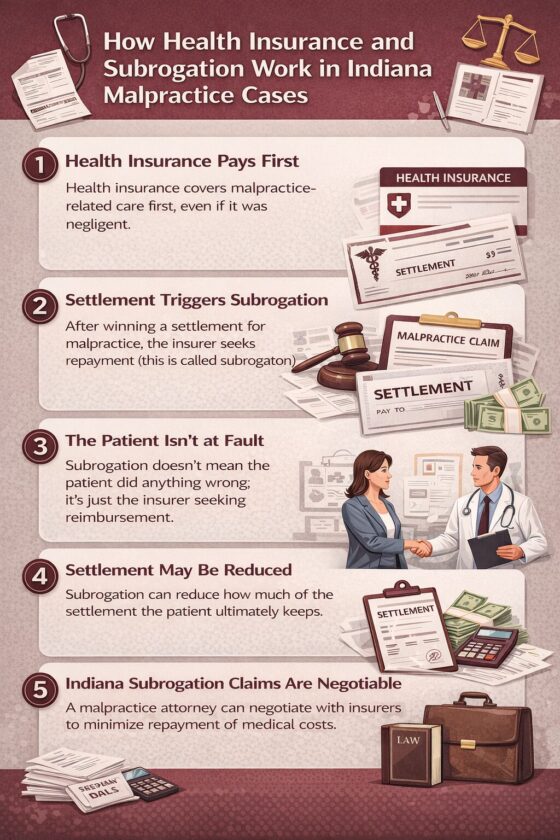
How Health Insurance and Subrogation Work in Indiana Medical Malpractice Cases
In many medical malpractice situations, health insurance is the first source of payment for treatment related to the injury. Even when care was negligent, insurers usually process claims the same way they would for any other medical service, covering costs according to the policy terms.
When a malpractice claim later results in a settlement or verdict, the insurance company may seek repayment for what it paid. This process is called subrogation. Subrogation allows the insurer to recover its expenses from the compensation awarded in the malpractice case rather than leaving the financial burden entirely on the insurer.
Subrogation does not mean the patient did anything wrong. It is a reimbursement mechanism built into most insurance policies. However, it can affect how much of a settlement the injured patient ultimately keeps, because insurance repayment is typically handled before funds are distributed to the patient.
In Indiana medical malpractice cases, subrogation claims are often negotiable. An experienced Indiana malpractice attorney can review the insurance policy terms, challenge improper repayment demands, and work to reduce the amount owed so the patient retains as much of the recovery as possible.
Medical Malpractice Laws and Patient Rights in Indiana
Indiana medical malpractice claims are governed by specific statutes that control how cases are filed, reviewed, and resolved. These rules affect whether a claim can move forward and how much compensation may be available, regardless of how serious the injury may be.
Key Indiana laws patients should be aware of include:
- Indiana Medical Malpractice Act: This law governs malpractice claims against qualified healthcare providers and sets procedural requirements that must be satisfied before a lawsuit can proceed.
- Medical Review Panel requirement: Many Indiana medical malpractice claims must first be reviewed by a state-appointed medical review panel before they can proceed in court. The panel typically includes healthcare providers practicing in the same or similar field as the defendant, along with a non-voting attorney who oversees the process. The panel evaluates whether the provider failed to meet the applicable standard of care.
- Caps on damages: Indiana limits the total amount of compensation available in medical malpractice cases. For malpractice occurring after June 30, 2019, the maximum recovery is $1.8 million. A qualified healthcare provider may be responsible for up to $500,000, with any additional compensation paid through the Indiana Patient’s Compensation Fund.
- Statute of limitations: Most medical malpractice claims must be filed within two years of the negligent act. In limited circumstances, the discovery rule may apply if the injury could not reasonably have been identified right away.
Understanding these rules is important when deciding how to handle medical bills, pursue a claim, or evaluate settlement options under Indiana law.
Can You Delay or Dispute Hospital Charges While a Malpractice Case Is Pending?
In limited situations, you may be able to delay or manage hospital charges during a pending malpractice case, even though providers generally continue billing under Indiana law.
Options to Manage Medical Bills While Your Case Is Pending
- Request a billing hold: Some providers may temporarily pause billing or collection activity after being notified that a malpractice claim is pending.
- Set up a payment plan: Making smaller, scheduled payments can help prevent accounts from being sent to collections while your case is unresolved.
- Attorney involvement: Your malpractice attorney can contact the provider to request a hold, arrange a letter of protection, or negotiate a lien so the bill is paid from a future settlement rather than out of pocket.
- Use health insurance: Even when treatment is related to malpractice, processing charges through insurance can reduce immediate costs and delay direct payment demands.
Why Ignoring Medical Bills Is Risky
Failing to address medical bills without a legal strategy can lead to serious consequences. Unpaid accounts may be sent to collections, reported to credit bureaus, or pursued through legal action by the provider, even while a malpractice claim is ongoing.
Billing Disputes vs. Medical Malpractice Claims
A billing dispute involves administrative issues, such as duplicate charges, incorrect coding, or services you never received. A medical malpractice claim, by contrast, is a legal action focused on whether negligent medical care caused harm. These are separate issues and are handled through different processes.
Example: Disputing a charge for a test you never received is a billing issue. Filing a claim because a test was misread and led to a delayed diagnosis is a malpractice claim.
Do not stop paying or responding to medical bills without legal guidance. Keep detailed records of all medical expenses and allow your attorney to communicate with providers so those costs can be properly addressed as part of your malpractice claim.
When You Might Be Able to Avoid Paying Hospital Bills
In certain situations, you may not have to pay hospital bills out of pocket if those costs are later shifted to a malpractice settlement, verdict, or negotiated lien after liability is established.

If Malpractice Is Proven in Court or Settled
If your case is successful, either through a verdict or a settlement, your compensation will typically include:
- Reimbursement for medical expenses you have already paid out of pocket.
- Payment of outstanding medical bills directly from the settlement or judgment.
- Coverage for future medical care that is medically necessary and directly linked to the malpractice injury.
These amounts are treated as part of your total financial recovery in a malpractice claim.
If Providers Agree to Wait for Settlement
Hospitals or clinics may delay collection efforts when:
- They are formally notified that a malpractice claim is pending.
- Your attorney negotiates a letter of protection or a formal lien.
In these situations, the provider agrees to be paid from any future settlement or court award rather than pursuing you personally during the legal process.
If Charges Were for Corrective or Unnecessary Care
In limited cases, charges may be waived or removed when:
- The treatment was required solely to correct the original provider’s mistake.
- The care was clearly unnecessary or caused additional harm.
This outcome usually requires strong medical evidence and direct intervention by your attorney.
If Your Attorney or Insurance Negotiates Bill Reductions
After a settlement or verdict, your lawyer may:
- Negotiate with hospitals or providers to reduce the amount they collect.
- Work with your health insurer to resolve subrogation claims.
- Help you retain more of your final compensation by reducing repayment obligations.
What to Do if You Suspect Medical Malpractice in Valparaiso
If you believe a medical provider made a mistake that caused harm, what you do next matters. Medical malpractice is not always obvious, and providers may label serious errors as complications or unavoidable outcomes. Acting early helps protect your health, preserve evidence, and prevent billing or legal issues from getting worse.
Immediate Steps to Protect Your Rights
- Secure your medical records: Request copies of all medical records related to your care as soon as possible. Early access helps preserve documentation and prevents delays or missing information later.
- Document what happened: Write down provider names, dates of treatment, symptoms, medications, test results, and how your condition changed. Keep copies of relevant records and bills.
- Be cautious with paperwork: Do not sign releases, waivers, or settlement documents from hospitals or insurers without legal review. Some forms can limit your right to pursue a malpractice claim.
- Consult a medical malpractice attorney: A Valparaiso malpractice attorney can review your records, evaluate whether negligence may be present, and advise you on appropriate next steps.
What If the Hospital Says It Wasn’t Malpractice?
Hospitals and providers often deny fault, even after serious or unexpected outcomes. A provider’s explanation is not a legal determination. Whether malpractice occurred can only be established through independent medical review and legal analysis, not the hospital’s internal assessment.
Terms like “known risk” or “complication” do not automatically rule out malpractice. If evidence shows improper procedures, delayed treatment, or preventable errors, a valid claim may still exist.
A hospital’s denial does not close the issue. Legal and medical review are necessary to determine whether the standard of care was breached.
How Langer & Langer Helps Valparaiso Malpractice Victims
Based in Valparaiso and serving patients throughout Northwest Indiana, Langer & Langer attorneys represent individuals harmed by medical negligence. Medical malpractice claims require medical analysis, strict compliance with Indiana procedure, and active management of billing issues and insurer pressure.
We handle the legal and procedural demands of Indiana medical malpractice law so you are not left dealing with hospitals, insurers, review panels, or deadlines while trying to recover from unexpected harm caused by medical care.
Here’s how we support victims of medical error:
- Case investigation: We obtain and analyze medical records and work with qualified medical experts to determine whether the standard of care was violated.
- Medical review panel compliance: Indiana law requires most malpractice claims to go through a medical review panel before court. We handle all filings, deadlines, and strategy.
- Claim preparation and litigation: We prepare cases thoroughly from the outset, whether resolution occurs through negotiation or trial.
- Medical billing and lien resolution: We address hospital liens, insurance subrogation, and malpractice-related billing as part of the overall claim.
- Damage recovery: We pursue compensation for medical expenses, lost income, and other legally recoverable losses tied to negligent care.
Common Questions About Paying for Malpractice-Related Care
Does Medical Malpractice Erase Medical Debt in Indiana?
No. Medical malpractice does not automatically eliminate medical debt. However, a successful claim can provide the funds needed to pay outstanding bills or reimburse expenses tied to negligent care.
What If I’m Uninsured? Who Pays for Corrective Care After Medical Malpractice?
If you are uninsured, you are typically responsible for corrective care at first. A malpractice claim may later shift those costs to the negligent provider if liability is established.
How Long Does It Take to Get Reimbursed Through a Medical Malpractice Lawsuit in Indiana?
Medical malpractice cases in Indiana often take one to several years to resolve. The timeline depends on factors such as the medical review panel process, the complexity of the case, expert involvement, and whether the claim settles or proceeds to litigation. Reimbursement typically occurs only after liability is established through settlement or court judgment.
How Much Does It Cost to Hire a Medical Malpractice Lawyer in Indiana?
It costs nothing up front to hire a medical malpractice lawyer in Indiana. We work on a contingency fee, meaning you only pay if we successfully recover malpractice compensation for your specific injuries and related treatment costs.
Final Thoughts: Don’t Take on Medical Bills That Weren’t Your Fault
Medical malpractice claims often involve ongoing billing, but those bills are not always your responsibility in the end.
If you are unsure whether malpractice occurred or how medical bills should be handled, getting informed guidance early can help you avoid unnecessary financial consequences and protect your legal options.
If you have questions about your situation, speaking with Langer & Langer can help you understand what steps make sense next.