
If you or someone you love was harmed after surgery, you may be trying to understand whether what happened was a known risk of the procedure or a mistake that should not have happened. That distinction is not always easy to see without reviewing the records.
Common preventable surgical errors that lead to medical malpractice claims in Indiana include wrong-site surgery, operating on the wrong patient, retained surgical instruments inside the body, anesthesia errors, nerve damage, organ perforation, internal bleeding, surgical infections caused by negligence, and failures in post-operative monitoring or follow-up care. These mistakes can happen before, during, or after surgery and cause serious harm, including infection, permanent injury, or the need for additional treatment.
A case may support a claim when the harm resulted from a preventable mistake that fell below Indiana’s accepted standard of care, not from a recognized surgical risk.
If you are trying to determine which applies to your situation, the surgical error lawyers at Langer and Langer can review your records and give you a clear, honest answer.
- Not every bad surgical outcome is malpractice. Some surgical errors support a claim because they were preventable.
- Common surgical errors can happen before, during, or after surgery.
- Wrong-site surgery, retained surgical instruments, anesthesia errors, and post-operative failures are among the most serious malpractice concerns.
- In Indiana, most claims begin with a proposed complaint through the ,b>Indiana Department of Insurance, and a Medical Review Panel may then be requested.
- A valid claim depends on the records, the timeline of care, and whether the harm came from a preventable error rather than a known complication.
What Is a Surgical Error and When Is It Malpractice?
A surgical error is a preventable mistake that happens before, during, or after an operation and causes patient harm. It can involve the wrong procedure, a breakdown in verification, poor monitoring, a retained object, or another failure that should not have happened with proper care. A bad result alone does not make it malpractice.
A case becomes medical malpractice when the harm was caused by negligent care rather than a known risk of surgery. Under the Indiana Medical Malpractice Act, the standard applied is whether a reasonably careful provider in the same situation would have acted differently. Surgery always carries recognized complications even when providers act appropriately. The legal question is whether the injury came from an unavoidable surgical risk or from a preventable mistake that fell below that standard.
What Separates a Surgical Complication from a Surgical Error
The distinction comes down to cause, not outcome. The outcome may look the same. The legal analysis focuses on why it happened.
| Basis | Surgical Complication | Surgical Error |
|---|---|---|
| What it is | An adverse result that falls within the known, disclosed risks of a procedure. | A preventable failure that falls below the accepted standard of care. |
| Did it require negligence? | No. It can occur even when care is appropriate. | Yes. It results from a mistake that should not have happened. |
| Examples | Post-operative infection after abdominal surgery when that risk was properly disclosed. | Post-operative infection caused by failure to sterilize instruments or follow infection-control protocols. |
| What determines it | The disclosed risk materialized. | The operative report, anesthesia records, and post-operative notes show a preventable failure. |
Symptoms alone rarely tell you which category applies. The records do.
Types of Surgical Errors That Can Lead to Malpractice Claims
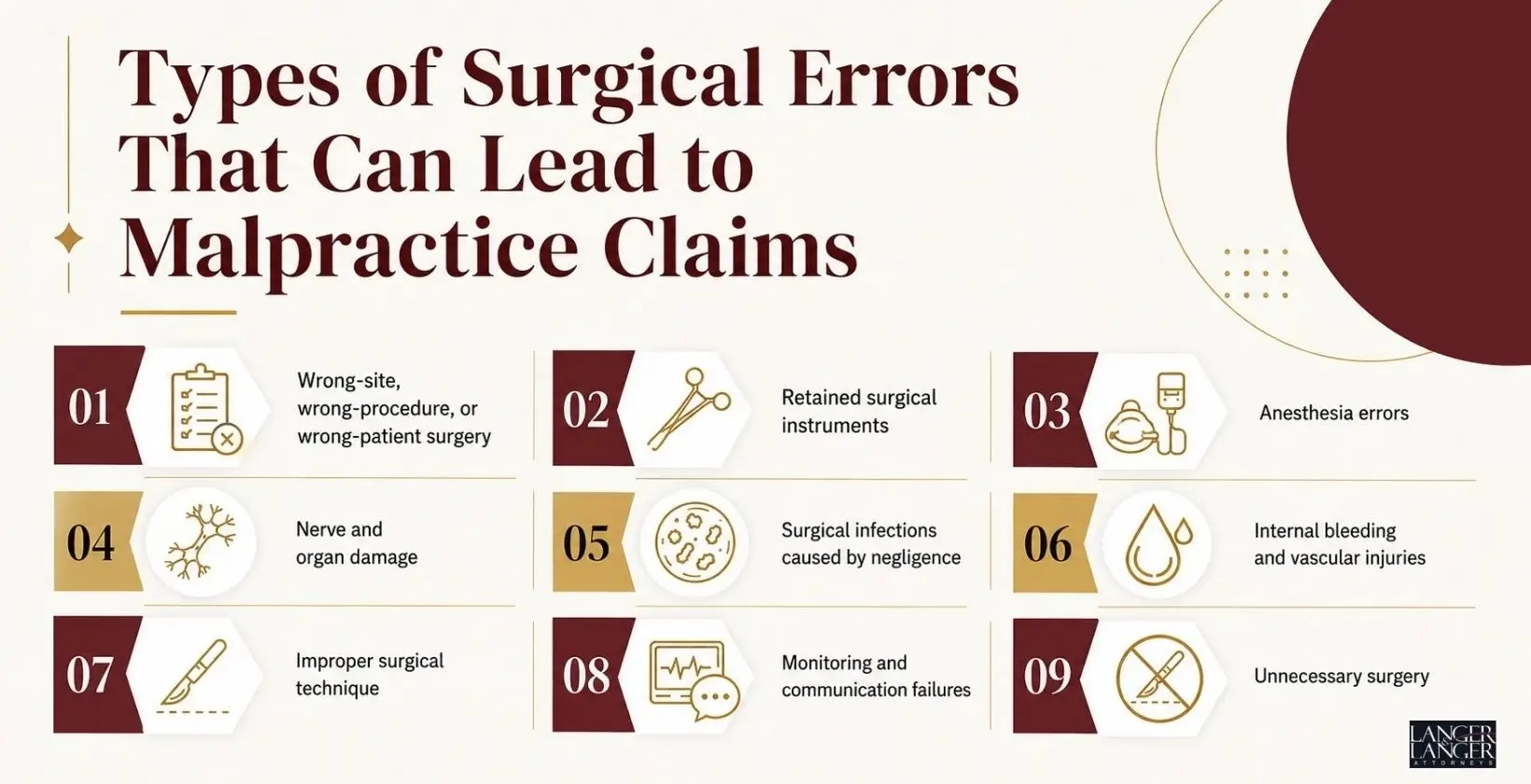
The surgical errors most frequently linked to malpractice have one thing in common: they were preventable. The categories below reflect the error types identified in patient safety classifications by the National Quality Forum and the Agency for Healthcare Research and Quality.
Wrong-Site, Wrong-Procedure, or Wrong-Patient Surgery
Wrong-site surgery is classified as a never event by the National Quality Forum (NQF), meaning it should not happen when proper safety protocols are followed. Operating on the wrong body part, performing the wrong procedure, or operating on the wrong patient points to negligence rather than an accepted surgical risk. Patient safety research consistently identifies communication breakdown as the most cited root cause of these errors.
Before any surgery, the surgical team is required to complete a pre-procedure timeout confirming the patient’s identity, operative site, and planned procedure. The Centers for Medicare and Medicaid Services (CMS) does not reimburse hospitals for costs associated with never events, including wrong-site surgery. When that verification step is skipped, and a wrong-site, wrong-patient, or wrong-procedure error occurs, the failure can strongly support a negligence claim.
Retained Surgical Instruments
Retained surgical instruments include sponges, clamps, needles, and other items left inside a patient’s body after surgery is complete. Like wrong-site surgery, these events are classified as never events by the NQF.
A retained object may not be discovered right away. Symptoms can appear days, weeks, or even months later as pain, infection, obstruction, or internal bleeding. When they do, tracing the cause requires a close review of the operative record.
The failures that most commonly lead to these errors include inaccurate instrument counts during surgery, rushed wound closure before counts are verified, and incomplete documentation of what entered and left the operating field.
Anesthesia Errors
Anesthesia errors involve preventable mistakes in dosing, monitoring, airway management, or administration. Too much anesthesia can cause oxygen deprivation or brain injury. Too little can result in anesthesia awareness, where a patient regains consciousness during surgery but cannot move or communicate.
Other failures include administering the wrong drug, missing a documented drug interaction, incorrect intubation, failure to monitor vital signs, premature extubation, and inadequate monitoring in the post-anesthesia care unit (PACU). Because anesthesia is a separate area of care with its own licensed providers, claims for anesthesia errors can extend beyond the operating surgeon to the anesthesiologist and the facility.
Nerve and Organ Damage
Not all nerve or organ damage during surgery is malpractice. The legal question is whether the injury came from a known surgical risk or from a technique failure that a competent surgeon should have avoided. Common examples include bowel perforation, bladder or ureter damage, nerve injury, and vascular damage causing hemorrhage.
When a risk was properly disclosed before surgery, the analysis differs from cases where the damage resulted from poor visualization or careless technique. Bile duct injury during laparoscopic gallbladder removal, for example, is one of the most frequently litigated nerve and organ damage claims precisely because the line between a known surgical risk and an avoidable technique failure is often disputed. The operative report and surgical notes are what show which side of that line the injury falls on.
Surgical Infections Caused by Negligence
A surgical site infection is a known risk of surgery, so the infection alone does not prove malpractice. The stronger legal question is whether it resulted from poor sterilization, improper draping, inadequate wound care, or failure to follow established infection-control standards such as those outlined in the Surgical Care Improvement Project (SCIP) protocols.
When providers miss warning signs and allow an infection to progress into post-operative sepsis, the negligence analysis extends into post-operative care as well.
Internal Bleeding and Vascular Injuries
A vascular injury during surgery is not automatically negligent. It can support a malpractice claim when a blood vessel was damaged through an avoidable technique failure, such as injury to the inferior vena cava or iliac vessels during abdominal surgery, or when hemorrhage developed and the surgical team failed to recognize and treat it in time.
That second failure matters independently. Even when the cause of the initial injury is disputed, a delayed response to internal bleeding can support a claim on its own.
Improper Surgical Technique
Improper surgical technique covers actions in the operating room that fall below what a competent surgeon would have done under similar circumstances. This can include cutting tissue that should have been avoided, failing to control bleeding before closing, or using methods inconsistent with accepted surgical practice.
These failures often leave a record. The documents most commonly reviewed in a surgical technique claim include the operative report, intraoperative photos where taken, and surgical video where recorded. If you believe technique played a role in your outcome, requesting and preserving these records early is important.
Monitoring and Communication Failures
Monitoring and communication failures involve broader team responsibility than anesthesia errors alone. Anesthesiologists, nurses, and surgical staff all play a role in tracking vital signs, oxygen levels, and changes in the patient’s condition during surgery.
When monitoring lapses allow hypoxia, cardiac instability, or other emergencies to go untreated, those failures can support a negligence claim separate from the surgical technique itself. Communication failures at handoff points are a common contributing factor. When providers fail to follow the Situation, Background, Assessment, Recommendation (SBAR) protocol during shift changes or patient transfers, critical information can be lost, and harm can follow. Missed handoffs and delayed escalation often make the outcome worse than the original error.
Unnecessary Surgery
Unnecessary surgery occurs when a procedure is performed without sufficient medical justification. This happens when the underlying diagnosis was incorrect, the workup was incomplete, or conservative alternatives that should have been tried first were never offered. The claim is not about how the surgery was performed but whether any reasonable provider with the same information would have recommended it at all.
A surgeon who proceeds based on misread imaging, an incomplete workup, or without considering less invasive alternatives may be liable for the decision to operate. When surgery was not medically warranted, complications that would ordinarily be treated as known surgical risks may become compensable harms.
Surgical Errors That Happen Before, During, and After Surgery
Surgical negligence is not limited to what happens on the operating table. Preventable mistakes can happen before surgery begins, during the operation itself, or during recovery, and each phase carries its own duties for the surgeon, anesthesia team, nurses, and facility staff.
Pre-Operative Errors
Pre-operative errors create risk before the patient enters the operating room. Common examples include:
- Failing to review the patient’s medical history, allergies, medications, prior surgeries, imaging, or diagnostic tests
- Failing to identify and explain patient-specific risks before informed consent is obtained
- Failing to mark the operative site correctly
- Scheduling or verification mistakes that bring the wrong patient into the operating room
These failures are not intraoperative errors, but they are often what makes the intraoperative error possible.
Intraoperative Errors
Intraoperative errors occur from the first incision through wound closure. This phase includes wrong-site surgery, retained surgical instruments, anesthesia errors, avoidable nerve or organ damage, poor surgical technique, and monitoring failures. These errors happen while the patient is under anesthesia and fully dependent on the surgical team.
Post-Operative Errors
Post-operative errors happen during recovery, whether the patient is still in the facility or has been discharged. Common failures include:
- Missing early signs of internal bleeding
- Failing to recognize respiratory distress after anesthesia
- Failing to monitor for deep vein thrombosis (DVT)
- Overlooking early signs of wound complications or infection
- Discharging a patient before vital signs are stable or without clear follow-up instructions
When a surgical site infection progresses to sepsis because providers failed to monitor and respond to warning signs, that failure can support a malpractice claim even if the original surgery was performed correctly.
Why Do Preventable Surgical Errors Still Happen?
When something goes wrong in surgery, patients and families often ask how it happened. The answer is rarely one person making one mistake. Most surgical errors result from compounding failures in communication, planning, training, and hospital systems. Knowing why an error happened is often what determines who is legally responsible.
- Communication breakdowns: Surgery involves a team that changes across shifts and departments. When information about a patient’s condition, surgical site, or care plan is incomplete or unconfirmed, errors follow. In a malpractice case, documentation of what was and was not communicated can be critical evidence.
- Fatigue: Fatigue affects judgment and technical precision. Federal training regulations limit resident duty hours because the connection between exhaustion and medical error is well established. When records show a provider was working extended consecutive hours at the time of an error, fatigue becomes a factor in the negligence analysis.
- Incomplete pre-operative planning: Many errors begin before the first incision. Failing to review imaging, medical history, allergies, or prior surgical records, or marking the wrong operative site, can set a preventable error in motion that traces directly back through the pre-operative record.
- Training and credentialing gaps: When a provider operates outside their established competency without proper supervision, the standard of care may not have been met. Hospitals are required to verify that surgeons are privileged for specific procedures. When that process fails, liability can extend to the institution.
- Protocol failures: Surgical safety protocols, including the pre-procedure timeout required by the Joint Commission, exist to catch errors before they happen. When a team skips those steps, and an error follows, that deviation becomes central to a negligence claim.
- Hospital and facility failures: A hospital can be legally responsible for a surgical error even when the negligence is attributed to a staff member. Understaffing, poor equipment maintenance, and weak oversight systems can all contribute to patient harm. When facility-level failures play a role, the claim can be brought against the institution directly.
Can a Surgeon Be Liable for Failing to Explain the Risks?
Yes. Before any non-emergency operation, a provider must explain the procedure, its risks, its benefits, and the available alternatives in terms the patient can understand. A signed consent form does not shield a provider from a malpractice claim. It records that a conversation occurred, not that the conversation met the legal standard.
Indiana courts apply a patient-based standard. The question is whether a reasonable patient in the same situation would have wanted to know what was withheld, and whether knowing it would have changed their decision. If a provider omitted a material risk and the patient suffered that exact harm, that failure can support a standalone malpractice claim regardless of whether the surgery itself was performed correctly.
What Providers are Required to Disclose
A provider must explain the nature of the procedure, the probability and severity of known material risks, less invasive alternatives, and the consequences of declining treatment. A pre-printed consent form with generic risk language does not satisfy this requirement if the specific risk relevant to that patient was not clearly communicated. For patients who do not speak English as a primary language, the duty includes ensuring adequate interpretation.
What a Signed Consent Form Does Not Protect Against
A consent form does not protect a surgeon from a claim about how the surgery was performed. If a patient consented to the risks of spinal surgery and the surgeon caused nerve damage through an avoidable technique rather than a recognized surgical risk, the consent form is not a defense to that claim. Consent also provides no protection when the procedure performed was different from the one the patient agreed to, which can support both a failure-to-inform claim and a wrong-procedure claim.
Failure-to-Inform Claims in Indiana
A failure-to-inform claim requires showing three things: the provider failed to disclose a material risk, that risk materialized and caused harm, and the patient would have refused or chosen differently had the risk been properly explained. These claims arise most often in elective procedures where less invasive alternatives existed and were never offered.
What Are the Warning Signs of a Surgical Error?
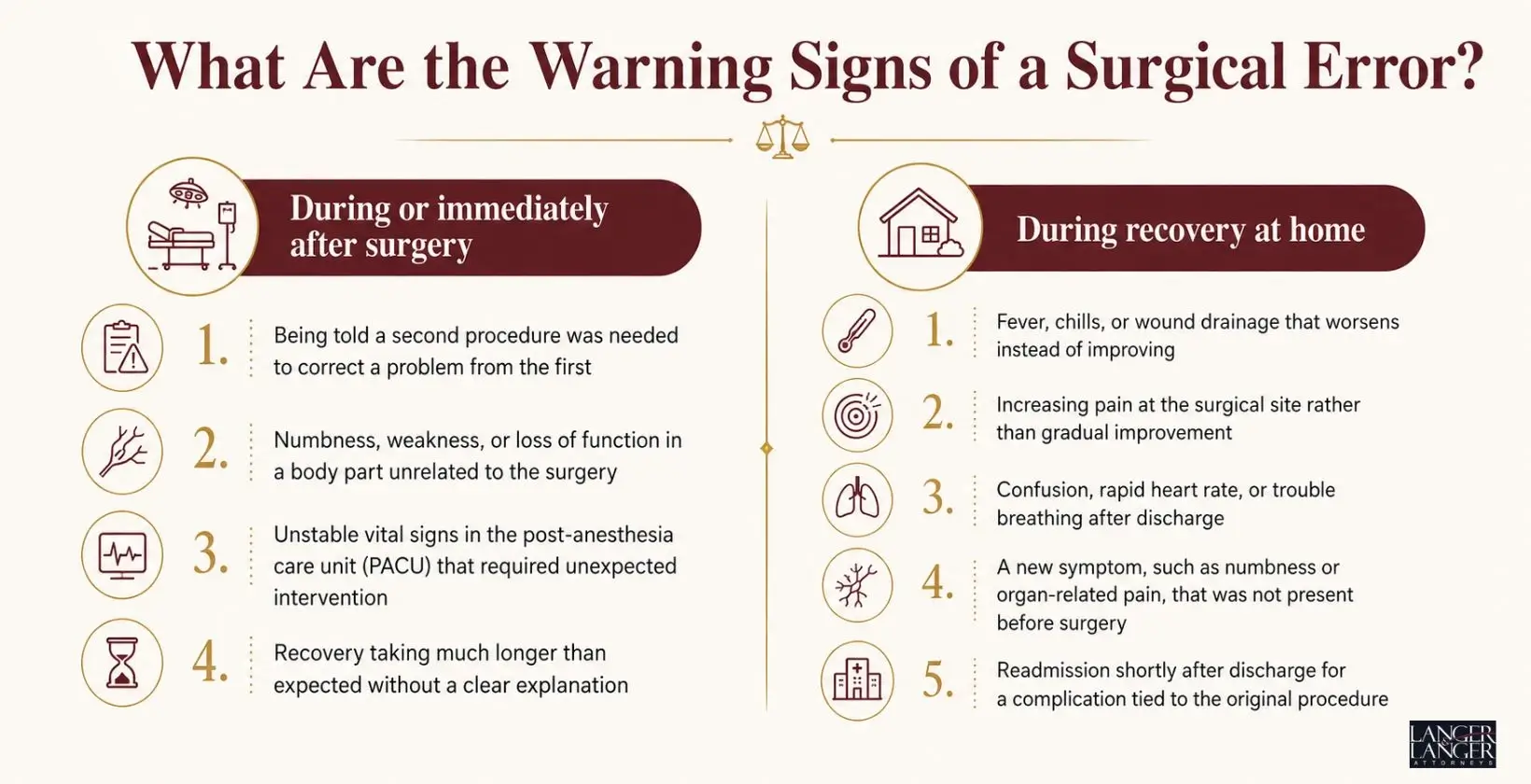
Surgical errors are not always obvious on the day of the procedure. Some signs appear immediately, while others develop days or weeks into recovery. These signs are not a diagnosis, but they are the kinds of developments that justify prompt medical attention and careful documentation.
During or immediately after surgery:
- Being told a second procedure was needed to correct a problem from the first.
- Numbness, weakness, or loss of function in a body part unrelated to the surgery.
- Unstable vital signs in the post-anesthesia care unit (PACU) that required unexpected intervention.
- Recovery taking much longer than expected without a clear explanation.
During recovery at home:
- Fever, chills, or wound drainage that worsens instead of improving.
- Increasing pain at the surgical site rather than gradual improvement.
- Confusion, rapid heart rate, or trouble breathing after discharge.
- A new symptom, such as numbness or organ-related pain, that was not present before surgery.
- Readmission shortly after discharge for a complication tied to the original procedure.
If you are recognizing any of these signs in your own recovery or a loved one’s, our surgical malpractice attorneys can help you understand what the records may show.
Who Can Be Held Liable for a Surgical Error in Indiana
Liability for a surgical error is not always limited to the operating surgeon. Depending on what happened and who made the decisions that caused the harm, more than one party may share legal responsibility.
- Operating Surgeon: Can be liable for errors in technique, judgment, operative planning, or post-operative decisions, including wrong-site surgery, improper surgical technique, and avoidable nerve or organ damage.
- Anesthesiologist: Has an independent duty for anesthesia and monitoring decisions from pre-operative assessment through recovery. Dosing errors, airway mistakes, anesthesia awareness, and monitoring failures can support a separate claim.
- Surgical Nurses and Scrub Technicians: May share responsibility for instrument counts, safety checklists, handoffs, and other intraoperative duties. A retained surgical instrument is not always traced to one provider alone.
- Hospital or Ambulatory Surgical Center: May be liable when staffing, supervision, protocol enforcement, credentialing, or equipment maintenance failures contributed to the error. Under the doctrine of respondeat superior, a hospital is also vicariously liable for the negligent acts of its employees, meaning the institution can be held responsible even when the negligence is attributed to an individual staff member.
- Medical Device Manufacturer: Can be liable if a defective instrument or device directly contributed to the harm, which may also raise product liability issues separate from the malpractice claim.
If you are unsure who was responsible for what went wrong, Langer and Langer can review the full record and identify every potentially liable party.
When a Surgical Error May Support a Malpractice Claim in Indiana
A surgical malpractice claim in Indiana depends on four elements, and all four must be present.
- Duty of Care: The provider was treating the patient and had a legal duty to provide competent care.
- Breach of Duty: The provider made a mistake, omission, or clinical decision that fell below what a reasonably careful provider in the same specialty, under the same or similar circumstances, would have done. Indiana courts apply this standard by reference to providers with similar training and experience, not a national ideal.
- Causation: That failure directly caused the injury or made the outcome worse. If the harm had occurred regardless of the error, causation is absent.
- Damages: The patient suffered measurable harm, such as physical injury, added treatment, lost income, permanent impairment, or lasting pain.
Proving these elements requires the operative report, anesthesia records, post-operative notes, discharge records, and expert medical review. A surgical error without measurable harm is not a viable claim, and harm by itself is not enough without proof that the provider’s care caused it. In most cases, the records are what show whether the claim can move forward under Indiana law.
Indiana Surgical Malpractice Laws and Deadlines
Indiana surgical malpractice claims follow procedural rules that are different from ordinary injury cases. The filing deadline, panel process, and recovery limits can all affect whether a claim can move forward at all. These rules are governed by the Indiana Medical Malpractice Act (IC 34-18).
Filing deadlines
Indiana gives a patient two years from the date of the alleged malpractice to file a claim. Filing a proposed complaint with the Indiana Department of Insurance (IDOI) tolls that deadline through 90 days after the claimant receives the Medical Review Panel opinion. Delayed-discovery issues can be complicated, especially in retained-object cases where the harm may not surface for months. Timing should be reviewed early.
Medical Review Panel
Most surgical malpractice claims against qualified providers in Indiana begin with a proposed complaint filed through the IDOI. A Medical Review Panel is not automatic. Either party can request one at least 20 days after the complaint is filed. The panel includes three health care providers and one attorney chair. Its opinion is not binding on the court, but it is admissible at trial and can carry significant weight with a jury, which makes the panel process an important strategic phase of any Indiana malpractice claim.
Damage caps
Indiana caps total recovery in malpractice cases against qualified providers. For malpractice occurring after June 30, 2019, the total cap is $1.8 million. The provider is generally responsible for up to $500,000, and the Patient’s Compensation Fund covers the remainder up to the statutory limit.
What Can Victims of Surgical Errors Recover in Indiana?
When a surgical malpractice claim is successful, compensation is intended to account for the full impact of the harm caused. Under Indiana law, recoverable damages generally fall into three categories: economic, non-economic, and punitive.
- Economic damages cover measurable financial losses directly tied to the malpractice. These include the cost of additional medical treatment required because of the error, rehabilitation expenses, lost income during recovery, and reduced earning capacity if the injury caused a long-term or permanent limitation.
- Non-economic damages cover losses that do not come with a receipt but are nonetheless real. Physical pain, emotional suffering, loss of enjoyment of life, and lasting disability are all recognized categories of non-economic harm under Indiana law.
- Punitive damages are rarely awarded in Indiana malpractice cases. When they do apply, they require a showing of conduct beyond ordinary negligence, such as willful or reckless disregard for patient safety.
If you have questions about what your case may be worth, Langer and Langer can review your records and give you a clear answer.
Get a Free Case Review From a Surgical Error Attorney in Indiana
Figuring out whether a surgical outcome was a known risk or a preventable mistake is difficult without the records and the medical insight to interpret them.
Langer & Langer reviews surgical error cases throughout Indiana by examining operative records, medical timelines, and post-operative documentation. The goal is to give patients and families a clear, honest assessment of what the records show and whether a claim is worth pursuing. There are no upfront fees. Our firm only collects a fee if compensation is recovered.
To discuss what happened, call 219-464-3246 or visit 4 Indiana Ave, Valparaiso, IN 46383. We serve patients and families across Northwest Indiana and throughout the state.