
Patients in Bloomington who have suffered harm due to medical mistakes can face serious, life-changing consequences. If you’ve experienced a misdiagnosis, surgical error, medication mistake, or other medical negligence, our Bloomington medical malpractice attorneys are here to help. As an experienced Bloomington law firm, we handle a wide range of medical malpractice cases, including diagnostic errors, hospital negligence, and improper treatment, providing compassionate guidance and fighting to secure the compensation you deserve.
4 Indiana Ave Valparaiso, IN 46383
in**@*******aw.com
When a preventable medical error happens, the impact can be immediate and life-changing. What started as a hospital visit, surgery, diagnosis, or prescription can leave you or someone you love dealing with more pain, more treatment, lost income, and a lot of unanswered questions. If this happened in Bloomington or Monroe County, you may be unsure whether it was medical malpractice and what steps to take next.
At Langer & Langer, our experienced Bloomington medical malpractice lawyers help patients and families understand their rights after suspected medical negligence. We review medical records, work with qualified medical experts, prepare claims through Indiana’s Medical Review Panel process, and pursue compensation for medical expenses, lost wages, and pain and suffering.
Schedule a free consultation.
Medical malpractice is more than a bad medical outcome. Under Indiana law, it refers to a legal claim based on health care or professional services a provider gave, or should have given, to a patient, when a failure in care causes harm.
Common case types include:
Birth Injury
Negligent care during pregnancy, labor, or delivery can cause serious harm to the baby or mother, including oxygen deprivation, brain injury, and other lasting complications.
Cardiology Malpractice
Errors in cardiac care can include missed heart attack symptoms, delayed treatment, poor monitoring, or mistakes during heart-related procedures.
Communication Error
Breakdowns between doctors, nurses, specialists, or hospital staff can lead to delayed treatment, medication mistakes, and preventable harm.
Hospital Malpractice
Hospitals may be responsible for understaffing, poor supervision, unsafe policies, infection control failures, or other system-level care failures.
Medication Error
These cases include the wrong drug, wrong dose, missed drug interactions, pharmacy mistakes, or medication given to the wrong patient.
Emergency Room Error
ER errors may involve delayed triage, missed symptoms, early discharge, or failure to diagnose urgent conditions such as stroke, sepsis, or internal bleeding.
Surgical Error
Surgical malpractice can include wrong-site surgery, retained instruments, anesthesia mistakes, or avoidable nerve and organ damage.
Radiologist Error
A radiology error may involve misread imaging, missed fractures, tumors, bleeding, or other findings that delay proper treatment.
Misdiagnosis Error
Misdiagnosis or delayed diagnosis can allow a condition to worsen and may reduce treatment options or long-term recovery.
Hospitals and providers rarely admit fault on their own. Strong medical malpractice claims are built on clear records, qualified expert review, and a timeline that shows what happened and when.
To prove a claim, we focus on the four elements of medical malpractice:
Our medical malpractice attorneys in Bloomington build these cases with medical records, imaging and test results, provider notes, hospital documentation, treatment timelines, and qualified medical experts. Preserving evidence early is critical because missing records, delayed review, or incomplete documentation can weaken a valid claim.
In many medical malpractice cases, more than one party may be legally responsible for the harm. Depending on what happened, liability may involve a doctor, hospital, nurse, specialist, pharmacy, or medical group.
Potentially liable parties may include:
Hospitals & healthcare systems:
For staffing, supervision, policies, or employed providers.
Physicians and surgeons:
For diagnostic errors, treatment decisions, or surgical mistakes.
Nurses and medical staff:
For medication errors, monitoring failures, or care breakdowns.
Anesthesiologists and specialists:
For procedure-related errors or delayed responses.
Pharmacies and pharmacists:
For incorrect medications, dosages, or missed interactions.
Medical groups or clinics:
When care is delivered through a coordinated practice.
Most Bloomington medical malpractice claims follow a similar process under Indiana law. The exact timeline depends on the injury, the providers involved, and the medical evidence.
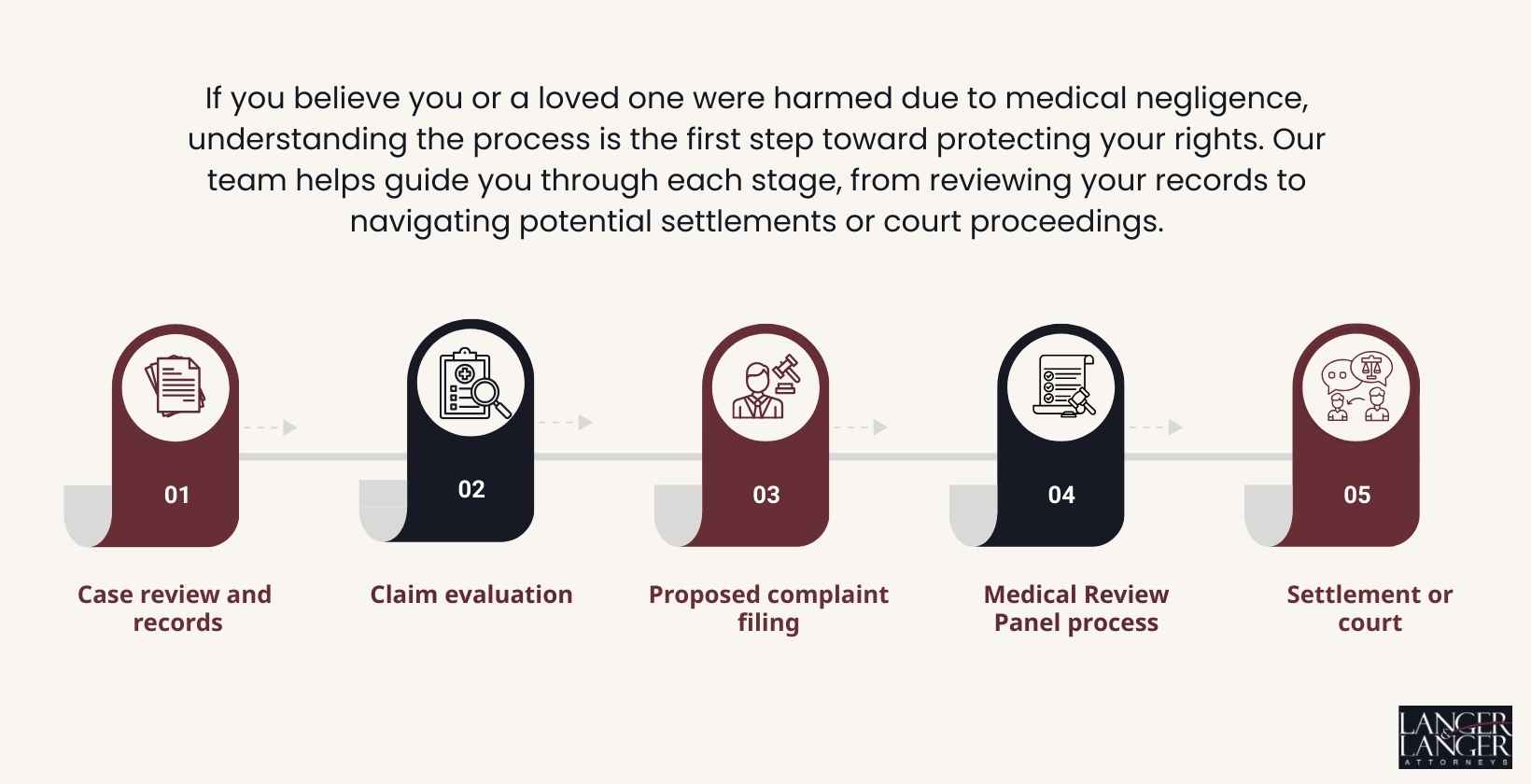
A free case review with our Bloomington medical misdiagnosis can clarify where your claim stands.
While compensation cannot undo what happened, it may help cover the financial and personal losses caused by medical malpractice.
A medical malpractice claim may seek compensation for both economic and non-economic damages, including:
Economic damages:
Non-economic damages:
Indiana law also limits the total amount recoverable in medical malpractice cases based on when the malpractice occurred. For acts that occurred after June 30, 2019, the total recovery cap is $1.8 million. For qualified health care providers, the law also limits provider liability to $500,000, and amounts above that may be paid through the Indiana Patient’s Compensation Fund.
If you believe medical negligence may have caused harm, taking a few early steps can protect both your health and your legal options.
Many patients and families delay because they are unsure whether what happened was malpractice. Request a free consultation with our Indiana medical malpractice lawyers.
Medical malpractice claims are often complex, and hospitals and insurers usually start defending these cases early. You need a medical malpractice law firm that understands Indiana malpractice law, the Medical Review Panel process, and how to build a claim with strong evidence.
Clients in Bloomington and Monroe County choose Langer & Langer because:
Speak with a Bloomington medical negligence lawyer for clear answers about your case.
Langer & Langer has experience handling serious medical negligence claims and preparing cases for negotiation or litigation when needed.
Past results do not guarantee future outcomes.
Clients value our responsiveness, case preparation, and clear guidance throughout the process.
I highly recommend Steve Langer & his attorneys for medical malpractice representation. From the beginning I have always felt that they listened intently with care & compassion. There were always available to answer any of my questions and concerns. I can’t thank Steve Langer enough for getting justice for my Mom.
I needed help with a situation after my divorce. I called Langer & Langer and connected with attorney Danielle Polito. She handled my situation fast and efficiently! She conducted herself with the upmost professionalism and helped me throughout the entire process. Danielle answered every question and helped me to feel confident and comfortable. I would highly recommend this practice for anyone who finds themselves needing legal help! I am thrilled with my results!
Mr. Langer began our long journey with us through what I would never wish on anyone. Both Attorneys Langer dealt with very difficult circumstances with a trucking company whose driver hit the side of my husband's car in Nov 2021. My husband's been in a great deal of pain and doesn't get sleep. Mr. Langer, in my opinion, went above and beyond to help settle this delicate matter as quickly as they did. We would recommend them to anyone.
You usually have two years from the date of the alleged malpractice to file a medical malpractice claim in Indiana. Filing a proposed complaint can toll the deadline through the Medical Review Panel process and for 90 days after the panel opinion.
It costs nothing upfront to hire a medical malpractice attorney. Fees are owed only if compensation is recovered, subject to the signed fee agreement.
It depends. If your injury was not discovered until months later, Indiana law may allow limited delayed discovery in some cases. These cases are fact-specific, and deadlines may still apply.
Yes. You can file a malpractice claim for a deceased family member in some cases if the Indiana wrongful death law applies and the claim is brought by the proper party within the required time.
Medical malpractice cases usually take longer in Indiana because the Medical Review Panel process can take months. The full timeline depends on the records, experts, providers, and whether the case settles or goes to court.
No. Filing a proposed complaint does not automatically create a Medical Review Panel. A panel is formed only if a party requests one, and the request cannot be made earlier than 20 days after filing.
If an avoidable medical error harmed you or someone you love, you deserve clear answers and experienced legal guidance.
Langer & Langer can review what happened, explain whether you may have a medical malpractice claim under Indiana law, and help you understand the next steps and deadlines.
Call 219-600-8847 to speak with our medical malpractice attorney in Bloomington. A free case review can give you clarity about your options after a serious medical injury.
Serving Bloomington and Monroe County from our Indiana office at 4 Indiana Ave, Valparaiso, IN 46383.



© 1980-2026 Langer & Langer • All Rights Reserved
Copyright © 1980-2026 All Rights Reserved.
Past results do not guarantee any future outcome, and every case is different.
We improve our products and advertising by using Microsoft Clarity to see how you use our website. By using our site, you agree that we and Microsoft can collect and use this data.
Have legal questions or need expert advice? Our experienced team is here to help.
Langer & Langer
Accessibility Statement
Compliance status
We firmly believe that the internet should be available and accessible to anyone, and are committed to providing a website that is accessible to the widest possible audience, regardless of circumstance and ability.
To fulfill this, we aim to adhere as strictly as possible to the World Wide Web Consortium’s (W3C) Web Content Accessibility Guidelines 2.1 (WCAG 2.1) at the AA level. These guidelines explain how to make web content accessible to people with a wide array of disabilities. Complying with those guidelines helps us ensure that the website is accessible to all people: blind people, people with motor impairments, visual impairment, cognitive disabilities, and more.
This website utilizes various technologies that are meant to make it as accessible as possible at all times. We utilize an accessibility interface that allows persons with specific disabilities to adjust the website’s UI (user interface) and design it to their personal needs.
Additionally, the website utilizes an AI-based application that runs in the background and optimizes its accessibility level constantly. This application remediates the website’s HTML, adapts Its functionality and behavior for screen-readers used by the blind users, and for keyboard functions used by individuals with motor impairments.
If you’ve found a malfunction or have ideas for improvement, we’ll be happy to hear from you. You can reach out to the website’s operators by using the following email
Screen-reader and keyboard navigation
Our website implements the ARIA attributes (Accessible Rich Internet Applications) technique, alongside various different behavioral changes, to ensure blind users visiting with screen-readers are able to read, comprehend, and enjoy the website’s functions. As soon as a user with a screen-reader enters your site, they immediately receive a prompt to enter the Screen-Reader Profile so they can browse and operate your site effectively. Here’s how our website covers some of the most important screen-reader requirements, alongside console screenshots of code examples:
Screen-reader optimization: we run a background process that learns the website’s components from top to bottom, to ensure ongoing compliance even when updating the website. In this process, we provide screen-readers with meaningful data using the ARIA set of attributes. For example, we provide accurate form labels; descriptions for actionable icons (social media icons, search icons, cart icons, etc.); validation guidance for form inputs; element roles such as buttons, menus, modal dialogues (popups), and others. Additionally, the background process scans all the website’s images and provides an accurate and meaningful image-object-recognition-based description as an ALT (alternate text) tag for images that are not described. It will also extract texts that are embedded within the image, using an OCR (optical character recognition) technology. To turn on screen-reader adjustments at any time, users need only to press the Alt+1 keyboard combination. Screen-reader users also get automatic announcements to turn the Screen-reader mode on as soon as they enter the website.
These adjustments are compatible with all popular screen readers, including JAWS and NVDA.
Keyboard navigation optimization: The background process also adjusts the website’s HTML, and adds various behaviors using JavaScript code to make the website operable by the keyboard. This includes the ability to navigate the website using the Tab and Shift+Tab keys, operate dropdowns with the arrow keys, close them with Esc, trigger buttons and links using the Enter key, navigate between radio and checkbox elements using the arrow keys, and fill them in with the Spacebar or Enter key.Additionally, keyboard users will find quick-navigation and content-skip menus, available at any time by clicking Alt+1, or as the first elements of the site while navigating with the keyboard. The background process also handles triggered popups by moving the keyboard focus towards them as soon as they appear, and not allow the focus drift outside it.
Users can also use shortcuts such as “M” (menus), “H” (headings), “F” (forms), “B” (buttons), and “G” (graphics) to jump to specific elements.
Disability profiles supported in our website
Additional UI, design, and readability adjustments
Browser and assistive technology compatibility
We aim to support the widest array of browsers and assistive technologies as possible, so our users can choose the best fitting tools for them, with as few limitations as possible. Therefore, we have worked very hard to be able to support all major systems that comprise over 95% of the user market share including Google Chrome, Mozilla Firefox, Apple Safari, Opera and Microsoft Edge, JAWS and NVDA (screen readers).
Notes, comments, and feedback
Despite our very best efforts to allow anybody to adjust the website to their needs. There may still be pages or sections that are not fully accessible, are in the process of becoming accessible, or are lacking an adequate technological solution to make them accessible. Still, we are continually improving our accessibility, adding, updating and improving its options and features, and developing and adopting new technologies. All this is meant to reach the optimal level of accessibility, following technological advancements. For any assistance, please reach out to