
Northwest Indiana medical malpractice cases are complex and life-changing. They often involve doctors, hospitals, or nursing homes failing to provide the care patients deserve. These errors can lead to permanent injuries, delayed diagnoses, or even wrongful death. Our Northwest Indiana medical malpractice lawyers protect your rights, expose negligence, and fight for the compensation you and your family need to move forward.
4 Indiana Ave Valparaiso, IN 46383
in**@*******aw.com

Medical malpractice occurs when a doctor, hospital, or healthcare provider fails to meet the standard of care and a patient suffers serious, preventable harm. These cases often begin with unanswered questions, worsening symptoms, or a sense that something important was overlooked.
If you or a family member experienced harm due to a medical error in Lake, Porter, or LaPorte County & areas like Valparaiso, Crown Point, or Michigan City you may have grounds for a malpractice claim under Indiana law.
At Langer & Langer, our Medical Malpractice Lawyers Northwest Indiana help families uncover the truth, protect their legal rights, and pursue full compensation under Indiana law. We bring trusted legal insight and local experience to every case we handle.
We handle every part of your malpractice claim from medical investigation to courtroom advocacy so that you can focus on recovery, not legal stress.

Review records
Collaborate with independent physicians to identify signs of medical error or oversight.

Collect and analyze evidence
Includes hospital charts, diagnostic images, surgical reports, and provider notes.

Work with experts
Consult board-certified specialists to establish how the standard of care was violated.

Track deadlines
Ensure all filings meet Indiana’s medical malpractice timelines, including notice and panel review requirements.

Negotiate settlements
Communicate with insurers and defense lawyers to pursue a resolution that reflects the full extent of your losses.

Keep you informed
Provide regular updates, case strategy, and clear legal guidance at every stage.
Litigate when necessary
Prepare and present your case in court if negotiation fails to deliver fair compensation.
We handle a range of medical malpractice cases involving serious errors by doctors, hospitals, and other healthcare providers in Indiana. Below are the most common types of malpractice claims our experienced attorneys pursue for injured patients and their families.
Misdiagnosis means giving the wrong diagnosis. Delayed diagnosis means finding the right condition too late. Both become malpractice when they prevent timely treatment and cause harm.
These failures often involve missed cancer, sepsis, or heart attack conditions, where delay can be fatal. If an earlier diagnosis had changed the outcome, Indiana law allows you to file a claim.
Errors during pregnancy, labor, or delivery can cause permanent injury to a newborn or mother. These cases often involve delayed C-sections, misuse of forceps, or failure to monitor fetal distress.
When medical staff fail to act quickly or follow accepted standards, the result can be brain damage, oxygen deprivation, or long-term disability. Families can pursue compensation to cover medical care, therapy, and future support needs.
Surgical errors happen when a mistake is made during an operation. Anesthesia errors involve incorrect dosing, monitoring, or timing that lead to serious harm or death. Both are preventable and often result from negligence in the operating room.
Common examples include wrong-site surgery, retained instruments, nerve damage, or anesthesia overdose. These cases rely on expert review to prove that the surgical team failed to meet accepted medical standards. Our surgical malpractice attorneys in Northwest Indiana work closely with board-certified specialists to build clear, fact-based claims.
In nursing homes, malpractice often involves medically negligent care not just isolated mistakes, but patterns like untreated infections, dehydration, or failure to prevent bedsores. In some cases, these issues overlap with elder abuse, especially when neglect results from poor supervision or unqualified staff.
Our team investigates staffing practices, documentation gaps, and oversight failures to expose systemic negligence. A nursing home malpractice lawyer can hold facilities accountable for the care they were trusted to deliver and failed to provide.
Hospitals and ERs can put patients at risk through issues like understaffing, poor sanitation, or rushed emergency care. These systemic issues can lead to medication errors, untreated conditions, or even preventable fatalities. Our malpractice law firm has the experience to pursue claims against both individual providers and hospital systems when institutional failures play a role.
If you’re unsure whether what happened was “just a complication” or something more serious, you’re not alone. Many of our clients come to us with questions, not certainty. What matters is timing; waiting too long can hurt your case and your recovery.
Consider hiring a malpractice lawyer if:
In many cases, more than one party shares responsibility. For example, a hospital might be liable for hiring an unqualified doctor, while the doctor is separately liable for the care they provided.
Only certain people have the legal right to file a medical malpractice claim in Indiana. This right is based on your relationship to the injured person and whether they are able to file on their own.
You can file a claim if:
You are the injured patient: Adults who suffer harm due to medical negligence can file on their own behalf.
You are the parent or guardian of a minor: Parents can file if their child was injured due to a medical mistake.
You represent someone who died or cannot file themselves: A personal representative, often appointed through probate court, may file on behalf of the estate.
You are the legal guardian of an incapacitated adult: If a person is unable to understand or manage their legal affairs, their guardian may take legal action.
Example: A mother can file on behalf of a newborn harmed during birth. If an adult patient dies, their spouse, child, or executor may file as the estate’s representative.
If you’re unsure whether you’re eligible, we can help you determine your standing and guide you through the next steps.
Anyone involved in providing negligent medical care can be held legally responsible under Indiana malpractice law. Liability depends on each party’s role in the patient’s care and whether their actions violated accepted medical standards.
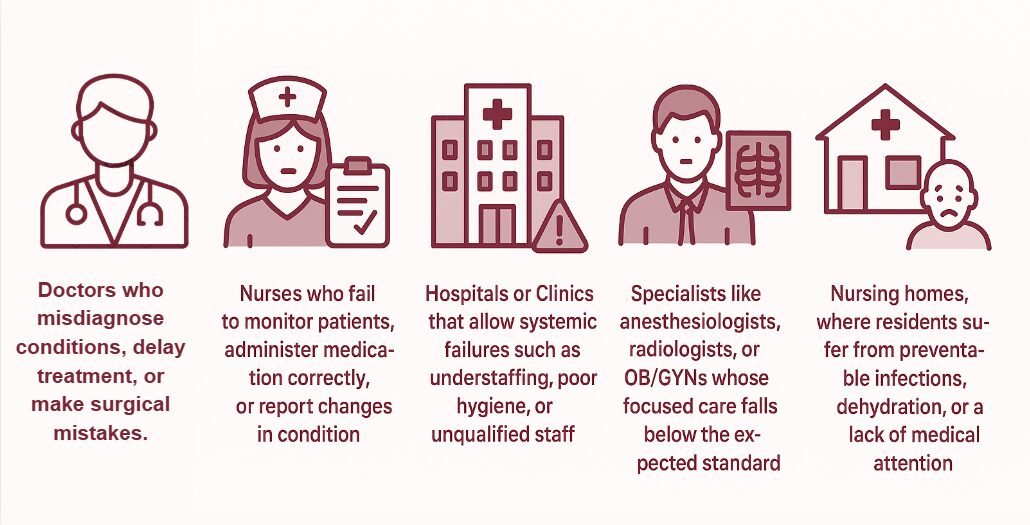
Anyone involved in providing negligent medical care can be held legally responsible under Indiana malpractice law. Liability depends on each party’s role in the patient’s care and whether their actions violated accepted medical standards.
The following parties may be held liable in a malpractice claim:
In many cases, more than one party shares responsibility. For example, a hospital might be liable for hiring an unqualified doctor, while the doctor is separately liable for the care they provided.
A medical malpractice claim in Northwest Indiana allows you to recover compensation for both the financial losses and emotional harm caused by a preventable medical error. In Indiana, damages fall into two categories: economic and non-economic.
Our job is to ensure that every part of your loss is clearly documented, valued, and pursued, especially in a state that limits the total amount you can recover.
These two categories reflect both the financial costs of malpractice and the personal impact it has on your daily life.
If medical malpractice leads to death, families may pursue a wrongful death claim through the estate’s personal representative. Damages may cover:
Loss of love, care, and companionship
These are still considered economic and non-economic damages, but the rules on who can recover, and for what, are narrower. Indiana caps total recovery at $1.8 million, with a portion available through the Patient’s Compensation Fund (PCF). This special state fund helps victims recover more than what providers alone can pay.
Not every medical error is legally considered malpractice. To file a valid malpractice claim under Indiana law, four key elements must be proven:
1. Duty of care:
The provider had a legal obligation to treat you according to accepted medical standards.
2. Breach of duty:
They failed to meet that standard through an act or omission.
3. Causation:
Their actions directly caused your injury or made your condition worse.
4. Damages:
You suffered physical, emotional, or financial harm as a result.
Example: If a doctor fails to diagnose an infection that leads to sepsis and permanent damage, and earlier treatment would have prevented it, the four elements may be met.
Medical malpractice cases don’t begin in a courtroom, and they don’t move quickly. Indiana requires several legal steps before a lawsuit can even proceed to trial. Our job is to walk you through each one, protect your rights, and make sure you’re never left wondering what comes next.
Indiana law requires most malpractice claims to go through a Medical Review Panel before they can be heard in court. The process starts by filing a complaint with the Indiana Department of Insurance, not directly in civil court.
The panel consists of three healthcare professionals and one attorney who review the evidence and issue an opinion. This step can take 6 to 12 months, depending on complexity. While the panel’s opinion isn’t final, it can strongly influence the outcome of your case.
We handle all filings, deadlines, and communications during this phase so nothing gets missed.
If the panel review does not resolve your claim, the case proceeds to court. This phase includes:
We work with licensed, credible medical experts to build a clear, compelling picture of what went wrong and how it could have been prevented. You’ll always know what’s happening and what to expect before trial.
Most malpractice cases settle before trial, especially after strong panel opinions and expert evaluations. A settlement allows for faster resolution, less emotional stress, and more privacy.
But if the defense refuses a fair settlement, we’re fully prepared to take your case to trial and present it to a jury. Our goal is always to pursue the outcome that gives you and your family the fullest possible recovery, whether that’s at the table or in court. We’ve secured favorable verdicts and settlements for malpractice victims across Valparaiso, Merrillville, Crown Point, and surrounding areas.
When families in Lake, Porter, and LaPorte Counties face the aftermath of medical negligence, they choose us for our deep local insight, medical-legal skill, and commitment to personal care. Whether you’re pursuing a hospital negligence claim, a fatal misdiagnosis, or a surgical injury case, our team brings local knowledge and decades of experience to every case.
What sets our malpractice team apart:
Local Court and Panel Experience: We’ve handled malpractice cases in Northwest Indiana for decades and understand how local judges and medical review panels operate.
Depth in Complex Medical Claims: From birth injuries to fatal misdiagnoses, we partner with top medical experts to build strong, fact-driven cases.
Recognized by Peers and Clients: Named to Indiana Super Lawyers®, a reflection of both legal skill and client trust.
Direct, Personal Representation: We don’t hand you off to case managers. You speak with your attorney, get clear answers, and stay informed throughout your case.
Focused on Full Recovery: We pursue every dollar allowed under Indiana’s malpractice cap through both settlements and trials.
Yes, you need a medical review panel before filing a lawsuit in Indiana. Indiana law requires most medical malpractice claims to be reviewed by a panel before they can move forward in court.
The deadline to file a malpractice claim in Indiana is generally 2 years from the date of the malpractice. Some exceptions apply for minors or when the injury was discovered later.
It depends. Most malpractice claims in Indiana require physical injury, but financial loss or severe emotional distress directly caused by negligence may be enough. A lawyer can confirm if your situation qualifies.
A medical error is legally actionable under Indiana law if it breaches the standard of care, causes direct harm, and results in measurable damages, such as permanent injury, disability, or financial loss.
Yes, government malpractice claims in Indiana have different deadlines. You must provide notice within 270 days under the Indiana Tort Claims Act, which is shorter than the two-year deadline for private providers.
You’ve been through medical treatment, and something went wrong. You may not be sure if it was malpractice, but you know the outcome wasn’t what it should’ve been.
That’s exactly why we offer a free, confidential consultation. No pressure. No legal jargon. Just honest answers from a top-rated Indiana medical malpractice attorney who listens, explains your options, and helps you understand what comes next.
This is a hard time. Taking the first step shouldn’t be. The clarity you deserve is just one conversation away.



© 2025 Langer & Langer • All Rights Reserved
Disclaimer | Site Map | Privacy Policy | Payment | Business Development Solutions by Blue Summit SEO.
Copyright © 1980-2026 All Rights Reserved.
Past results do not guarantee any future outcome, and every case is different.
We improve our products and advertising by using Microsoft Clarity to see how you use our website. By using our site, you agree that we and Microsoft can collect and use this data.
Have legal questions or need expert advice? Our experienced team is here to help.
Langer & Langer
Accessibility Statement
Compliance status
We firmly believe that the internet should be available and accessible to anyone, and are committed to providing a website that is accessible to the widest possible audience, regardless of circumstance and ability.
To fulfill this, we aim to adhere as strictly as possible to the World Wide Web Consortium’s (W3C) Web Content Accessibility Guidelines 2.1 (WCAG 2.1) at the AA level. These guidelines explain how to make web content accessible to people with a wide array of disabilities. Complying with those guidelines helps us ensure that the website is accessible to all people: blind people, people with motor impairments, visual impairment, cognitive disabilities, and more.
This website utilizes various technologies that are meant to make it as accessible as possible at all times. We utilize an accessibility interface that allows persons with specific disabilities to adjust the website’s UI (user interface) and design it to their personal needs.
Additionally, the website utilizes an AI-based application that runs in the background and optimizes its accessibility level constantly. This application remediates the website’s HTML, adapts Its functionality and behavior for screen-readers used by the blind users, and for keyboard functions used by individuals with motor impairments.
If you’ve found a malfunction or have ideas for improvement, we’ll be happy to hear from you. You can reach out to the website’s operators by using the following email
Screen-reader and keyboard navigation
Our website implements the ARIA attributes (Accessible Rich Internet Applications) technique, alongside various different behavioral changes, to ensure blind users visiting with screen-readers are able to read, comprehend, and enjoy the website’s functions. As soon as a user with a screen-reader enters your site, they immediately receive a prompt to enter the Screen-Reader Profile so they can browse and operate your site effectively. Here’s how our website covers some of the most important screen-reader requirements, alongside console screenshots of code examples:
Screen-reader optimization: we run a background process that learns the website’s components from top to bottom, to ensure ongoing compliance even when updating the website. In this process, we provide screen-readers with meaningful data using the ARIA set of attributes. For example, we provide accurate form labels; descriptions for actionable icons (social media icons, search icons, cart icons, etc.); validation guidance for form inputs; element roles such as buttons, menus, modal dialogues (popups), and others. Additionally, the background process scans all the website’s images and provides an accurate and meaningful image-object-recognition-based description as an ALT (alternate text) tag for images that are not described. It will also extract texts that are embedded within the image, using an OCR (optical character recognition) technology. To turn on screen-reader adjustments at any time, users need only to press the Alt+1 keyboard combination. Screen-reader users also get automatic announcements to turn the Screen-reader mode on as soon as they enter the website.
These adjustments are compatible with all popular screen readers, including JAWS and NVDA.
Keyboard navigation optimization: The background process also adjusts the website’s HTML, and adds various behaviors using JavaScript code to make the website operable by the keyboard. This includes the ability to navigate the website using the Tab and Shift+Tab keys, operate dropdowns with the arrow keys, close them with Esc, trigger buttons and links using the Enter key, navigate between radio and checkbox elements using the arrow keys, and fill them in with the Spacebar or Enter key.Additionally, keyboard users will find quick-navigation and content-skip menus, available at any time by clicking Alt+1, or as the first elements of the site while navigating with the keyboard. The background process also handles triggered popups by moving the keyboard focus towards them as soon as they appear, and not allow the focus drift outside it.
Users can also use shortcuts such as “M” (menus), “H” (headings), “F” (forms), “B” (buttons), and “G” (graphics) to jump to specific elements.
Disability profiles supported in our website
Additional UI, design, and readability adjustments
Browser and assistive technology compatibility
We aim to support the widest array of browsers and assistive technologies as possible, so our users can choose the best fitting tools for them, with as few limitations as possible. Therefore, we have worked very hard to be able to support all major systems that comprise over 95% of the user market share including Google Chrome, Mozilla Firefox, Apple Safari, Opera and Microsoft Edge, JAWS and NVDA (screen readers).
Notes, comments, and feedback
Despite our very best efforts to allow anybody to adjust the website to their needs. There may still be pages or sections that are not fully accessible, are in the process of becoming accessible, or are lacking an adequate technological solution to make them accessible. Still, we are continually improving our accessibility, adding, updating and improving its options and features, and developing and adopting new technologies. All this is meant to reach the optimal level of accessibility, following technological advancements. For any assistance, please reach out to