
4 Indiana Ave Valparaiso, IN 46383
in**@*******aw.com

Protecting your parental rights starts with the right legal guidance. When a relationship ends, your child’s need for care, stability, and emotional support remains unchanged. At Langer & Langer, our Indiana child custody attorneys help parents act quickly to secure their role and influence their child’s future through effective custody arrangements.
We represent divorcing parents, unmarried parents, and single fathers navigating custody under Indiana Code § 31-17-2 and IC 31-14-13. Our attorneys appear in courts statewide, building strong cases grounded in parenting history, evidence of involvement, and the child’s best interests as defined by law.
Your role as a parent matters. Speak with an experienced Indiana custody attorney who understands how the court evaluates custody decisions and how to position your case from day one.
Judges in Indiana family court prioritize stability. Securing the right outcome early gives parents the strongest long-term position. At Langer & Langer, we represent Indiana mothers and fathers facing urgent threats to their parenting time, decision-making authority, and overall role in their child’s life.
Here’s how our trusted attorneys protect parental rights in custody cases:

Parenting plans can only be modified through court order if there’s a substantial change in circumstances and the change supports the child’s best interests. Protect your role early; modification is harder and riskier later.
Every custody case needs a strategy that matches your parenting role, court expectations, and the child’s best interests. Our Indiana custody lawyers prepare each case with the right balance of litigation readiness, parenting plan strategy, and evidence-based positioning.
Our approach delivers real legal benefits:
Parents across Indiana trust our custody attorneys to manage every step of the petition process, from initial filings to courtroom appearances. We handle custody petitions under IC 31-17-2 for divorcing parents and IC 31-14-13 for unmarried or paternity-based claims.
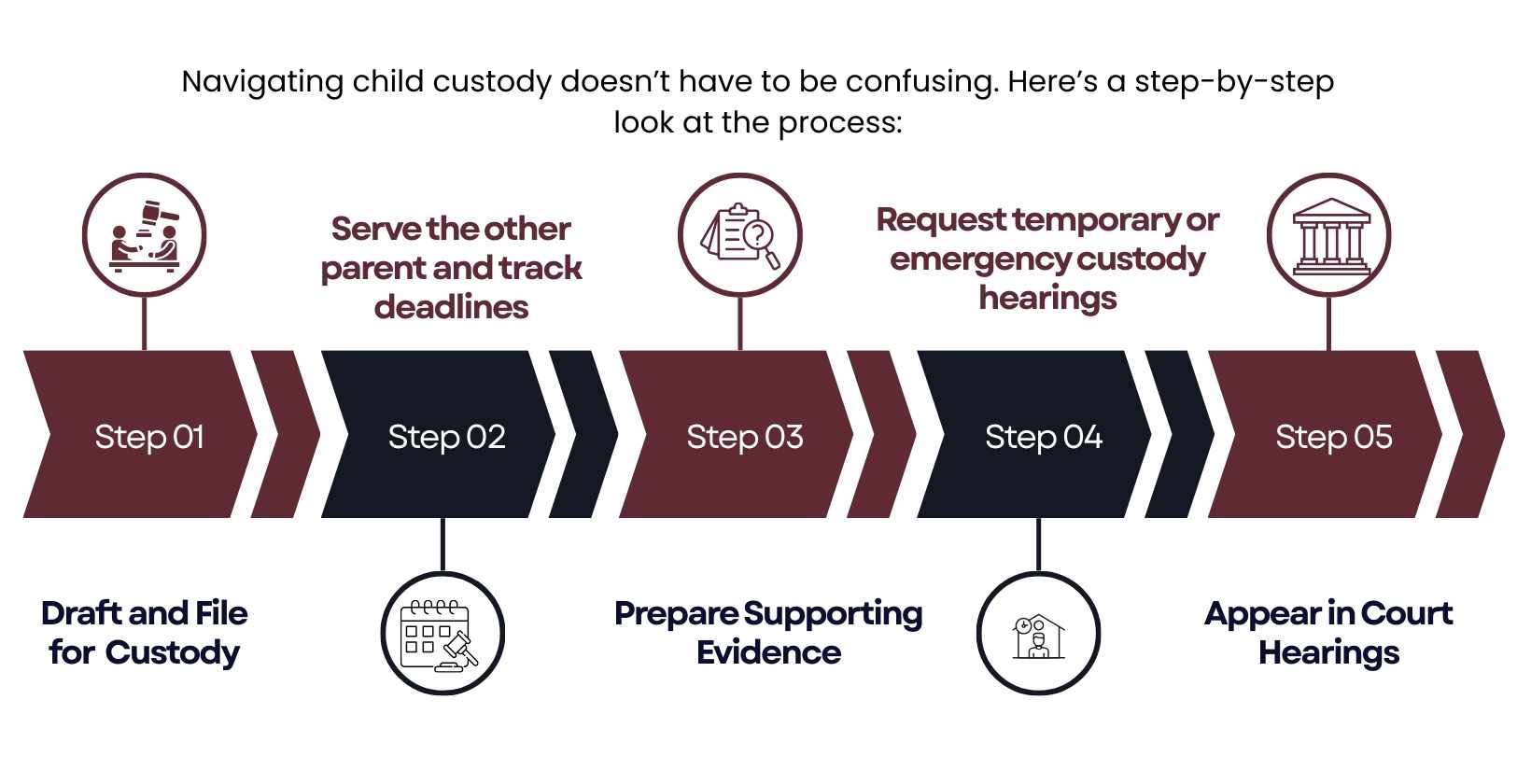
How the filing process works:
Custody petitions can request new orders or modify existing arrangements. Speak with our legal team to start the process with confidence.
Indiana child custody cases fall into distinct legal categories, each with specific court procedures, risks, and outcomes. Our family law attorneys help parents understand which type applies to their situation and how to pursue the strongest custody position from the beginning.
We represent clients in:
Legal Custody
Involves disputes over major decision-making authority, such as education, healthcare, and religion.
Example: A parent may seek sole legal custody if the other has a history of refusing medical care or ignoring school obligations.
Determines the child’s primary residence and which parent provides day-to-day care.
Example: One parent may request primary physical custody to maintain the child’s school stability and daily routine.
Requires shared responsibilities through a court-approved parenting plan.
Example: Both parents may split weekdays and alternate weekends, with shared decisions on extracurricular activities.
One parent seeks exclusive legal and physical rights due to safety, neglect, or parental unfitness.
Example: Sole custody may be pursued if one parent struggles with addiction or has a domestic violence record.
Filed when immediate court intervention is needed to protect a child from harm.
Example: Emergency custody may be granted when a parent flees with the child, or if abuse or neglect is reported.
Applies when a non-parent, such as a grandparent, aunt, or family friend, has acted as the child’s primary caregiver for a significant period and seeks full legal custody.
Example: A grandmother who has raised her grandchild for two years while both parents were incarcerated may petition the court for de facto custody under Indiana law.
Third-Party Custody & Grandparent Visitation (IC 31-17-5)
Allows non-parents to request limited custody or visitation rights, especially when a parent has died, the parents are divorced, or the child is born out of wedlock.
Example: A grandfather requests weekend visitation after the mother passes away, and the surviving parent refuses contact.
We build every case to meet Indiana’s legal standards and position you to secure parenting time, decision-making rights, or full custody.
Fathers often face legal obstacles when asserting custody rights, especially in cases involving paternity, outdated orders, or restricted parenting time. Our Indiana fathers’ rights lawyers represent unmarried and divorcing fathers under IC 31-17-2 and IC 31-14-13, helping them establish legal standing and pursue fair custody outcomes.
Common strategies used in father custody cases include:
If you’re a father facing custody barriers in Indiana, speak with an attorney who knows how to protect your rights and reposition your case in court.
Indiana’s county courts vary in how they manage custody filings, enforce orders, and schedule hearings. Parents benefit from working with family law lawyers who understand the specific procedures and expectations in their local courtrooms. Our child custody lawyers appear in courts throughout the state, giving clients an advantage when navigating judge preferences, timeline rules, and county-specific custody procedures.
We represent parents in custody cases across northern and central Indiana, including:
Valparaiso and Porter County
LaPorte County
Lake County
Indianapolis and Marion County
Additional northern and central Indiana courts
Working with a local Indiana custody lawyer helps you avoid missteps, anticipate court preferences, and move through the legal process with clarity.
Indiana courts prioritize the child’s emotional well-being, household stability, and each parent’s role when deciding custody cases. Our lawyers build every case around the “best interests of the child” standard outlined in IC 31-17-2-8, using early strategy, documentation, and legal positioning to guide the outcome.
Whether your case moves through mediation or litigation depends on the level of conflict, cooperation, and urgency involved.
Not every case should go to trial. Speak with a custody attorney to determine the strongest legal route for your case.
Ready to Talk? Schedule a Free Consultation With Our Legal Team

Speak directly with a child custody attorney, someone who understands Indiana custody law and takes your case seriously from the start.
Your consultation is confidential, practical, and focused on helping you understand your rights, your legal options, and what steps to take next.
While Indiana law does not impose a statute of limitations for initial custody filings, timing significantly affects how your case is received in court. Delays can weaken evidence, disrupt your parental position, and reduce judicial urgency, especially in contested or emergency cases.
Modifications and appeals are time-sensitive and must meet Indiana’s legal standards for review or reconsideration.
Key timing triggers include:
Custody decisions are time-sensitive, not because of deadlines, but because delay weakens your legal position. The earlier you act, the stronger your options.
Indiana parents choose Langer & Langer because custody outcomes depend on strategy, preparation, and courtroom credibility. With over 100 years of combined experience, our child support attorneys are known for case-specific planning, legal insight, and consistent results in high-conflict and complex custody disputes.
What sets our legal team apart:
Board-certified family law attorneys with extensive trial experience in contested custody hearings.
Proven results in joint custody arrangements, parenting time enforcement, and legal custody modifications.
Rapid response in emergency custody filings involving risk, relocation, or protective orders.
Deep familiarity with Indiana county courts, giving clients insight into judge expectations and filing practices.
Focused representation for fathers, unmarried parents, and non-traditional caregivers navigating Indiana custody laws.
Langer & Langer is trusted across Indiana for courtroom readiness, legal ethics, and consistent results in complex custody cases. Our recognitions reflect the level of preparation and judgment we bring to every client relationship in and out of court.
Firm Recognitions:


These credentials reflect our firm’s commitment to high-level advocacy, disciplined case preparation, and results-driven representation in Indiana courts.
No. A child cannot choose which parent to live with in Indiana. The court may consider the child’s preference, but the judge decides based on the best interests of the child, not the child’s choice alone.
No specific age allows a child to legally refuse visitation in Indiana. Courts may consider maturity, but parenting time must be followed unless officially modified by the judge.
Indiana courts determine the best interest of the child by reviewing emotional bonds, parental stability, caregiving history, and cooperation. These factors are set under IC 31-17-2-8 and guide all custody decisions in Indiana.
No. Indiana does not favor mothers in custody cases. Custody decisions are gender-neutral and based on evidence showing which parent best meets the child’s needs under the best interest standard.
It depends. A custody order in Indiana can only be changed without going to court if both parents agree and a judge signs the modification. Otherwise, court approval is required to make it legally enforceable.
A guardian ad litem is a court-appointed representative who advocates for the child’s best interests in custody cases, especially when conflict or abuse is alleged.
If a parent violates a custody order in Indiana, the court may issue penalties. These include contempt findings, fines, makeup time, or custody changes. Indiana courts apply orders to protect the child’s best interest.
Indiana custody cases must comply with IC 31-17-2 and IC 31-14, which govern court filings, parenting plans, and evidentiary standards. Judges expect clear alignment with these laws at every stage.
We structure each case to meet those standards so your filings are admissible, your arguments are supported, and your position holds in court.
Take the next step with an Indiana child custody attorney who knows how local courts apply the law and how to apply it in your favor.

© 1980-2026 Langer & Langer • All Rights Reserved
Copyright © 1980-2026 All Rights Reserved.
Past results do not guarantee any future outcome, and every case is different.
We improve our products and advertising by using Microsoft Clarity to see how you use our website. By using our site, you agree that we and Microsoft can collect and use this data.
Have legal questions or need expert advice? Our experienced team is here to help.
Langer & Langer
Accessibility Statement
Compliance status
We firmly believe that the internet should be available and accessible to anyone, and are committed to providing a website that is accessible to the widest possible audience, regardless of circumstance and ability.
To fulfill this, we aim to adhere as strictly as possible to the World Wide Web Consortium’s (W3C) Web Content Accessibility Guidelines 2.1 (WCAG 2.1) at the AA level. These guidelines explain how to make web content accessible to people with a wide array of disabilities. Complying with those guidelines helps us ensure that the website is accessible to all people: blind people, people with motor impairments, visual impairment, cognitive disabilities, and more.
This website utilizes various technologies that are meant to make it as accessible as possible at all times. We utilize an accessibility interface that allows persons with specific disabilities to adjust the website’s UI (user interface) and design it to their personal needs.
Additionally, the website utilizes an AI-based application that runs in the background and optimizes its accessibility level constantly. This application remediates the website’s HTML, adapts Its functionality and behavior for screen-readers used by the blind users, and for keyboard functions used by individuals with motor impairments.
If you’ve found a malfunction or have ideas for improvement, we’ll be happy to hear from you. You can reach out to the website’s operators by using the following email
Screen-reader and keyboard navigation
Our website implements the ARIA attributes (Accessible Rich Internet Applications) technique, alongside various different behavioral changes, to ensure blind users visiting with screen-readers are able to read, comprehend, and enjoy the website’s functions. As soon as a user with a screen-reader enters your site, they immediately receive a prompt to enter the Screen-Reader Profile so they can browse and operate your site effectively. Here’s how our website covers some of the most important screen-reader requirements, alongside console screenshots of code examples:
Screen-reader optimization: we run a background process that learns the website’s components from top to bottom, to ensure ongoing compliance even when updating the website. In this process, we provide screen-readers with meaningful data using the ARIA set of attributes. For example, we provide accurate form labels; descriptions for actionable icons (social media icons, search icons, cart icons, etc.); validation guidance for form inputs; element roles such as buttons, menus, modal dialogues (popups), and others. Additionally, the background process scans all the website’s images and provides an accurate and meaningful image-object-recognition-based description as an ALT (alternate text) tag for images that are not described. It will also extract texts that are embedded within the image, using an OCR (optical character recognition) technology. To turn on screen-reader adjustments at any time, users need only to press the Alt+1 keyboard combination. Screen-reader users also get automatic announcements to turn the Screen-reader mode on as soon as they enter the website.
These adjustments are compatible with all popular screen readers, including JAWS and NVDA.
Keyboard navigation optimization: The background process also adjusts the website’s HTML, and adds various behaviors using JavaScript code to make the website operable by the keyboard. This includes the ability to navigate the website using the Tab and Shift+Tab keys, operate dropdowns with the arrow keys, close them with Esc, trigger buttons and links using the Enter key, navigate between radio and checkbox elements using the arrow keys, and fill them in with the Spacebar or Enter key.Additionally, keyboard users will find quick-navigation and content-skip menus, available at any time by clicking Alt+1, or as the first elements of the site while navigating with the keyboard. The background process also handles triggered popups by moving the keyboard focus towards them as soon as they appear, and not allow the focus drift outside it.
Users can also use shortcuts such as “M” (menus), “H” (headings), “F” (forms), “B” (buttons), and “G” (graphics) to jump to specific elements.
Disability profiles supported in our website
Additional UI, design, and readability adjustments
Browser and assistive technology compatibility
We aim to support the widest array of browsers and assistive technologies as possible, so our users can choose the best fitting tools for them, with as few limitations as possible. Therefore, we have worked very hard to be able to support all major systems that comprise over 95% of the user market share including Google Chrome, Mozilla Firefox, Apple Safari, Opera and Microsoft Edge, JAWS and NVDA (screen readers).
Notes, comments, and feedback
Despite our very best efforts to allow anybody to adjust the website to their needs. There may still be pages or sections that are not fully accessible, are in the process of becoming accessible, or are lacking an adequate technological solution to make them accessible. Still, we are continually improving our accessibility, adding, updating and improving its options and features, and developing and adopting new technologies. All this is meant to reach the optimal level of accessibility, following technological advancements. For any assistance, please reach out to