
When drivers in Valparaiso fail to follow traffic laws, pedestrians can suffer serious, life-changing injuries. If you’ve been hit by a car, a Valparaiso pedestrian accident attorney can help you seek compensation. Langer & Langer has extensive experience handling claims for pedestrian injuries, insurance disputes, and liability cases.
4 Indiana Ave Valparaiso, IN 46383
in**@*******aw.com

After being hit while walking, many people are left dealing with injuries, medical appointments, and insurance calls they did not expect. Questions about who was at fault, who pays the medical bills, and whether compensation may be available often come up early. In Valparaiso, these accidents often happen in school zones, parking lots, intersections, or near areas like Calumet Avenue and Valparaiso University.
At Langer & Langer, our experienced Valparaiso pedestrian accident attorney reviews what happened, investigates the crash, assesses liability based on the facts, and handles insurance communications on your behalf. Our role is to pursue compensation available under Indiana law for documented economic and non-economic losses, while addressing claim disputes if they arise, so you can focus on your health and next steps.
Call 219-600-8847 to schedule a free, confidential consultation. There is no fee unless compensation is recovered.
Insurance companies often dispute fault in pedestrian accidents, especially when crosswalk markings are unclear or visibility is limited, or the driver claims the pedestrian was not where they should have been. Injured victims may also face early pressure to settle before the full scope of their injuries and financial losses is clear. Legal guidance at the outset helps protect your rights and avoid common claim pitfalls.
Here is how our experienced pedestrian accident lawyer in Valparaiso supports you throughout the claims process:
1. Investigate the Scene
We review police reports, crash photographs, available surveillance footage, and witness statements to understand how the vehicle-pedestrian collision occurred and preserve critical evidence.
2. Assess and Document Liability
We evaluate driver conduct, right-of-way issues, and other relevant factors to establish responsibility and respond to insurer attempts to shift blame onto the pedestrian.
3. Build the Claim File
Medical records, treatment history, and financial documentation are organized to reflect the full impact of the injuries and support a properly documented claim.
4. Handle Insurance Communications
We manage communications with insurance carriers, respond to questions or disputes, and address settlement discussions so you are not dealing with adjusters directly.
5. Address Disputes When They Arise
If a claim cannot be resolved through negotiation, we are prepared to litigate when appropriate under Indiana law to move the matter forward through the court system.
Learn more about your legal options.
Many pedestrians are struck in places they walk every day, intersections, parking lots, and neighborhood streets. These details are important because they influence how responsibility is determined and what legal options may be available.
Typical pedestrian collision cases our injury attorney handle in Valparaiso include:
Crosswalk and intersection collisions involving drivers who fail to yield to pedestrians.
Hit and run pedestrian crashes, where the at-fault driver leaves the scene before providing information.
Parking lot and garage incidents often involving reversing vehicles or limited visibility.
School zone and residential street injuries often affect children, seniors, or other vulnerable pedestrians.
Impacts caused by distracted drivers, including cellphone use or inattention behind the wheel.
Turning vehicle and failure-to-yield accidents, common at busy intersections.
Crashes involving commercial or delivery vehicles may raise complex insurance issues.
While each situation is different, every pedestrian crash requires careful legal review to determine how the crash occurred, how liability may be assigned, and what options are available under Indiana law.
Being struck by a vehicle often leads to more than medical treatment alone. Pedestrian injuries can disrupt work, income, mobility, and everyday routines, sometimes for months or longer. Indiana law allows injured pedestrians to seek damages that reflect both the financial costs of an accident and the personal impact of the injuries involved.
Depending on the circumstances, our lawyers help injured pedestrians in Valparaiso document and pursue damages related to:
Pedestrian accident claims often turn on why the crash occurred and what injuries resulted. Understanding common driver behaviors and injury patterns helps clarify how fault and liability are evaluated under Indiana law.
Many roadway pedestrian injuries occur when drivers fail to use reasonable care in areas where vehicles and foot traffic intersect. Common contributing factors include:
Because pedestrians have no physical protection, even a low-speed impact can result in serious harm. The injuries we commonly see in pedestrian accident cases include:
Head and brain injuries: Concussions or traumatic brain injuries (TBI) with lasting effects on memory, concentration or cognitive function.
Spinal and neck injuries: Disc damage, nerve compression, or spinal trauma that may affect mobility or coordination.
Broken bones and fractures: Often involving legs, arms, hips, or ribs due to the force of impact.
Internal injuries: Organ damage or internal bleeding that may not be immediately visible after the crash.
Soft tissue injuries: Torn ligaments, muscle strain, and joint trauma that limit movement or slow recovery.
Psychological trauma: Post-crash stress, anxiety, or emotional distress that can disrupt daily life long after the accident.
When a pedestrian is hit by a driver who has little or no insurance, the situation can quickly become confusing and stressful. Many injured pedestrians are unaware that they may still have coverage options through their own auto policy or a household member’s policy. These claims are often challenged by insurers, especially when fault is disputed or the driver cannot be identified after a hit and run.
Our Valparaiso personal injury lawyers help injured pedestrians understand what insurance coverage may apply and handle uninsured or underinsured motorist claims on their behalf.
Indiana pedestrian accident claims are shaped by specific right-of-way and fault laws that insurers often rely on when disputing liability. How these laws apply depends on where the crash occurred and what each party was doing at the time.
What you do in the hours and days after a walking-related injury can affect both your health and how an insurance claim is handled. Taking a few careful steps early can help preserve important information and avoid common problems later.
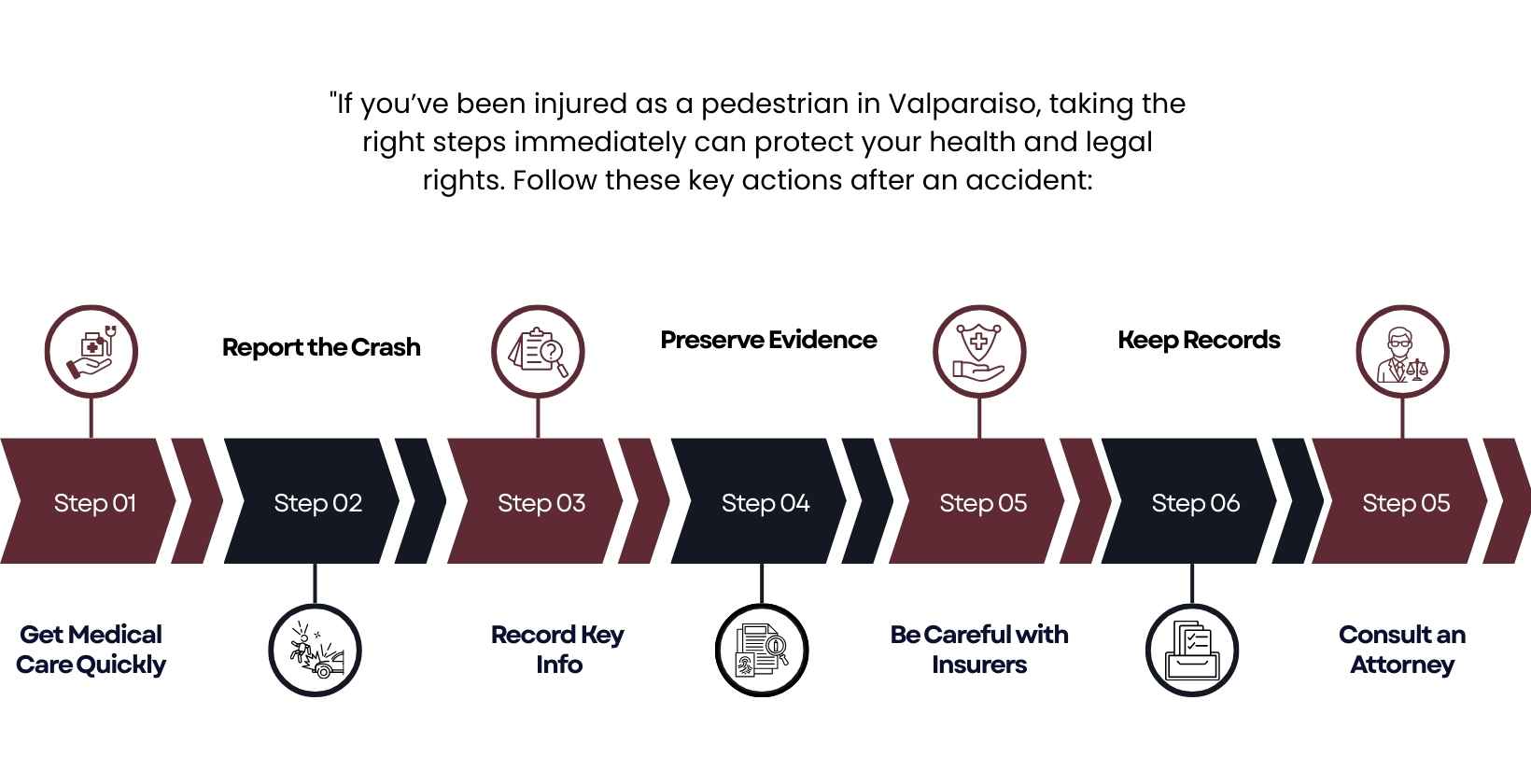
If you are able, consider the following actions:
After a pedestrian crash, many people are not just looking for legal representation. They want clear guidance, steady communication, and a legal team that understands how pedestrian injury claims are handled locally. At Langer & Langer, our lawyers bring more than 100 years of combined legal experience to helping injured pedestrians navigate the claims process with care, attention to detail, and practical legal support.
What sets our Valparaiso pedestrian accident law firm apart includes:
24/7 availability, so clients can reach our team when questions or concerns arise
Clear and consistent communication, so clients understand what is happening with their case and what to expect next
A measured, professional approach to claim handling, including investigation, documentation, and insurer negotiations
Local knowledge of Valparaiso and Porter County, including how pedestrian accident claims are typically evaluated and litigated.
Client-focused support during a difficult time, with an emphasis on clarity, responsiveness, and respect
Our firm has represented pedestrians in cases involving serious injuries, including a $250,000 recovery in a pedestrian accident. Past results depend on the specific facts of each case and do not guarantee similar outcomes.

Ready to discuss your pedestrian injury claim with a Valparaiso attorney? Contact Langer & Langer today for a free, confidential consultation. Our team is available to listen, answer your questions, and explain your legal options. There’s no fee unless we win your case.
Many injured pedestrians are unsure what to expect after reaching out to a personal injury law firm. While every case is different, most pedestrian collision claims follow a similar process once contact is made.
Langer & Langer represents pedestrian accident clients throughout Valparaiso and nearby communities across Porter County.
We proudly serve clients in:
Downtown Valparaiso
Westchester
Sunset Hills
Sunset Hills
Union Township
Chesterton
Yes. You can still have a claim even if you were not in a crosswalk. Indiana law requires drivers to exercise reasonable care to avoid hitting pedestrians, and fault may still rest with the driver depending on speed, attention, and roadway conditions.
You have two years to file a pedestrian accident claim in Indiana. If a city vehicle, school bus, road contractor, or other public entity is involved, special notice deadlines, sometimes as short as 180 days, may apply.
Yes. A pedestrian wrongful death claim in Indiana may be filed by a surviving spouse, children, or, in some cases, parents. These family members may seek damages for funeral expenses, medical bills, and loss of companionship under Indiana law.
A police report is not final. If the police report is wrong or incomplete, a pedestrian accident claim can still proceed using witness statements, video footage, medical records, and an independent investigation to correct or supplement the report.
Yes. A delay in medical treatment can hurt a pedestrian injury claim. Insurance companies often argue that delayed care means the injuries were minor or unrelated, which can affect how the claim is evaluated.
After a pedestrian accident, having clear information can make the next steps feel more manageable. A free consultation with an experienced pedestrian accident lawyer can help you understand where you stand and what options may be available under Indiana law.
Langer & Langer represents injured pedestrians on a contingency fee basis, so there are no legal fees unless compensation is recovered.
Complete our secure contact form to reach our Valparaiso office.
Our team will review your information and follow up to discuss next steps.



© 2025 Langer & Langer • All Rights Reserved
Disclaimer | Site Map | Privacy Policy | Payment | Business Development Solutions by Blue Summit SEO.
Copyright © 1980-2026 All Rights Reserved.
Past results do not guarantee any future outcome, and every case is different.
We improve our products and advertising by using Microsoft Clarity to see how you use our website. By using our site, you agree that we and Microsoft can collect and use this data.
Have legal questions or need expert advice? Our experienced team is here to help.
Langer & Langer
Accessibility Statement
Compliance status
We firmly believe that the internet should be available and accessible to anyone, and are committed to providing a website that is accessible to the widest possible audience, regardless of circumstance and ability.
To fulfill this, we aim to adhere as strictly as possible to the World Wide Web Consortium’s (W3C) Web Content Accessibility Guidelines 2.1 (WCAG 2.1) at the AA level. These guidelines explain how to make web content accessible to people with a wide array of disabilities. Complying with those guidelines helps us ensure that the website is accessible to all people: blind people, people with motor impairments, visual impairment, cognitive disabilities, and more.
This website utilizes various technologies that are meant to make it as accessible as possible at all times. We utilize an accessibility interface that allows persons with specific disabilities to adjust the website’s UI (user interface) and design it to their personal needs.
Additionally, the website utilizes an AI-based application that runs in the background and optimizes its accessibility level constantly. This application remediates the website’s HTML, adapts Its functionality and behavior for screen-readers used by the blind users, and for keyboard functions used by individuals with motor impairments.
If you’ve found a malfunction or have ideas for improvement, we’ll be happy to hear from you. You can reach out to the website’s operators by using the following email
Screen-reader and keyboard navigation
Our website implements the ARIA attributes (Accessible Rich Internet Applications) technique, alongside various different behavioral changes, to ensure blind users visiting with screen-readers are able to read, comprehend, and enjoy the website’s functions. As soon as a user with a screen-reader enters your site, they immediately receive a prompt to enter the Screen-Reader Profile so they can browse and operate your site effectively. Here’s how our website covers some of the most important screen-reader requirements, alongside console screenshots of code examples:
Screen-reader optimization: we run a background process that learns the website’s components from top to bottom, to ensure ongoing compliance even when updating the website. In this process, we provide screen-readers with meaningful data using the ARIA set of attributes. For example, we provide accurate form labels; descriptions for actionable icons (social media icons, search icons, cart icons, etc.); validation guidance for form inputs; element roles such as buttons, menus, modal dialogues (popups), and others. Additionally, the background process scans all the website’s images and provides an accurate and meaningful image-object-recognition-based description as an ALT (alternate text) tag for images that are not described. It will also extract texts that are embedded within the image, using an OCR (optical character recognition) technology. To turn on screen-reader adjustments at any time, users need only to press the Alt+1 keyboard combination. Screen-reader users also get automatic announcements to turn the Screen-reader mode on as soon as they enter the website.
These adjustments are compatible with all popular screen readers, including JAWS and NVDA.
Keyboard navigation optimization: The background process also adjusts the website’s HTML, and adds various behaviors using JavaScript code to make the website operable by the keyboard. This includes the ability to navigate the website using the Tab and Shift+Tab keys, operate dropdowns with the arrow keys, close them with Esc, trigger buttons and links using the Enter key, navigate between radio and checkbox elements using the arrow keys, and fill them in with the Spacebar or Enter key.Additionally, keyboard users will find quick-navigation and content-skip menus, available at any time by clicking Alt+1, or as the first elements of the site while navigating with the keyboard. The background process also handles triggered popups by moving the keyboard focus towards them as soon as they appear, and not allow the focus drift outside it.
Users can also use shortcuts such as “M” (menus), “H” (headings), “F” (forms), “B” (buttons), and “G” (graphics) to jump to specific elements.
Disability profiles supported in our website
Additional UI, design, and readability adjustments
Browser and assistive technology compatibility
We aim to support the widest array of browsers and assistive technologies as possible, so our users can choose the best fitting tools for them, with as few limitations as possible. Therefore, we have worked very hard to be able to support all major systems that comprise over 95% of the user market share including Google Chrome, Mozilla Firefox, Apple Safari, Opera and Microsoft Edge, JAWS and NVDA (screen readers).
Notes, comments, and feedback
Despite our very best efforts to allow anybody to adjust the website to their needs. There may still be pages or sections that are not fully accessible, are in the process of becoming accessible, or are lacking an adequate technological solution to make them accessible. Still, we are continually improving our accessibility, adding, updating and improving its options and features, and developing and adopting new technologies. All this is meant to reach the optimal level of accessibility, following technological advancements. For any assistance, please reach out to