
At Langer and Langer, our Valparaiso slip and fall lawyers understand that even a minor fall can have serious consequences. Whether it’s wet floors, uneven sidewalks, or unsafe property conditions, we fight to ensure injury victims receive the compensation they deserve. Our experienced team handles personal injury claims, premises liability disputes, medical expense and wage loss recovery, and assists with evidence collection and documentation to build a strong case.
4 Indiana Ave Valparaiso, IN 46383
in**@*******aw.com

If you slipped on a wet floor without a warning sign or tripped over a hazard that should have been fixed, the property owner may be responsible, and you may have a slip-and-fall claim. In Valparaiso, owners and businesses must keep premises safe. When hazards are ignored, repairs are delayed, or warnings are missing, that can be negligence.
Evidence can disappear quickly. Spills get cleaned, ice melts, mats get moved, and stairs get repaired. An insurance adjuster may call and look for ways to shift blame, including comparative fault arguments.
At Langer & Langer, our Valparaiso slip-and-fall lawyers have represented injured victims in Porter County and Northwest Indiana since 1980. We build premises liability claims with photos, surveillance video, incident reports, inspection and maintenance records, witness details, and medical documentation, and pursue compensation for medical bills, lost income, and pain and suffering.
Call 219-533-2744 for a free consultation, or visit our office at 4 Indiana Ave, Valparaiso, IN 46383.
“Free consultations. No fees unless we win—protecting you from injury across Valparaiso and Porter County.”
Proving negligence is the foundation of every successful premises liability claim. Liability depends on demonstrating that a property owner failed to maintain reasonably safe conditions, leading directly to your injury.
To establish liability under Indiana law, four specific elements must be proven:
Constructive notice is a key element we use to prove negligence. It means a property owner can be held liable if a hazard existed long enough that they should have discovered and fixed it through reasonable care.
Furthermore, Indiana’s comparative fault system ensures that partial blame does not automatically ruin your case. Liability is balanced between parties, and as long as you are found to be less than 51% responsible for the accident, you can still pursue the compensation you deserve.
After a slip and fall in Valparaiso, the property insurer often focuses on one question: can they blame the fall on you or call the hazard “not their fault”. We move quickly to preserve video, reports, and maintenance records, then tie the hazard to your injuries with clear medical documentation.
Here is how our premises liability attorney protects your rights:
Investigation and Evidence Preservation
We identify who controlled the area and act fast to secure surveillance footage, incident reports, inspection logs, and maintenance records before they disappear.
Medical Documentation and Damages Calculation
We use medical records and diagnoses to document the harm, then calculate medical bills, lost wages, and future limitations when the injury affects your work or daily life.
Demand Letter and Claim Presentation
We package the evidence and damages into a clear demand that explains the hazard, notice, and how the fall changed your life.
Negotiation With the Insurance Company
We manage adjuster calls, recorded statement requests, and settlement talks so you are not pressured into mistakes or a rushed payout.
Lawsuit and Discovery When Needed
If the insurer refuses to be reasonable, we can file suit and use discovery, including depositions and subpoenas when necessary, to obtain key evidence.
Mediation or Trial Preparation When Required
Many claims settle, but we prepare every case to stand up at mediation or trial if that becomes necessary.
In Valparaiso, liability depends on who controlled the area where you fell, such as a store, landlord, or property manager. Slip and fall claims start with a simple question: was the hazard fixed or clearly warned about when it should have been?
Common hazards that frequently lead to premises liability claims include:
1. Wet or Slippery Floors:
Spills, leaking coolers, or freshly mopped areas lacking “Wet Floor” signs (grocery store slip and fall).
2. Ice and Snow Accumulation:
Failure to clear walkways during winter creating dangerous icy sidewalk conditions.
3. Uneven or Damaged Flooring:
Cracked pavement, torn carpet, or raised thresholds that cause trip and fall accidents.
4. Broken or Unsafe Stairways:
Loose handrails, rotting steps, or code violations in stairwell construction.
5. Poor Lighting:
Inadequate illumination in parking lots or hallways that hides obstacles from view.
6. Cluttered walkways:
Merchandise displays, cords, boxes, or debris left in walking paths.
Want to know if you have a claim? Get a free case review.
Insurers sometimes minimize falls as “minor,” but a hard surface can cause serious trauma, especially when the head, spine, or hip takes the impact.
Common categories of injury include:
Your claim should reflect your real life, not an adjuster’s “typical” fall. That means documenting treatment needs, time missed from work, and how the injury affects day-to-day activities.
We document your losses in a way that is clear, complete, and backed by records, so the insurance company cannot downplay what the fall has cost you.
We pursue:
See what your claim should account for, now and later.
Public property claims and private property claims do not follow the same rules. If a city, county, or state agency controlled the area where you fell, the Indiana Tort Claims Act may require a formal Notice of Tort Claim before you can sue.
Key Differences:
| Feature | Private Property Claims | Public Property Claims (Government) |
|---|---|---|
| Examples | Retail stores, apartments, restaurants. | City sidewalks, post offices, schools. |
| Primary Defendant | Business owner or landlord. | City of Valparaiso or State of Indiana. |
| Key Requirement | Prove an unsafe condition and notice. | File a Notice of Tort Claim before suing. |
| Time Limit to Notify | Generally, 2 years (Statute of Limitations). | Deadline varies by entity (often 180 days for local government claims). |
| Common Defense | We didn’t know about the hazard. | Immunity defenses or “notice was not filed correctly/on time.” |
If your fall involved public property, getting legal guidance early can help you avoid missing a strict notice deadline.
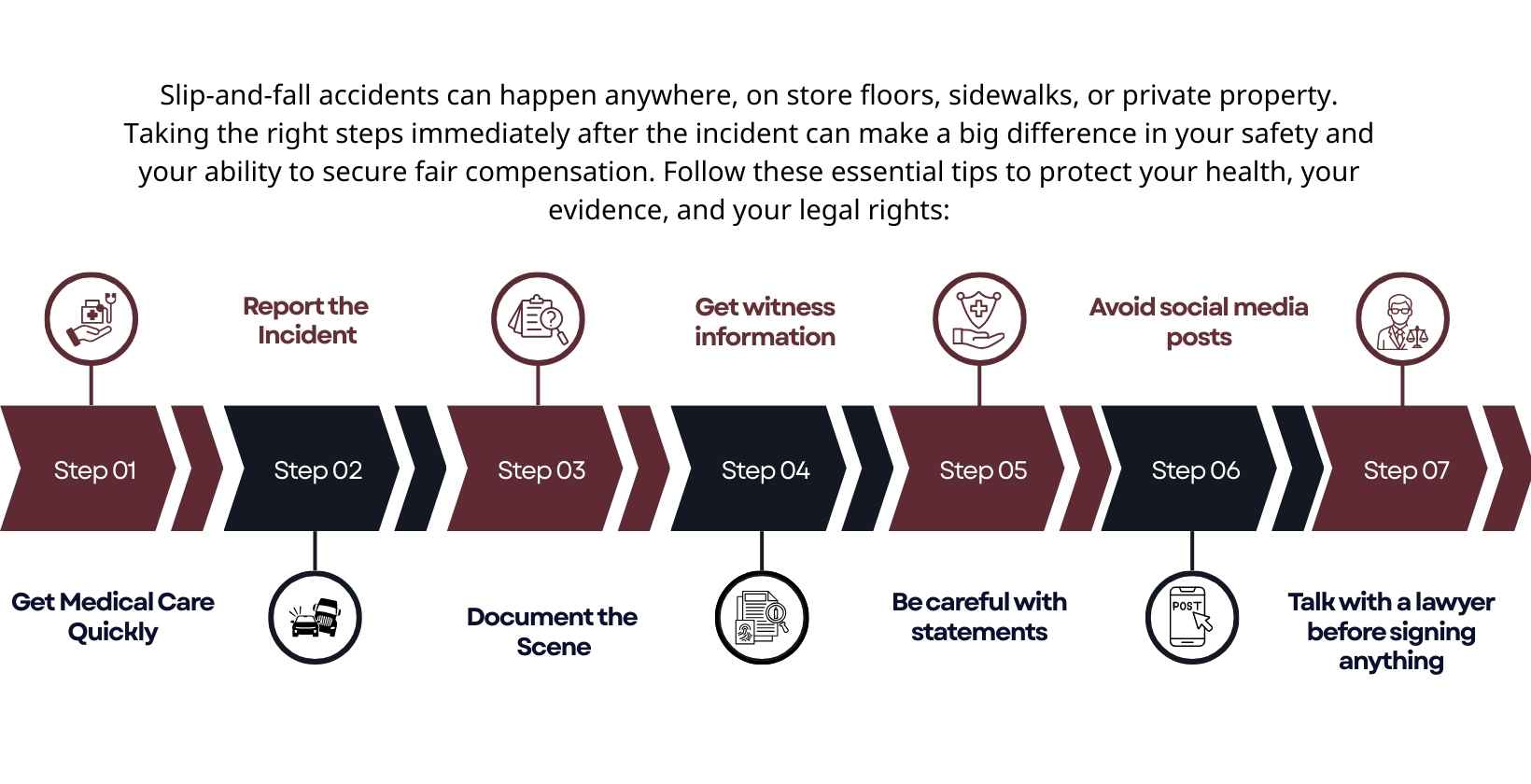
The minutes after a fall are stressful. These steps can protect both your health and your ability to pursue a claim.
Why Injured Clients in Valparaiso Choose Langer & Langer
Choosing the right fall injury attorney affects both your recovery and your case outcome. Clients across Porter County turn to us for protection against aggressive insurance companies.
Here is why clients trust us with premises liability claims:
Start with a case evaluation today.
What Our Clients Say About Working With Langer & Langer
Clients often mention clear communication, timely updates, and steady guidance through the claims process. Testimonials reflect individual experiences and do not guarantee results.
Robert was extremely helpful and informative and made room to meet with me even though his schedual was tight! Even though he wasn't able to help me moving forward he gave me the advice and confidence I needed to move forward on my own! I highly recommend him.
Robert representative after a bad car accident for myself and my family. He was everything that we had hoped for in an attorney to deal with this challenging situation. I highly recommend Langer and Langer especially Robert for any personal injury needs.
I highly recommend Steve Langer & his attorneys for medical malpractice representation. From the beginning I have always felt that they listened intently with care & compassion. There were always available to answer any of my questions and concerns. I can’t thank Steve Langer enough for getting justice for my Mom.
Our personal injury law firm is based in Valparaiso, but we represent clients across Porter, Lake, and LaPorte Counties. As trusted Indiana injury lawyers, we possess deep experience in local courts throughout the region.
We represent clients in:
Downtown Valparaiso
Westchester
Sunset Hills
Central Valparaiso
Downtown Valparaiso
N Campbell Street
If a fall accident limits your mobility, we offer home, virtual, and phone consultations.


Yes, you need a premises liability lawyer even if the insurance company contacted you. Adjusters often aim to minimize payouts, so having an experienced lawyer protect you from misstatements and undervaluation.
You may still have a claim. Repairs after an incident are not always usable as direct proof of negligence, but other evidence can show the hazard existed and that the owner had notice before the fall.
Yes, you can still file a claim if there were no warning signs posted. Under comparative fault laws, you may recover damages for a fall accident even if partially to blame, provided you are less than 51% responsible.
Witnesses help, but they are not required in every case. Photos, surveillance footage, incident reports, and medical documentation can still establish what happened.
You pay no upfront fees to hire our Valparaiso slip and fall attorneys. We work on a contingency fee basis, so our fee is paid only from a recovery. If there is no recovery, you owe no attorney's fee.
It depends on the complexity of the dispute. How long a settlement usually takes varies, but the average case duration for a contested premises liability claim can range from a few months to over a year.
There is no standard payout for a slip and fall case. Settlement value usually depends on how clearly the evidence proves the hazard and notice, and how well your medical records document the injuries and losses caused by the fall.
If you are still getting treatment, missing work, or being pushed to “just give a statement,” you are at the point where small choices can change the outcome. A quick review can tell you whether this looks like a valid premises liability claim and what proof matters most based on where the fall happened.
If you have them, bring any photos, the incident report number, witness names, and your medical paperwork. We will handle the insurer communication from there.
Contact Langer & Langer:

© 1980-2026 Langer & Langer • All Rights Reserved
Copyright © 1980-2026 All Rights Reserved.
Past results do not guarantee any future outcome, and every case is different.
We improve our products and advertising by using Microsoft Clarity to see how you use our website. By using our site, you agree that we and Microsoft can collect and use this data.
Have legal questions or need expert advice? Our experienced team is here to help.
Langer & Langer
Accessibility Statement
Compliance status
We firmly believe that the internet should be available and accessible to anyone, and are committed to providing a website that is accessible to the widest possible audience, regardless of circumstance and ability.
To fulfill this, we aim to adhere as strictly as possible to the World Wide Web Consortium’s (W3C) Web Content Accessibility Guidelines 2.1 (WCAG 2.1) at the AA level. These guidelines explain how to make web content accessible to people with a wide array of disabilities. Complying with those guidelines helps us ensure that the website is accessible to all people: blind people, people with motor impairments, visual impairment, cognitive disabilities, and more.
This website utilizes various technologies that are meant to make it as accessible as possible at all times. We utilize an accessibility interface that allows persons with specific disabilities to adjust the website’s UI (user interface) and design it to their personal needs.
Additionally, the website utilizes an AI-based application that runs in the background and optimizes its accessibility level constantly. This application remediates the website’s HTML, adapts Its functionality and behavior for screen-readers used by the blind users, and for keyboard functions used by individuals with motor impairments.
If you’ve found a malfunction or have ideas for improvement, we’ll be happy to hear from you. You can reach out to the website’s operators by using the following email
Screen-reader and keyboard navigation
Our website implements the ARIA attributes (Accessible Rich Internet Applications) technique, alongside various different behavioral changes, to ensure blind users visiting with screen-readers are able to read, comprehend, and enjoy the website’s functions. As soon as a user with a screen-reader enters your site, they immediately receive a prompt to enter the Screen-Reader Profile so they can browse and operate your site effectively. Here’s how our website covers some of the most important screen-reader requirements, alongside console screenshots of code examples:
Screen-reader optimization: we run a background process that learns the website’s components from top to bottom, to ensure ongoing compliance even when updating the website. In this process, we provide screen-readers with meaningful data using the ARIA set of attributes. For example, we provide accurate form labels; descriptions for actionable icons (social media icons, search icons, cart icons, etc.); validation guidance for form inputs; element roles such as buttons, menus, modal dialogues (popups), and others. Additionally, the background process scans all the website’s images and provides an accurate and meaningful image-object-recognition-based description as an ALT (alternate text) tag for images that are not described. It will also extract texts that are embedded within the image, using an OCR (optical character recognition) technology. To turn on screen-reader adjustments at any time, users need only to press the Alt+1 keyboard combination. Screen-reader users also get automatic announcements to turn the Screen-reader mode on as soon as they enter the website.
These adjustments are compatible with all popular screen readers, including JAWS and NVDA.
Keyboard navigation optimization: The background process also adjusts the website’s HTML, and adds various behaviors using JavaScript code to make the website operable by the keyboard. This includes the ability to navigate the website using the Tab and Shift+Tab keys, operate dropdowns with the arrow keys, close them with Esc, trigger buttons and links using the Enter key, navigate between radio and checkbox elements using the arrow keys, and fill them in with the Spacebar or Enter key.Additionally, keyboard users will find quick-navigation and content-skip menus, available at any time by clicking Alt+1, or as the first elements of the site while navigating with the keyboard. The background process also handles triggered popups by moving the keyboard focus towards them as soon as they appear, and not allow the focus drift outside it.
Users can also use shortcuts such as “M” (menus), “H” (headings), “F” (forms), “B” (buttons), and “G” (graphics) to jump to specific elements.
Disability profiles supported in our website
Additional UI, design, and readability adjustments
Browser and assistive technology compatibility
We aim to support the widest array of browsers and assistive technologies as possible, so our users can choose the best fitting tools for them, with as few limitations as possible. Therefore, we have worked very hard to be able to support all major systems that comprise over 95% of the user market share including Google Chrome, Mozilla Firefox, Apple Safari, Opera and Microsoft Edge, JAWS and NVDA (screen readers).
Notes, comments, and feedback
Despite our very best efforts to allow anybody to adjust the website to their needs. There may still be pages or sections that are not fully accessible, are in the process of becoming accessible, or are lacking an adequate technological solution to make them accessible. Still, we are continually improving our accessibility, adding, updating and improving its options and features, and developing and adopting new technologies. All this is meant to reach the optimal level of accessibility, following technological advancements. For any assistance, please reach out to