
Indiana’s legal alcohol limit for driving is 0.08% blood alcohol concentration (BAC) for drivers age 21 and older. Indiana uses lower BAC limits for drivers under 21 and for drivers operating commercial motor vehicles, and police can still make an OWI (Operating While Intoxicated) arrest below 0.08% if they believe alcohol affected your ability to drive safely. In many Indiana OWI cases, a BAC of 0.08% to less than 0.15% is charged as a Class C misdemeanor.
If you were stopped or arrested, the process can feel confusing fast. A lot of drivers do not realize how quickly BAC issues can turn into license problems and criminal charges.
OWI cases can move quickly in Indiana, and license consequences may begin before your criminal case is resolved. Knowing what to expect early can help you make better decisions about your rights and your next steps.
Key Takeaways About Indiana’s Legal Alcohol Limit
- For most drivers age 21 and older, Indiana’s legal alcohol limit is 0.08% BAC.
- Drivers under 21 are subject to a lower limit of 0.02% BAC.
- Drivers operating a commercial motor vehicle can face legal consequences at 0.04% alcohol concentration.
- You can still be arrested for OWI below the legal limit if an officer believes you are impaired.
- BAC can rise faster than many drivers expect, even with a small number of drinks.
- Refusing a chemical test can lead to separate legal and license consequences.
- License suspension can begin early in an OWI case, even before the criminal case is resolved.
What Does Indiana Law Say About Blood Alcohol Concentration (BAC)?
Blood alcohol concentration (BAC) is the term most drivers use, but Indiana law often uses the term alcohol concentration equivalent (ACE). In Indiana, ACE means the alcohol concentration in a person’s blood or breath based on a chemical test.
Indiana uses this measurement as a key legal standard in Operating While Intoxicated (OWI) cases. If a driver’s test result is at or above the legal limit, prosecutors can bring a per se OWI charge, which means the alcohol level itself may be enough to support the charge even without proof of unsafe driving behavior.
BAC or ACE is usually measured through chemical testing, including:
- Breath testing: Common after a traffic stop or arrest.
- Blood testing: Often used after crashes or in hospital settings.
- Urine testing: May be used in some cases, including suspected drug impairment cases.
Indiana’s implied consent rules also matter here. If an officer has probable cause, the officer can offer one or more chemical tests, and a driver may be required to submit to those tests under Indiana law.
What Are Indiana’s Legal BAC Limits for Adult, Underage, and Commercial Drivers?
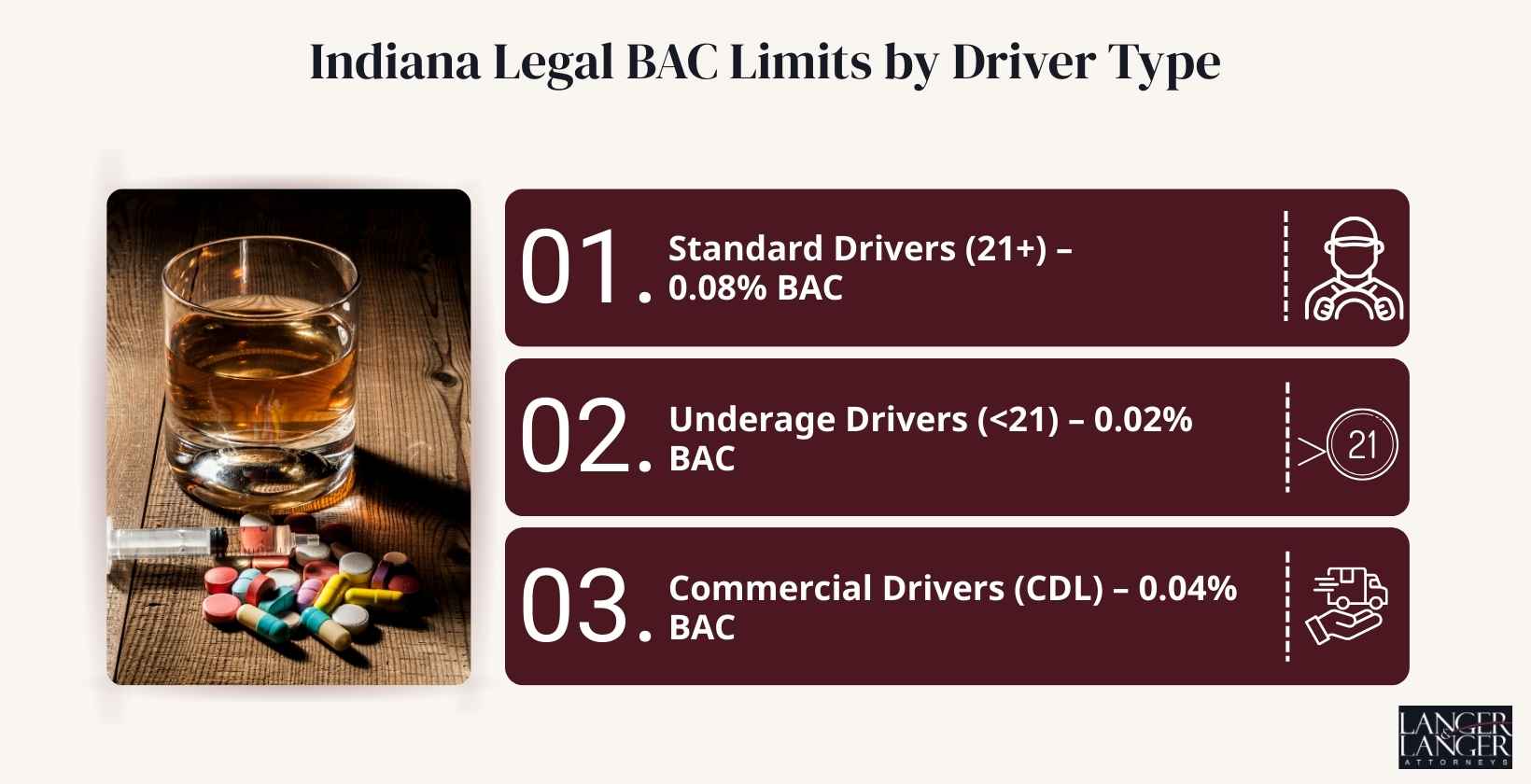
Indiana sets different blood alcohol concentration (BAC) limits depending on the type of driver. Standard drivers, underage drivers, and commercial drivers are each subject to unique thresholds. These limits apply even if the driver does not feel impaired or show no signs of intoxication. Legal consequences increase based on both the driver category and the measured BAC level.
Standard Drivers (21+): 0.08% BAC Limit
Drivers age 21 and older are legally intoxicated in Indiana at a BAC of 0.08% or higher. This is a per se limit, meaning no further evidence of impairment is required for OWI charges.
Underage Drivers (Zero Tolerance): 0.02% BAC Limit
Drivers under age 21 are subject to a 0.02% BAC limit under Indiana’s zero-tolerance law. OWI enforcement can occur even without obvious signs of intoxication. Consequences often focus on license suspension and long-term impacts on the driver’s record.
Commercial Drivers (CDL): 0.04% BAC Limit
Indiana applies a lower alcohol limit to people operating a commercial motor vehicle. A driver can violate Indiana law by operating a commercial motor vehicle with an alcohol concentration equivalent of 0.04% or more (and less than 0.08%), which can also create CDL-related consequences.
Can You Be Arrested Even If You’re Under the Legal Limit?
Yes. You can be arrested for OWI in Indiana even if your BAC is below 0.08%. Indiana law allows officers to file charges based on observable signs of impairment.
Common signs of impairment include:
- Swerving: Drifting between lanes or failing to stay centered.
- Delayed reactions: Slow responses to traffic signals or sudden changes.
- Slurred speech: Difficulty speaking clearly or forming sentences.
- Failed field sobriety tests: Trouble with balance, coordination, or following instructions.
Is the Legal Limit Only About Alcohol?
No. Indiana’s OWI laws are not limited to alcohol. Indiana law defines intoxicated broadly and includes alcohol, controlled substances, other drugs, and combinations of substances when they impair a person’s ability to think clearly or control their actions while driving.
In alcohol cases, BAC or ACE test results often drive the charge. In drug-related cases, the legal analysis can be different. Some cases are based on observable impairment, while others may involve allegations about certain controlled substances found in a chemical test.
How Many Drinks Equal the Legal Limit in Indiana?
There is no exact number of drinks that ensures a driver will stay under Indiana’s legal limit. Blood alcohol concentration (BAC) can vary from person to person, so drink-count estimates are not reliable.
Factors that can raise or lower your BAC include:
- Body weight and composition: A smaller or leaner person may reach a higher BAC than a heavier person after drinking the same amount of alcohol.
- Sex and body chemistry: Women often reach a higher BAC than men after the same amount of alcohol because of differences in body water and alcohol processing.
- Age: Age can affect how quickly the body processes alcohol.
- Rate of consumption: Drinking quickly can raise your BAC faster, while spacing drinks out gives your body more time to process alcohol.
- Food intake and medications: Eating can slow alcohol absorption, and some medications can increase alcohol’s effects.
- Time since your first drink: BAC can keep rising even after you stop drinking.
Example: Two adults may each have two drinks in one hour. One could measure 0.04% BAC, while the other could reach or exceed 0.08%, depending on these factors.
Because BAC varies so much, the safest choice is not to rely on drink counts when deciding whether to drive.
What Are the Legal Consequences for Driving Over the Limit?
Driving over the legal alcohol limit in Indiana can lead to both criminal charges and license-related consequences. The outcome depends on several factors, including the driver’s BAC level, any previous OWI history, and whether additional circumstances, such as having a passenger under 18, are involved.
Standard OWI Charges in Indiana
When a driver is found operating a vehicle over the legal limit, Indiana law treats the offense as a criminal charge. Under Indiana law, operating a vehicle with an alcohol concentration equivalent of 0.08% to less than 0.15% is generally charged as a Class C misdemeanor.
Consequences may include:
- Fines: Monetary penalties imposed by the court.
- Jail exposure: Time in jail, depending on case circumstances.
- License suspension: Temporary loss of driving privileges.
- Court-ordered conditions: Requirements such as alcohol education, treatment programs, or probation.
When a Driver’s BAC Is 0.15 or Higher
A BAC of 0.15% or more makes an Indiana OWI case more serious. Indiana law treats an alcohol concentration equivalent of 0.15% or higher as a Class A misdemeanor, which increases the legal exposure compared with lower-level OWI charges. A higher BAC can also lead to stricter penalties and closer review of the case.
When a Minor Passenger Is in the Vehicle
Driving over the legal limit with a passenger under the age of 18 increases the severity of the charge. Even for first-time offenders, this factor can elevate the case beyond a standard OWI and lead to a more serious classification under Indiana law, increasing long-term legal exposure.
What Happens If You Refuse a Chemical Test in Indiana?
Indiana follows an implied consent law. That means a person who operates a vehicle in Indiana is treated as having agreed to chemical testing under certain circumstances. If an officer has probable cause, the officer can offer a chemical test and may offer more than one test.
Refusing a requested chemical test can trigger serious license consequences, even before the criminal case is resolved. Indiana’s traffic safety guidance also warns that refusing a certified breath test can lead to an automatic license suspension, and a test result of 0.08% or more can trigger an early license suspension as well.
What Happens If You Refuse a Chemical Test in Indiana?
Indiana follows an implied consent law. That means a person who operates a vehicle in Indiana is treated as having agreed to chemical testing under certain circumstances. If an officer has probable cause, the officer can offer a chemical test and may offer more than one test.
Refusing a requested chemical test can trigger serious license consequences, even before the criminal case is resolved. Indiana’s traffic safety guidance also warns that refusing a certified breath test can lead to an automatic license suspension, and a test result of 0.08% or more can trigger an early license suspension as well.
Can You Get Specialized Driving Privileges After an OWI in Indiana?
Yes. Indiana law allows some drivers to request Specialized Driving Privileges (SDPs) after a license suspension related to an OWI. These privileges let a person drive for specific, court-approved purposes while the full suspension remains in effect.
Drivers with SDPs may be allowed to drive for:
- Employment: Traveling to and from work or job-related duties.
- Education: Attending school or vocational training programs.
- Medical care: Going to doctor appointments or receiving treatment.
- Family obligations: Handling essential family or child care needs.
What Should You Do If You’re Charged With OWI in Indiana?
Being charged with OWI can feel overwhelming, especially in the first few days. The steps you take early can affect your license, your court case, and what defenses may be available later.
Key steps to take after an OWI charge:
- Read your paperwork right away: Check the charging documents, court date, and any notice about your license or driving privileges.
- Be careful what you say: Do not give detailed statements about the stop or the incident without legal advice.
- Write down what happened: Record the time of the stop, what the officer said, what tests were requested, and anything you remember while it is still fresh.
- Save all records: Keep copies of citations, bond paperwork, test results, tow documents, and any BMV or court notices.
- Talk to an OWI attorney early: An attorney can review the stop, chemical testing, and deadlines before avoidable mistakes happen.
- Follow all court and license requirements: Attend hearings, follow bond conditions, and do not drive if your license is suspended.
How Does Langer & Langer Help Clients Facing DUI Charges?
At Langer & Langer, we represent people charged with OWI and DUI offenses in Indiana. We review the facts, explain the law, and handle the court process from start to finish.
Here’s how an Indiana DUI attorney at our firm can help:
- Review the stop and arrest: We examine the traffic stop, officer reports, and field sobriety testing.
- Analyze chemical test evidence: We look at breath, blood, or urine test results and how the testing was handled.
- Explain your options: We explain the charges, possible penalties, and what steps may help your case.
- Handle court proceedings: We manage filings, hearings, and case strategy.
- Protect your rights: We help you avoid mistakes that can affect your license or defense.
If you’re facing DUI charges in Indianapolis, contact our attorneys to schedule a confidential consultation.
FAQs About Indiana DUI Laws and Alcohol Limits
Does Drinking Coffee or Water Lower Your BAC?
No. Drinking coffee or water does not lower your BAC. BAC only decreases as your body naturally processes alcohol over time. Stimulants or hydration do not speed up alcohol elimination.
Can Prescription Medications Affect a DUI Charge in Indiana?
Yes. Prescription medications can lead to a DUI charge in Indiana. If the medication impairs your ability to drive safely, you can be charged even if the drug was legally prescribed.
Will You Automatically Lose Your License for Failing a BAC Test?
Yes. A failed chemical test can trigger license suspension early in an Indiana OWI case, even before the criminal case is finished. Indiana traffic safety guidance states that a certified breath test showing 0.08% or more can lead to a license suspension of at least 30 days.
Will a DUI Conviction Stay on Your Record Forever?
It depends. A DUI or OWI conviction does not go away automatically and can stay on your record for a long time. Some cases may qualify for expungement, but eligibility depends on the charge, the outcome, and your record.
What Rights Do You Have After an OWI Arrest?
After an OWI arrest in Indiana, you have the right to remain silent, the right to legal counsel, and the right to a hearing to contest license suspension. These rights protect your legal position.
Can a DUI Charge Be Dismissed or Reduced in Indiana?
It depends. A DUI charge can sometimes be dismissed or reduced in Indiana based on the facts of the case, legal errors, or evidentiary issues. Each case must be evaluated based on its specific facts.
Are DUI Checkpoints Legal in Indiana?
Yes. Sobriety checkpoints are used in Indiana, but officers still have to follow constitutional rules and proper procedures. If you were arrested after a checkpoint stop, our DUI defense lawyer can review how the checkpoint was conducted and whether the stop was lawful.
What Is the Difference Between OWI, DUI, and DWI?
In Indiana, OWI (Operating While Intoxicated) is the official legal term used in the statutes and most court proceedings. DUI and DWI are common terms people use to describe drunk or impaired driving, but Indiana law generally uses OWI (sometimes written as OVWI, or Operating a Vehicle While Intoxicated).
Final Thoughts: Protect Your License, Record, and Future
An OWI charge in Indiana can affect your license, criminal record, and daily life sooner than many people expect. The outcome often depends on the facts of the stop, the chemical test evidence, and the steps you take early in the case.
If you have been charged, Langer & Langer can review your case and explain your options.
Contact our criminal defense lawyers in Indiana to discuss what happened and what to do next.