

You should consider hiring a personal injury lawyer in Indiana when your injuries are serious, fault is disputed, the insurance company is pressuring you, or an important deadline may affect your rights. If any part of your claim feels complicated, getting legal advice early can help you avoid mistakes and make the process easier to manage.
Understanding when to hire a personal injury lawyer also helps protect critical evidence like photos, witness statements, surveillance footage, and official reports. An experienced personal injury lawyer can handle communication with the insurance company, keep track of deadlines, and help you avoid saying yes to a recorded statement or quick settlement before you understand the full extent of your injuries.
Key Takeaways
- Hire a personal injury lawyer in Indiana when your injuries are serious, treatment is ongoing, or you cannot work normally.
- Get legal advice if fault is disputed or the insurance company blames you.
- Be cautious if the insurer wants a recorded statement, broad medical release, or quick settlement before your treatment is clear.
- Consider a lawyer when the evidence is thin or could disappear, such as surveillance video or witness information.
- A denied claim, low offer, or causation dispute usually means you will need stronger proof and careful deadline tracking.
How Soon After an Accident Should You Hire a Personal Injury Attorney?
In many cases, you should talk to a personal injury attorney as soon as it becomes clear that your injuries may be more than minor, fault may be disputed, or the insurance company is already trying to control the conversation. You do not need to wait until your treatment ends to get legal advice. Early guidance can help you protect evidence, avoid mistakes, and make better decisions while your claim is still developing.
Signs You Need a Personal Injury Lawyer in Indiana
The need for a lawyer usually becomes clear when your case stops being simple. These signs can show that your claim involves more risk, more work, or more at stake than most people should handle alone.
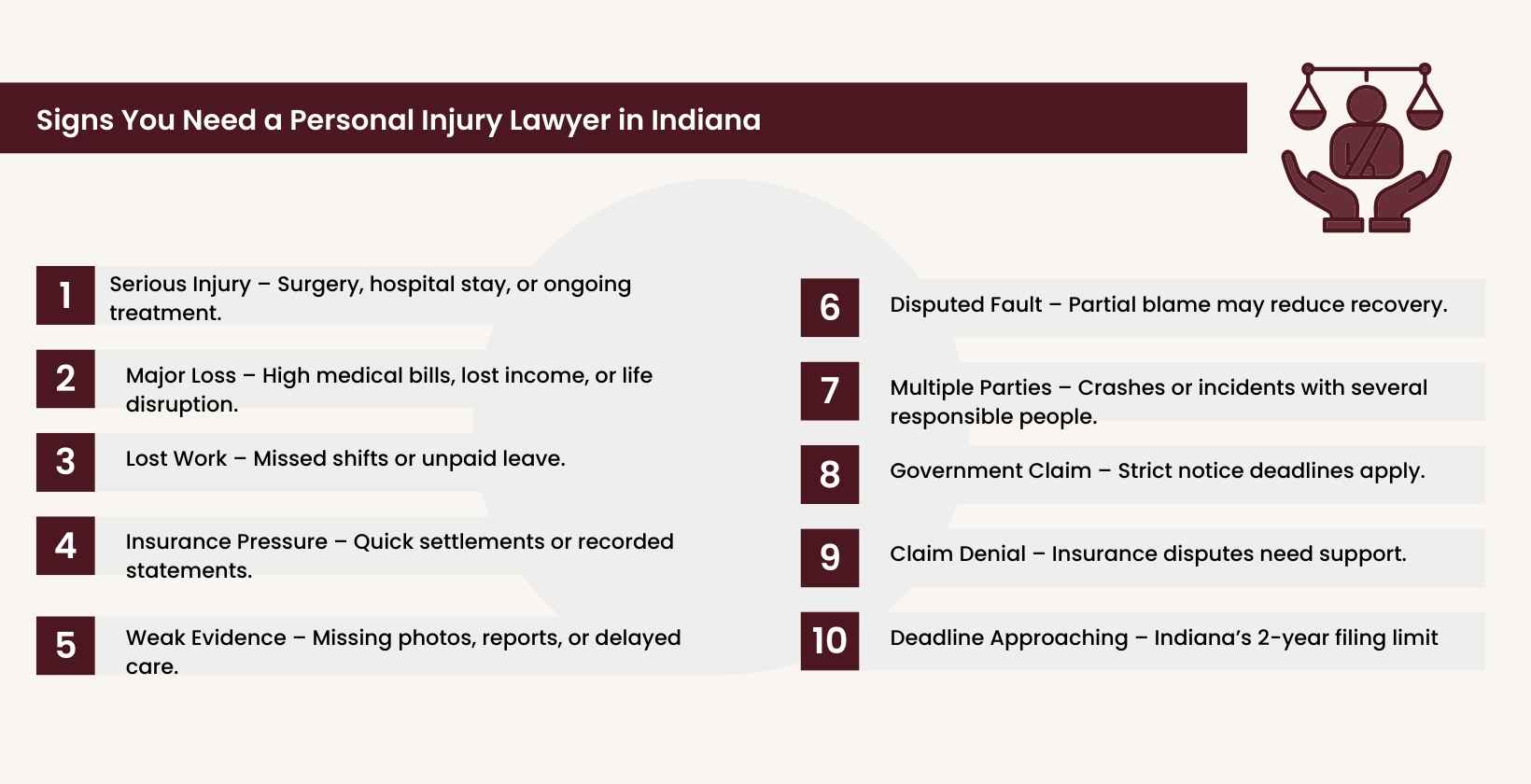
Serious Injury or Ongoing Medical Treatment
If your injury required emergency care, imaging, surgery, a hospital stay, or weeks of physical therapy, the claim is rarely “simple.” More serious injuries often come with future treatment needs, time away from work, and lasting limitations that are easy for an insurance company to downplay if the paperwork is incomplete.
Ongoing treatment also makes timing and documentation more important. Your medical records, follow-up visits, work restrictions, and the timeline of your symptoms all help show what the accident caused and what it will cost you going forward.
Significant Financial Losses or Major Disruption to Your Life
You should consider hiring a personal injury lawyer when the injury causes more than temporary inconvenience. If you are dealing with rising medical bills, missed work, reduced earning ability, ongoing pain, or lasting limits on your daily life, the claim may involve more than an insurance company is willing to value fairly on its own.
The more an injury affects your health, finances, and ability to function normally, the more important it becomes to document the full impact of the harm. That is often the point where legal help becomes worth serious consideration.
Lost Wages or Time Off Work
If the injury keeps you from working, even for a short period, it can quickly change what is at stake in your claim. Missed shifts, reduced hours, light-duty restrictions, unpaid leave, and lost self-employment income are all losses that often require more support than a few pay stubs.
The longer you are out, the easier it is for an insurance company to question why you missed work or argue that some of the lost income was not caused by the injury. Getting clear work notes from your doctor and keeping basic records early can prevent those disputes from growing, especially if your time off goes beyond a few days.
Insurance Pressure, Recorded Statements, or Quick Settlement Offers
If an insurance adjuster is calling repeatedly, asking for a recorded statement, or pushing a quick settlement early, it is usually a sign to slow down and get advice. Recorded statements can be taken out of context later and compared against your medical records to argue that your symptoms started later, are less serious than you claim, or were caused by something else.
Be careful with broad medical authorizations, too. Some releases give the insurer access to years of unrelated records, which can distract from what happened in this accident. And when a settlement offer shows up before your treatment is clear, accepting it can lock you into a number before you know what you will actually need for recovery.
Weak Evidence, Missing Records, or Delayed Reporting
If key details were not documented early, your claim may be harder to prove. Missing photos, unclear incident reports, no witness contact information, or a delay in getting medical care can give the insurance company room to argue that the injury was not caused by the accident or that it started later for another reason.
Evidence also tends to disappear quickly. Video can be erased or overwritten, businesses may not keep footage for long, and witnesses can become difficult to find. When documentation is thin, getting help sooner can make a real difference in preserving proof and building a clear timeline.
Disputed Fault or Comparative Fault Risk
If the insurance company says you caused the accident or shares blame, your claim can change quickly. Indiana uses a modified comparative fault rule. Your compensation is reduced by your percentage of fault, and you are barred from recovering anything if your fault is greater than the combined fault of everyone else involved. This is often described as a “51% bar in many cases.”
Example: If your total damages are $100,000 and you are found 20% at fault, your recovery is reduced to $80,000. If you are found 51% at fault, you cannot recover damages under Indiana law.
Multiple Parties or Commercial Vehicle Liability
business may be responsible. This can happen in many situations: a crash involving multiple drivers, an injury on commercial property, a job-related injury caused by a third party, or a case involving a company vehicle or employee on the clock.
When there are multiple parties, there are often multiple insurance policies, and each side may try to shift blame to someone else. Important evidence may also be held by a business, employer, or contractor, such as incident reports, schedules, training records, maintenance logs, or internal safety policies. In these cases, early legal help can make it easier to identify who is responsible and preserve the information needed to prove your claim.
Government Claims and Tort Notice Deadlines
If your injury involves a city, county, school district, or state agency, the timeline can move much faster than a typical personal injury case. Under the Indiana Tort Claims Act, you often must give written notice before you can sue. For many claims against local government entities, notice is due within 180 days of the loss. For claims against the State of Indiana, notice is due within 270 days.
Because a missed or late notice can bar the claim, government involvement is a strong reason to get legal guidance early, even if you think you have plenty of time under the usual two-year deadline.
Insurance Claim Denial
If the insurance company denies your claim, it usually means they are disputing something important: who was at fault, whether the accident caused your injuries, or whether the policy provides coverage. A denial does not always mean you are out of options, but it is a clear sign the insurer is not going to pay without stronger support for the facts and the medical connection.
Once a claim is denied, deadlines and documentation matter even more. The longer you wait, the easier it can be for the insurer to argue that evidence is missing, symptoms changed, or the injury came from another cause.
Approaching the Statute of Limitations
In Indiana, most personal injury lawsuits must be filed within two years of the date the claim accrues. Missing that deadline can end the case, even if liability is clear and your injuries are well documented.
If you are close to the deadline, it is a strong reason to speak with a lawyer right away, because filing and evidence steps take time. Also, if a government entity may be involved, the timeline can be much shorter due to the required notice under the Indiana Tort Claims Act, so it is safer to review timing early rather than assume you have two years.
Do You Need a Lawyer for a Minor Injury Claim in Indiana?
No. You do not need a lawyer for every minor injury claim in Indiana. Many small claims can be handled on your own when your symptoms are minor, you do not miss work, and the insurance company accepts responsibility and pays reasonable medical bills without delay.
That said, a case that starts out “minor” can change quickly if pain worsens, treatment expands, or the insurer begins disputing what happened. When that happens, handling the claim on your own gets harder, and the cost of a mistake goes up.
When You May Be Able to Handle the Claim Yourself
You may be able to handle the claim yourself when the facts and the damages stay simple:
- No meaningful injury: You feel better quickly, and you do not need ongoing care.
- No lost income: You do not miss work or need restrictions that affect pay.
- Clear responsibility: The other side accepts fault, and there is no serious dispute about what happened.
- Straightforward payment: Medical bills are paid reasonably, and you are not being pushed to settle before you feel stable.
Use caution before signing paperwork. A release can end the claim for good, even if symptoms return or worsen.
When a Minor Injury Claim Becomes Legally Complex
A claim that looked minor can become more complicated when the situation changes:
- Delayed symptoms: Neck, back, or joint pain shows up days later.
- Treatment grows: A simple visit turns into imaging, specialist care, injections, or weeks of physical therapy.
- Disputed fault: The insurer says you share blame or questions the accident details.
- Causation pushback: The insurer suggests your symptoms are from a prior issue or another event.
- Coverage problems: The at-fault party has limited insurance, no insurance, or there are multiple policies involved.
When any of these happen, the risk is not just undervaluation. It is also losing control of the record that the insurer will later use to evaluate the claim.
What Can Go Wrong If You Handle a Serious Claim Alone
If the claim is not truly minor, handling it alone can create common problems:
- Low settlement: You accept a number before the long-term impact is clear.
- Missed deadlines: Filing deadlines or early notice rules apply, and you do not catch them in time.
- Blame shifting: The insurer increases your share of fault, which can reduce or block recovery.
- Finality: Once you sign a release, the claim usually cannot be reopened, even if the injury gets worse.
What a Personal Injury Lawyer Does for Your Claim
At Langer & Langer, we move quickly to preserve proof that can be lost: requesting surveillance footage before it is overwritten, collecting witness information, and gathering the early records that often shape the claim (EMS notes, ER records, imaging reports, and incident reports). We then build a clear timeline linking the accident to your symptoms, treatment plan, work restrictions, and missed income.
- Identify all responsible parties and the insurance coverage that may apply.
- Document damages beyond the first bills, including future care, lost earning ability, and day-to-day impact.
- Track deadlines and required notices, including the Indiana Tort Claims Act notice when a government entity may be involved.
- Handle settlement negotiations and review releases before you sign.
- File in court and litigate when needed to pursue fair compensation.
How Much Does It Cost to Hire a Personal Injury Attorney in Indiana?
Many Indiana personal injury attorneys charge a contingency fee, which means the attorney is paid from the recovery rather than upfront. If there is no recovery, you typically do not owe attorney fees.
Attorney fees are separate from case costs. Case costs are the out-of-pocket expenses needed to pursue the claim, such as filing fees, medical record charges, expert fees, and deposition transcripts. Fee agreements should explain: the percentage charged, which costs may be deducted, and whether costs come out before or after attorney fees, because that affects what you receive.
How to Choose the Right Personal Injury Lawyer in Indiana
The right lawyer should have the experience and resources to handle your type of case, communicate clearly, and be prepared to take the matter to court if the insurance company is not reasonable.
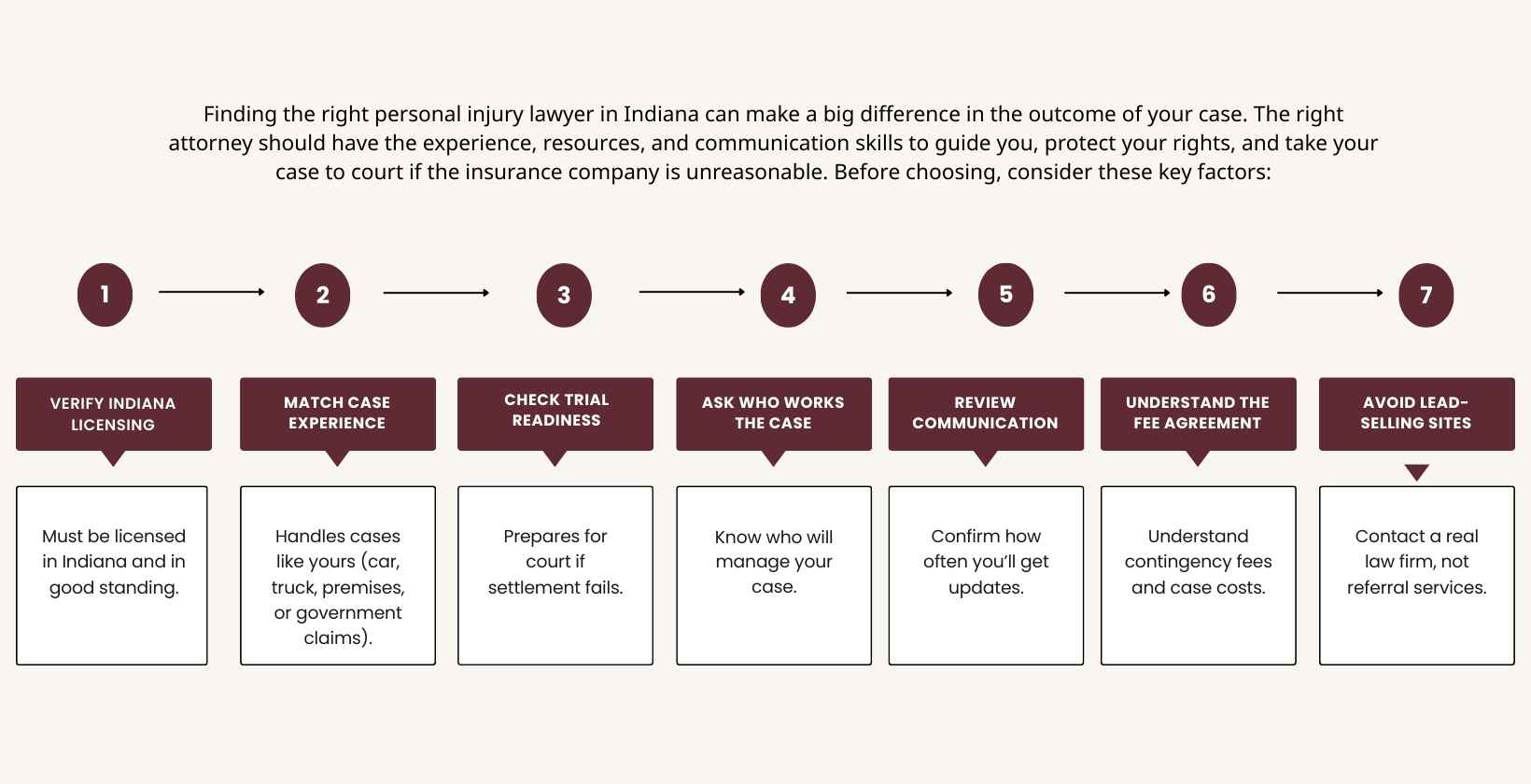
- Verify Indiana licensing: Confirm the lawyer is licensed in Indiana and in good standing.
- Match case experience: Ask whether they handle cases like yours (car crash, truck crash, premises injury, government claim).
- Check trial readiness: Confirm they prepare cases for trial when settlement talks fail.
- Ask who works the case: Learn whether your case stays with the lawyer or is handled mostly by staff.
- Review communication: Ask how often you will get updates and who you contact with questions.
- Understand the fee agreement: Read how the contingency fee and case costs are handled before you sign.
- Avoid lead-selling sites: Prefer contact with a law firm over lead-generation referral pages that sell your information.
Talk With an Indiana Personal Injury Attorney About Your Case
The right time to speak with a lawyer often comes down to what is at stake: the seriousness of your injury, whether fault is disputed, whether the insurance company is pushing back, and whether a deadline could affect your rights. Legal advice can also help when a claim is denied or the insurer disputes what caused your injuries.
Contact Langer & Langer to discuss your situation in a confidential consultation and get clear next-step guidance based on your facts, without promises or guarantees.