
A rideshare accident can turn your world upside down. At Langer & Langer, we represent passengers and drivers injured in Uber or Lyft crashes caused by negligence. Our Valparaiso rideshare accident lawyers protect your rights, pursue compensation, and guide you through every step of the recovery process.
4 Indiana Ave Valparaiso, IN 46383
in**@*******aw.com

Langer & Langer represents passengers, drivers, and pedestrians injured in accidents involving Transportation Network Companies (TNCs) like Uber and Lyft. Located at 4 Indiana Ave, Valparaiso, IN 46383, our firm serves clients throughout Valparaiso and Porter County.
Rideshare cases are different from standard car accidents because a driver’s app status can determine which insurance policy applies, and key evidence often exists in digital trip records. If someone else’s carelessness caused your injuries, we can review the facts, explain whether you may have a claim, and walk you through the next steps.
Our Valparaiso rideshare accident lawyers help you address the “independent contractor” defense, preserve digital evidence before it is lost, and pursue compensation available under Indiana law.
If you are unsure whether you have a valid claim, we can review the crash details and explain your legal options. Request a free case review.
“Free consultations. No fees unless we win—protecting you from injury across Valparaiso and Porter County.”
Determining liability in a rideshare crash is significantly more complex than a standard car accident. Because Uber and Lyft classify their drivers as independent contractors rather than employees, they often attempt to avoid vicarious liability for their drivers’ negligence.
In many rideshare cases, more than one party may share fault. Passengers injured in Uber or Lyft accidents are rarely assigned fault for the crash. In these situations, liability and available insurance coverage typically depend on the driver’s app status and the actions of other involved parties.
Parties Who May Be Liable Include:
The Rideshare Driver
If they were speeding, distracted by the app, or violating traffic laws.
The TNC (Uber/Lyft)
If they failed to properly screen a driver with a dangerous history, or if the app encouraged unsafe driving behaviors.
Third-Party Drivers
If another motorist on U.S. 30 (Lincolnway) or State Road 49 caused the collision.
Government Entities
If poor road maintenance or defective traffic signals in Porter County contributed to the crash.
Under Indiana’s comparative fault laws (Indiana Code § 34-51-2-6), you can recover damages only if your own fault does not exceed 50 %; if you are 51 % or more at fault, you are barred from recovery.
Rideshare accidents can happen in many different ways, depending on traffic conditions, driver behavior, and whether a ride is actively in progress at the time of the crash. We routinely handle claims arising from the following types of Uber and Lyft accidents across Indiana:
Rear‑end collisions
Passengers are often injured when a stopped or slowing rideshare vehicle is hit from behind.
Side‑impact (T‑bone) crashes
Common at intersections, injuring rideshare passengers and occupants of other vehicles.
Head‑on collisions
Pose serious risks to rideshare occupants and oncoming motorists.
Intersection accidents
Result from failure to yield or misjudging turns during active rides.
Lane‑change and sideswipe accidents
Occur during merges or abrupt lane shifts, affecting vehicles and cyclists.
Pedestrian or cyclist strikes
Happen during pickups, drop‑offs, or sudden turns.
Multi‑vehicle crashes
Chain‑reaction collisions with multiple vehicles complicate liability and insurance issues.
Rideshare accident claims often involve app-based evidence, multiple insurance policies, and specific defenses raised by rideshare companies. Our experienced Valparaiso rideshare injury attorney helps address these issues early and manage the claim through each stage.

If you have screenshots, a trip receipt, or a claim denial letter, bring them to a free case review.
Uber and Lyft crashes in Valparaiso often occur during active rides, pickups, or drop-offs, where driver attention, traffic conditions, and local road familiarity play a role.
Common causes of rideshare accidents include:
Injuries often seen in rideshare accidents include:
In a rideshare accident claim, injured parties may seek recovery for both economic and non-economic damages. The amount depends on factors such as injury severity, treatment duration, fault allocation, and the long-term effect on daily life.
Economic damages may include:
Non-Economic Damages May Include:
Insurance coverage after an Uber or Lyft accident depends on the driver’s status within the app at the exact moment the crash occurred. Different insurance policies apply depending on whether the driver was offline, waiting for a ride request, en route to pick up a passenger, or actively transporting a rider. Because rideshare claims often involve multiple insurers, identifying the correct app status is essential to understanding which policy may apply.
Uber and Lyft use a tiered insurance system that changes based on the driver’s activity within the app at the time of the collision.
| Driver App Status | Insurance Provider | Applicable Policy Limits |
|---|---|---|
| App off | Driver’s personal auto insurance | Based on individual policy limits |
| App on, no ride accepted | Uber/Lyft contingent liability | In many states, contingent liability coverage may apply (Limits vary by state, insurer, and policy terms.) |
| En route to pick up a passenger on board | Uber / Lyft commercial insurance | Commercial liability coverage may apply (Higher limits may apply during an accepted ride or trip; exact limits depend on the policy and jurisdiction) |
Coverage terms vary by insurer and policy. Trip records and app activity data often determine which coverage period applies.
When a third-party driver causes the collision, that driver’s insurance is usually responsible for covering damages. Rideshare insurance may still become relevant in certain situations, such as when a passenger is injured or when coverage disputes arise, but fault and insurance priority depend on the specific facts of the accident.
Medical expenses are often paid initially through health insurance or Medical Payments (MedPay) coverage while liability is being investigated. Once fault and coverage are determined, the responsible insurance carrier may reimburse eligible medical costs as part of the claim resolution.
When a passenger is injured during an active Uber or Lyft ride, and the at-fault driver lacks insurance or carries insufficient coverage, uninsured or underinsured motorist (UM/UIM) coverage under the rideshare company’s commercial policy may apply. This coverage can help address injury-related losses when the responsible driver cannot fully compensate the claim.
To protect your right to compensation, you must gather evidence immediately. The unique digital nature of these rides requires specific actions.
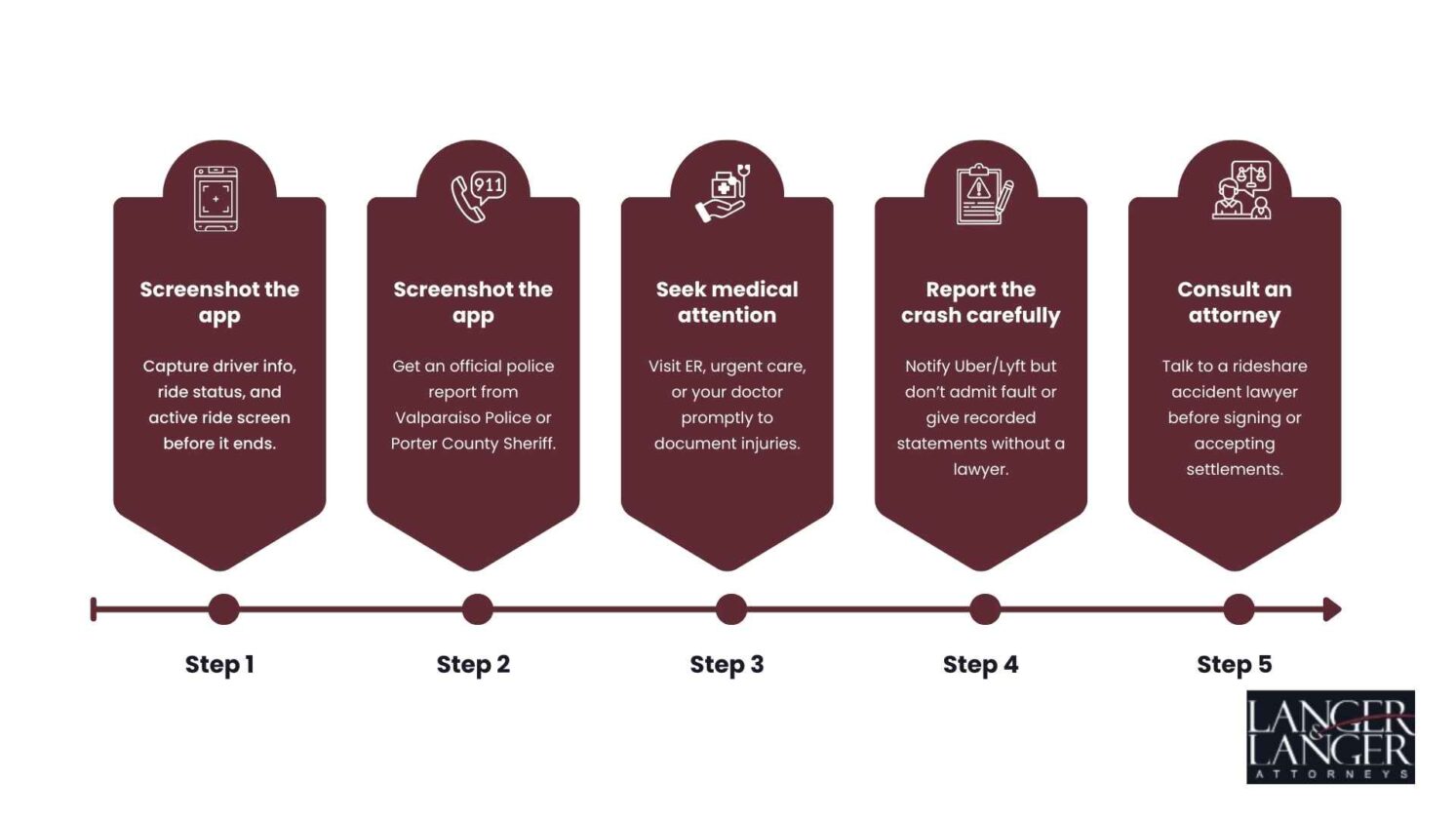
If you already reported the crash in the app, we can explain what to document next and what to avoid in adjuster calls.
A claim denial does not automatically end a rideshare accident case. A denial means the insurer is disputing coverage, fault, or the scope of damages, and the decision should be reviewed carefully.
Common reasons for denial include:
After a denial, practical next steps often include:
After reviewing a denial, an attorney can assess the insurer’s stated reasons, request additional records such as app data or internal reports, and determine whether further steps, including an appeal or litigation, may be appropriate based on the facts.
In most personal injury cases, including Uber and Lyft crashes, you generally have 2 years from the date of the accident to file a lawsuit under Indiana Code § 34‑11‑2‑4. Exceptions include:
If you miss the statute of limitations, you may lose the right to pursue compensation.
Local knowledge can matter when evaluating how and why a rideshare crash occurred. Traffic patterns, road design, and seasonal conditions in Valparaiso often play a role in where Uber and Lyft accidents happen.
If your crash happened in one of these areas, our auto accident lawyers can review the scene factors that often show up in Porter County reports.
Langer & Langer represents individuals injured in Uber and Lyft accidents throughout Valparaiso and Porter County. Our work focuses on how rideshare claims are evaluated, how insurance coverage applies, and how cases proceed through local courts.
More than 100 years of combined experience representing injury victims across Indiana.
Regular involvement with Porter County courts, filing procedures, and local insurance practices.
Experience handling app-based insurance coverage and layered policy structures used in rideshare cases.
Regular experience reviewing policies issued by insurers commonly involved in Uber and Lyft claims, including surplus line carriers.
Contingency fee representation, with attorney’s fees paid only if compensation is recovered, as described in the fee agreement.
We represent clients throughout Valparaiso, Porter County, and surrounding communities in Northwest Indiana, including:
Downtown Valparaiso
Westchester
Sunset Hills
Central Valparaiso
Downtown Valparaiso
N Campbell Street
Our familiarity with local roads, traffic patterns, and court procedures helps us evaluate rideshare accident claims with appropriate regional context.


Rideshare accident cases can take several months to more than a year, depending on factors such as injury severity, treatment duration, insurer response time, and whether liability is disputed. Claims involving multiple parties or complex insurance issues often take longer to resolve.
Indiana law generally applies to accidents that occur in Valparaiso, even if you live elsewhere. You may file a claim locally while coordinating with your home-state insurer for medical coverage or vehicle damage, depending on your policy.
Yes. Rideshare accident claims often involve multiple insurers, including the rideshare driver’s policy, a third-party driver’s insurer, and Uber or Lyft’s coverage. Determining which policies apply depends on fault and the driver’s app status at the time of the crash.
In most cases, filing a rideshare accident claim does not affect your own auto insurance unless your policy is used to pay certain costs, such as Medical Payments or uninsured motorist coverage. Many claims are resolved through the at-fault driver’s or rideshare company’s insurance.
In most cases, claims are brought against the driver and resolved through applicable insurance coverage. Direct claims against Uber or Lyft may be possible in limited situations, such as negligent hiring or app-related conduct, depending on the facts.
If your question is not listed, we can address it during a free case review.
If you were injured in an Uber or Lyft accident, speaking with a lawyer can help you understand how insurance coverage applies and what options may be available under Indiana law. At Langer & Langer, we review the details of rideshare accident claims and explain the next steps in a clear, straightforward way.
We offer virtual consultations for clients who cannot travel and handle rideshare injury cases on a contingency fee basis, meaning attorney’s fees are only paid if compensation is recovered, as described in the fee agreement.
To discuss your situation and ask questions about your claim:
Call: 219-356-2644
Contact Us Online: Use our secure contact form to schedule a review.

© 1980-2026 Langer & Langer • All Rights Reserved
Copyright © 1980-2026 All Rights Reserved.
Past results do not guarantee any future outcome, and every case is different.
We improve our products and advertising by using Microsoft Clarity to see how you use our website. By using our site, you agree that we and Microsoft can collect and use this data.
Have legal questions or need expert advice? Our experienced team is here to help.
Langer & Langer
Accessibility Statement
Compliance status
We firmly believe that the internet should be available and accessible to anyone, and are committed to providing a website that is accessible to the widest possible audience, regardless of circumstance and ability.
To fulfill this, we aim to adhere as strictly as possible to the World Wide Web Consortium’s (W3C) Web Content Accessibility Guidelines 2.1 (WCAG 2.1) at the AA level. These guidelines explain how to make web content accessible to people with a wide array of disabilities. Complying with those guidelines helps us ensure that the website is accessible to all people: blind people, people with motor impairments, visual impairment, cognitive disabilities, and more.
This website utilizes various technologies that are meant to make it as accessible as possible at all times. We utilize an accessibility interface that allows persons with specific disabilities to adjust the website’s UI (user interface) and design it to their personal needs.
Additionally, the website utilizes an AI-based application that runs in the background and optimizes its accessibility level constantly. This application remediates the website’s HTML, adapts Its functionality and behavior for screen-readers used by the blind users, and for keyboard functions used by individuals with motor impairments.
If you’ve found a malfunction or have ideas for improvement, we’ll be happy to hear from you. You can reach out to the website’s operators by using the following email
Screen-reader and keyboard navigation
Our website implements the ARIA attributes (Accessible Rich Internet Applications) technique, alongside various different behavioral changes, to ensure blind users visiting with screen-readers are able to read, comprehend, and enjoy the website’s functions. As soon as a user with a screen-reader enters your site, they immediately receive a prompt to enter the Screen-Reader Profile so they can browse and operate your site effectively. Here’s how our website covers some of the most important screen-reader requirements, alongside console screenshots of code examples:
Screen-reader optimization: we run a background process that learns the website’s components from top to bottom, to ensure ongoing compliance even when updating the website. In this process, we provide screen-readers with meaningful data using the ARIA set of attributes. For example, we provide accurate form labels; descriptions for actionable icons (social media icons, search icons, cart icons, etc.); validation guidance for form inputs; element roles such as buttons, menus, modal dialogues (popups), and others. Additionally, the background process scans all the website’s images and provides an accurate and meaningful image-object-recognition-based description as an ALT (alternate text) tag for images that are not described. It will also extract texts that are embedded within the image, using an OCR (optical character recognition) technology. To turn on screen-reader adjustments at any time, users need only to press the Alt+1 keyboard combination. Screen-reader users also get automatic announcements to turn the Screen-reader mode on as soon as they enter the website.
These adjustments are compatible with all popular screen readers, including JAWS and NVDA.
Keyboard navigation optimization: The background process also adjusts the website’s HTML, and adds various behaviors using JavaScript code to make the website operable by the keyboard. This includes the ability to navigate the website using the Tab and Shift+Tab keys, operate dropdowns with the arrow keys, close them with Esc, trigger buttons and links using the Enter key, navigate between radio and checkbox elements using the arrow keys, and fill them in with the Spacebar or Enter key.Additionally, keyboard users will find quick-navigation and content-skip menus, available at any time by clicking Alt+1, or as the first elements of the site while navigating with the keyboard. The background process also handles triggered popups by moving the keyboard focus towards them as soon as they appear, and not allow the focus drift outside it.
Users can also use shortcuts such as “M” (menus), “H” (headings), “F” (forms), “B” (buttons), and “G” (graphics) to jump to specific elements.
Disability profiles supported in our website
Additional UI, design, and readability adjustments
Browser and assistive technology compatibility
We aim to support the widest array of browsers and assistive technologies as possible, so our users can choose the best fitting tools for them, with as few limitations as possible. Therefore, we have worked very hard to be able to support all major systems that comprise over 95% of the user market share including Google Chrome, Mozilla Firefox, Apple Safari, Opera and Microsoft Edge, JAWS and NVDA (screen readers).
Notes, comments, and feedback
Despite our very best efforts to allow anybody to adjust the website to their needs. There may still be pages or sections that are not fully accessible, are in the process of becoming accessible, or are lacking an adequate technological solution to make them accessible. Still, we are continually improving our accessibility, adding, updating and improving its options and features, and developing and adopting new technologies. All this is meant to reach the optimal level of accessibility, following technological advancements. For any assistance, please reach out to